Key Quotes
"Maybe there is a beast... maybe it's only us."
Speaker: Simon (Chapter 5 — Beast from Water)
Simon says this during the assembly where the boys debate whether the beast is real. While the other boys argue about what form the beast takes — a snake, a sea creature, something that hunts at night — Simon cuts through to a possibility no one else can face. He's suggesting that the danger isn't out there in the jungle. It's inside the boys themselves. The assembly shouts him down almost immediately, and Simon, who struggles to articulate his thoughts under pressure, can't finish his idea. But his half-formed statement turns out to be the most important sentence in the novel.
Simon's suggestion functions as the novel's thesis statement, placed at almost exactly its midpoint. Golding gives the book's central truth to the character least equipped to communicate it — a boy who faints, who speaks haltingly, who lacks the social standing to command a room. This is deliberate irony: the wisdom the group most needs comes in the form they're least likely to accept. Simon is not making a philosophical argument here; he's groping toward something he senses intuitively, which is why his language is tentative ("maybe... maybe"). The repetition of "maybe" shows Simon trying to soften a claim he knows will be rejected. His insight is confirmed by the Lord of the Flies in Chapter 8 ("I'm part of you") and proven by his own murder in Chapter 9, when the boys become the very beast they fear.
"Kill the pig. Cut her throat. Spill her blood."
Speaker: Jack's hunters (Chapters 4, 7, 9 — recurring chant)
This chant starts as a hunting cry and ends as something far darker. The boys first use it in Chapter 4 after their first successful pig kill, repeating the words with the excitement of children who have accomplished something difficult. By Chapter 7, the chant accompanies a mock hunt where Robert — a boy, not a pig — plays the prey and is genuinely hurt. By Chapter 9, the same words fuel the frenzy in which the boys kill Simon. Three words that began as a description of hunting an animal become the soundtrack to murder.
The chant's evolution tracks the novel's central trajectory from play to ritual to violence. Golding understood something about rhythmic, communal language that anthropologists have long observed: chanting dissolves individual identity into group identity. Each time the boys repeat these words, they are less themselves and more a collective organism — a hunting pack that operates on instinct rather than thought. The pronoun shift is telling: "her throat" refers to a female pig, but the chant persists even when the target is human. The words have become detached from their literal meaning and function purely as a trigger for collective violence. This is Golding's study of how ritual language works: it doesn't describe an action; it creates the psychological conditions for that action. By the time the boys chant over Simon's body, the words have become an incantation, and the distinction between pig and person has ceased to matter.
"He began to dance and his laughter became a bloodthirsty snarling."
Speaker: Narrator, describing Jack (Chapter 4 — Painted Faces and Long Hair)
This sentence captures the moment Jack first paints his face with clay and charcoal and sees his reflection in a pool of water. The mask transforms him. What starts as laughter — a child's reaction to seeing himself look silly — shifts into something predatory within the same breath. Golding compresses an entire psychological transformation into a single sentence: the boy who laughed becomes the hunter who snarls, and the transition is seamless. The face paint doesn't change Jack. It reveals what was already there by removing the social self that kept it hidden.
This passage is Golding's most concise statement about the relationship between identity and civilization. The painted mask provides Jack with anonymity — not from others (they know who he is) but from himself. Behind the paint, he is "liberated from shame and self-consciousness," free from the internal monitoring that civilized life requires. Golding's word choices matter: "dance" connotes play and performance, "laughter" connotes joy, but "bloodthirsty snarling" belongs to an animal. By placing all three in the same sentence without transition, Golding argues that the distance between play and predation is shorter than we assume. The mask doesn't create a new personality; it removes the barriers that kept an existing one contained. This scene anticipates every subsequent act of violence in the novel — the pig hunts, the mock hunt, Simon's death — all of which involve the painted faces and the dissolution of individual moral restraint into collective frenzy.
"Ralph wept for the end of innocence, the darkness of man's heart, and the fall through the air of the true, wise friend called Piggy."
Speaker: Narrator, describing Ralph (Chapter 12 — Cry of the Hunters)
These are the novel's closing emotional lines. Ralph, collapsed on the beach with a naval officer standing over him, weeps — not from relief at being rescued, but from the weight of everything that happened. The sentence names three losses in ascending order of specificity: an abstract concept (innocence), a philosophical recognition (human darkness), and a particular person (Piggy). Ralph is mourning not just what the boys did on the island but what he now knows about human nature. He entered the island as a confident boy who assumed rescue was inevitable. He leaves it knowing that people are capable of things he never imagined, and that knowledge cannot be unlearned.
This passage operates as the novel's emotional and thematic summation. The three objects of Ralph's grief form a progression from the universal to the personal — from innocence as a concept, to the darkness of all human hearts, to the specific gravity of one friend's death. Golding reverses the expected order: a lesser writer would move from the personal to the abstract, building toward philosophical grandeur. Instead, Golding ends on Piggy — a name, a person, a body that fell. This grounds the novel's allegory in physical reality. Ralph isn't weeping for humanity in the abstract. He's weeping for a fat boy with asthma who was smarter than all of them and whom nobody protected. The phrase "the true, wise friend" is Ralph's belated acknowledgment of what Piggy was to him — an acknowledgment that comes too late to mean anything except as grief. Golding leaves the reader with no comfort: understanding arrives after the damage, and the naval officer's discomfort at Ralph's tears suggests that the adult world offers no framework for the knowledge Ralph has acquired.
"The world, that understandable and lawful world, was slipping away."
Speaker: Narrator, describing Ralph's thoughts (Chapter 5 — Beast from Water)
Ralph thinks this during the disastrous assembly where fear of the beast overwhelms any attempt at rational discussion. He can feel the group slipping beyond his control — not through any dramatic mutiny, but through the slow erosion of attention, discipline, and shared purpose. The sentence captures the horror of watching a system fail in real time while being unable to stop it. Ralph's world was "understandable and lawful" — it had rules, it made sense, adults enforced order. Now those guarantees are dissolving, and Ralph, at twelve years old, doesn't have the vocabulary or the power to hold them together.
Golding's phrasing here is precise in ways that reward close reading. The world is described as "understandable and lawful" — two adjectives that name different kinds of order. "Understandable" suggests that the world makes rational sense, that events have causes and consequences a person can follow. "Lawful" suggests that the world operates under rules that constrain behavior. Ralph is losing both simultaneously: the island's events are becoming incomprehensible to him (why won't anyone tend the fire? why does Jack defy him openly?) and the rules are ceasing to function. The verb "slipping" is also significant — not crashing, not breaking, but slipping. The loss of civilization, Golding argues, is not a dramatic rupture. It is a gradual loosening, felt in the hands before it's visible to the eyes. This sensation — the feeling that the ground is shifting beneath you while everyone else pretends it isn't — is one of the novel's most psychologically accurate observations.
"There was a space round Henry, perhaps six yards in diameter, into which he dare not throw."
Speaker: Narrator, describing Roger (Chapter 4 — Painted Faces and Long Hair)
Roger is throwing stones at a littlun named Henry on the beach, but he's aiming to miss. He throws close enough to frighten, but something stops him from actually hitting the boy. Golding names that something: the "taboo of the old life," the residual conditioning from a world of parents, schools, and police. Roger hasn't suddenly become kind. He's operating under muscle memory from a civilization that no longer exists on this island. The six-yard gap is the measured distance of that conditioning, and Golding presents it as a boundary that is already shrinking.
This is one of the most analyzed passages in the novel, and with good reason: it crystallizes Golding's argument about the nature of moral restraint. The invisible circle around Henry is not conscience, not empathy, not moral reasoning. It is conditioning — the behavioral residue of external authority. Roger refrains from hitting Henry because his body remembers punishment, not because his mind grasps that hurting Henry is wrong. Golding deliberately uses the word "dare" rather than "want" or "choose": Roger's restraint is about fear of consequences, not moral conviction. This distinction is the foundation for Roger's entire arc. When the consequences disappear — when there are no adults, no police, no punishment — the invisible circle vanishes too. By Chapter 11, Roger pushes a boulder onto Piggy "with a sense of delirious abandonment," and the six-yard taboo is revealed to have been the only thing between civilization and murder. Golding's bleakest suggestion is that for some people, perhaps many people, morality is compliance — nothing more.
"I'm part of you... I'm the reason why it's no go. Why things are what they are."
Speaker: The Lord of the Flies / the pig's head (Chapter 8 — Gift for the Darkness)
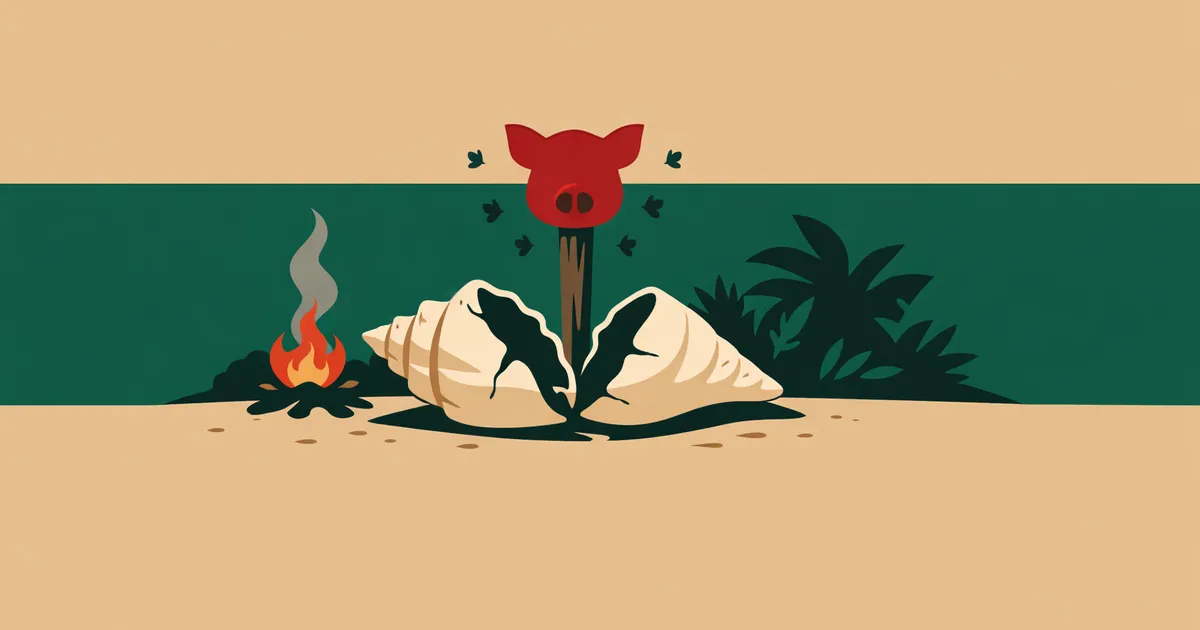
The severed pig's head, mounted on a stake and swarming with flies, speaks to Simon in a hallucination. Its voice is that of a "schoolmaster" — condescending, knowing, amused by the futility of Simon's goodness. The head tells Simon that the beast cannot be hunted or killed because it is not a separate creature. It is part of every boy on the island. "Things are what they are" because the capacity for evil is embedded in human nature, not imposed from outside. The message is that there is no escape from the beast, because you cannot run from yourself.
The Lord of the Flies scene is the novel's philosophical climax, and its power comes partly from its ambiguity. Simon is dehydrated, possibly in the grip of an epileptic episode, sitting alone in tropical heat before a rotting pig's head covered in flies. Everything the head "says" could be Simon's own subconscious, articulating what he has sensed since Chapter 5. Alternatively, Golding may be writing a genuine encounter with evil — Beelzebub, the Lord of the Flies, an ancient name for the devil. Both readings work simultaneously, and Golding seems uninterested in resolving the tension between them. What matters is the content of the message: evil is not external. It cannot be propitiated with offerings or destroyed by hunting parties. It is, as the head says, "close, close, close" — as close as the boys' own impulses, as close as the reader's own capacity for cruelty. The head's self-identification — "I'm part of you" — demolishes the novel's last refuge of innocence. If the beast is inside, then there are no good boys and bad boys. There are only boys, and what they choose to do with the darkness they carry.