Themes & Motifs
Civilization versus Savagery
The central tension of Lord of the Flies is not between good boys and bad boys but between two systems of social organization, each with its own logic. Ralph's beach camp represents democratic civilization: rules, assemblies, shared labor, the conch as a guarantor of equal voice. Jack's Castle Rock represents authoritarian tribalism: a chief who provides food and protection in exchange for obedience, punishment for dissent, and ritual as social glue. Golding's disturbing argument is that the second system wins not because it's imposed by force (though it is) but because it answers needs that the first system can't — the need for excitement, for belonging, for someone to make the fear go away.
The boys don't abandon civilization because they forget it. They abandon it because maintaining it requires sustained effort with no immediate reward, while savagery offers instant gratification. Keeping the signal fire burning is boring. Hunting is thrilling. Following rules requires self-discipline. Following a chief requires only submission. Golding watched this dynamic play out on a global scale during World War II, and the novel's island is his controlled experiment: what happens when you remove the external structures — laws, police, institutions, adults — that hold civilization in place?
Golding structures the novel so that civilization doesn't collapse in a single dramatic moment but erodes through a series of small surrenders. The assemblies grow shorter. The fire goes untended. Boys slip away from work to swim or hunt. Each individual defection seems minor, but their cumulative effect is catastrophic. This incremental structure is one of the novel's sharpest insights: civilizations rarely fall because someone attacks them head-on. They fall because people stop doing the tedious, unglamorous work of maintaining them.
The conch is the novel's primary symbol for civilized order, and Golding uses its fate to track the decline. In the early chapters, the conch commands genuine authority — whoever holds it speaks, and others listen. By Chapter 5, Jack can defy the conch openly and face no consequences. By Chapter 10, Jack's raiders ignore the conch entirely and steal the glasses instead. When Roger's boulder destroys the conch and kills Piggy simultaneously in Chapter 11, the symbol and the reality shatter together. Golding's point is precise: civilized order is not a permanent achievement. It is a collective agreement that exists only as long as enough people uphold it, and it can be unmade faster than it was made.
The novel also complicates any simple preference for civilization by showing that the boys' "civilized" society was itself built on hierarchy, exclusion, and quiet cruelty. Piggy is mocked and marginalized from the first chapter — not by Jack's savages but by Ralph's democrats. The littluns are largely ignored by both factions. Golding is not nostalgic for the civilization the boys lose; he's arguing that it contained the seeds of its own destruction. The savagery on the island is not an aberration from British schoolboy culture. It is an amplification of tendencies already present in it.
Loss of Innocence
The boys arrive on the island as children, and the novel tracks their transformation into something else — not adults, exactly, but people who have seen and done things that cannot be undone. The loss of innocence in Lord of the Flies is not a single event but a process, and Golding marks it with specific physical and psychological details. Jack's first inability to kill a piglet (Chapter 1) gives way to his painted, ceremonial butchery of a nursing sow (Chapter 8). Roger's carefully aimed misses (Chapter 4) become a killing blow (Chapter 11). Even Ralph, the novel's moral center, participates in the frenzy that kills Simon.
For a novel about children, Lord of the Flies offers almost no childhood after the first chapter. There are no games that stay games — the mock hunt turns violent, the chanting turns lethal. The littluns build sandcastles and older boys kick them down. The tropical island that should be a paradise becomes a slaughterhouse. Golding's version of lost innocence is not sentimental; he does not mourn a golden age of childhood purity. Instead, he suggests that innocence was always provisional — a function of protection and comfort, not an inherent state — and that it can be stripped away with terrifying speed.
Golding uses the figure of the littlun with the birthmark to establish the terms of innocence's destruction. This unnamed boy is the first to voice fear of the beast (Chapter 2) and the first to die — consumed by the fire the older boys set in their careless excitement. His disappearance is never formally acknowledged; the boys sense what happened but refuse to name it. This pattern — violence followed by denial — becomes the novel's signature emotional structure. After Simon's murder, Piggy insists "it was an accident" and Ralph can barely force himself to say "that was murder." The loss of innocence in the novel is not just the commission of violence but the psychological apparatus that develops to avoid confronting it.
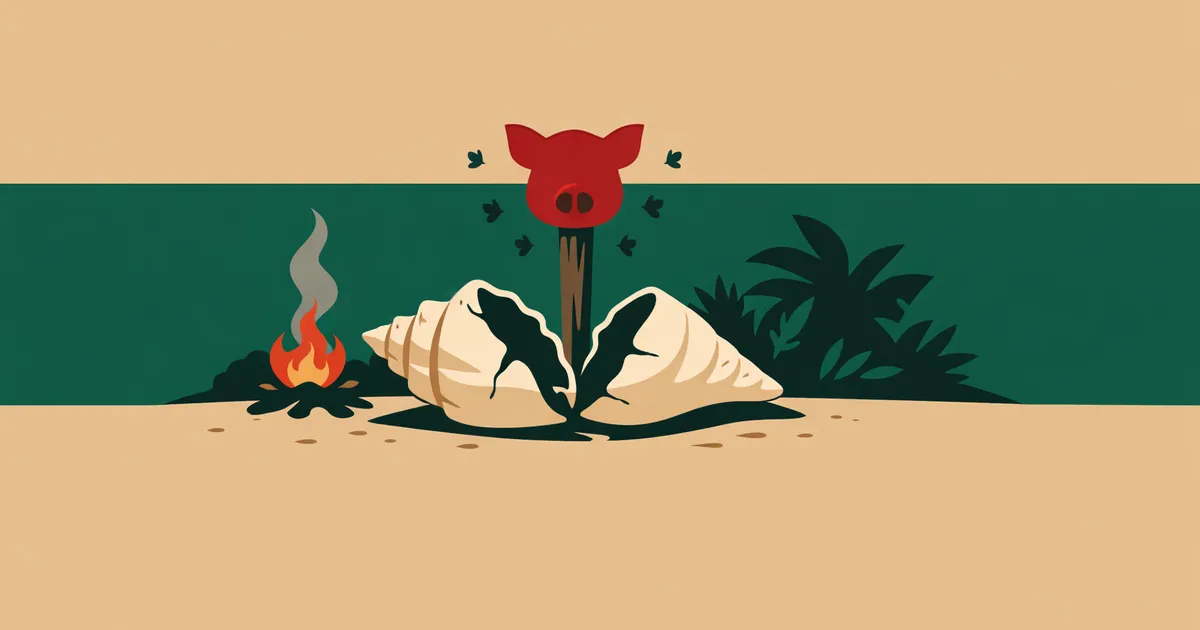
The "Lord of the Flies" itself — the pig's head on a stick — functions as the novel's emblem of corrupted innocence. It is a child's offering, conceived in a child's logic (appease the beast with a gift), executed with a brutality that belongs to no child's world. When the head "speaks" to Simon, it tells him the truth the other boys are too innocent to face and too corrupted to accept: "You knew, didn't you? I'm part of you?" The scene collapses the boundary between innocence and knowledge. Simon's understanding destroys him not because the truth is dangerous in the abstract but because the community cannot tolerate someone who names what they have become.
Ralph's weeping at the novel's end — "for the end of innocence, the darkness of man's heart" — is the only moment where a character fully comprehends what has been lost. But Golding frames this comprehension ironically. The naval officer who witnesses Ralph's grief is embarrassed by it, looking away at his warship. The adult world has its own mechanisms for not confronting the darkness — uniforms, ranks, national flags. Ralph has lost his innocence, but the officer never had the kind of innocence Ralph is mourning. He lost his long ago and replaced it with something functional and blind.
Power and Leadership
Lord of the Flies presents two models of leadership and watches one devour the other. Ralph leads through consensus: he proposes ideas, submits them to the group, and tries to persuade rather than command. Jack leads through provision and fear: he feeds the boys, protects them from the beast (which he needs to remain real in order to justify his authority), and punishes anyone who challenges him. The novel's political argument is that in the absence of institutional support — courts, constitutions, an educated citizenry — consensus-based leadership is structurally fragile, while authoritarian leadership is structurally resilient.
This doesn't mean Golding admires Jack's approach. The novel is clear-eyed about the cost of Jack's leadership: two boys dead, the island burned, and a community organized around terror rather than welfare. But Golding is equally clear-eyed about why Jack wins the immediate contest. Ralph offers rescue — a distant, abstract goal that requires patience and sustained effort. Jack offers meat, excitement, and the elimination of fear through ritual. In a group of frightened boys, the leader who addresses fear directly will always outperform the leader who asks them to ignore it.
The election in Chapter 1 is the novel's founding political event, and Golding loads it with significance. Ralph wins because he holds the conch (a symbol, not a qualification) and because "there was a stillness about Ralph as he sat that marked him out" — a physical charisma that has nothing to do with ideas or competence. Jack loses despite having actual organizational experience (he commands the choir). From the start, Golding establishes that democratic elections select for appearance and symbolism, not necessarily for ability. This is not a cynical observation so much as a realistic one, and it haunts the rest of the novel as Ralph repeatedly proves unable to translate electoral legitimacy into practical governance.
Piggy represents a third model of authority — intellectual meritocracy — that the novel treats with the most devastating irony. Piggy consistently has the best ideas and the worst ability to implement them. He cannot lead because the boys' social hierarchy, imported from their English school backgrounds, places him at the bottom regardless of his intelligence. Golding is arguing that every system of power — democratic, authoritarian, meritocratic — has structural weaknesses, and none is self-sustaining without the external frameworks (institutions, laws, cultural norms) that the island strips away. The boys' failure is not a failure of any particular political system but a demonstration of what all political systems require to function: a shared commitment to their maintenance that goes deeper than any individual's self-interest.
Roger's rise within Jack's tribe introduces a fourth dynamic: the enforcer who enables the leader. Jack's power depends on Roger's willingness to commit violence that Jack himself prefers to delegate. This mirrors the structure of real authoritarian regimes, where the visible leader and the apparatus of coercion are often different people. By the novel's end, Roger has arguably become more powerful than Jack — he's the one the twins fear most, and he's the one who sharpens the stick at both ends. Golding leaves open the possibility that Jack's tribe, had it continued, might have seen Roger supplant Jack through the same logic of escalating violence that brought Jack to power in the first place.
Fear and the Beast
Fear is the engine that drives every major event in Lord of the Flies. The beast — which exists only as a projection of the boys' terror — becomes the novel's central political tool. Jack uses fear of the beast to consolidate power: he offers protection, hunts the beast, and makes offerings to it. Ralph tries to counter fear with reason: the beast isn't real, focus on the fire, rescue is coming. Simon tries to name fear's true source: "maybe it's only us." All three responses fail. Jack's manipulation only deepens the fear. Ralph's rationalism can't touch it. Simon's truth gets him killed.
The beast evolves through the novel in a way that tracks the boys' psychological disintegration. It begins as a "snake-thing" glimpsed by a frightened littlun in Chapter 2 — vague, easily dismissed. By Chapter 5, it has become a subject of serious debate: does it come from the sea? From the air? Chapter 6 provides a physical manifestation — the dead paratrooper — that the boys interpret through their existing terror. By Chapter 8, the beast has become a deity requiring sacrifice. Each stage represents a deepening of collective fear, and each deepening gives Jack more power and Ralph less.
Golding's treatment of the beast operates on two levels that mirror the novel's two-tier structure of meaning. On the surface, the beast is a plot device — a misidentified corpse that frightens the boys and accelerates their social collapse. On the allegorical level, the beast is Golding's answer to the question of where evil comes from. The novel systematically eliminates every external explanation: it's not a snake (Chapter 2), not a sea creature (Chapter 5), not the dead paratrooper (Chapter 9, when Simon discovers the truth). What remains, after every external candidate is eliminated, is the answer Simon grasped: the beast is internal. It is "mankind's essential illness," as Simon tries to articulate — the capacity for fear, cruelty, and destruction that exists in every human being.
The Lord of the Flies — the pig's head on a stick — is the beast's final and most honest manifestation. Unlike the imagined snake-thing or the misidentified paratrooper, the pig's head is real, physical, and the boys' own creation. They killed the sow, mounted her head, and offered it to the beast they invented. In doing so, they created the very evil they feared. This is Golding's most sophisticated argument: fear does not respond to a pre-existing threat. Fear creates the threat. The boys' terror of the beast produces the rituals and violence that make the island genuinely dangerous. By the time Roger kills Piggy, the beast has become real — not as a creature, but as a pattern of behavior the boys can no longer control.
The dead paratrooper deserves particular attention as Golding's bridge between the island's microcosm and the world's macrocosm. The paratrooper is a casualty of the adult war — the same nuclear conflict that stranded the boys. His corpse on the mountaintop is visible proof that the adult world the boys idealize is producing the same violence they're producing on the island. When Simon discovers the paratrooper's identity and tries to bring this news down to the others, his murder becomes a refusal of knowledge: the boys cannot afford to learn that the beast is human, because that knowledge would destroy the system of fear and sacrifice that now organizes their society. Truth, in Golding's world, is the first casualty of any social order built on fear.
The Failure of Rational Thought
Piggy's glasses — cracked, stolen, and ultimately inseparable from the boy who dies — represent the novel's sustained argument about the limits of rational thought. Piggy is right about nearly everything: they need rules, they need the fire, the beast isn't real, Jack is dangerous. His analysis is consistently correct, and it consistently fails to change anything. Golding is not anti-intellectual — Piggy is clearly the most admirable thinker on the island — but he is deeply skeptical of the Enlightenment assumption that correct analysis leads to correct outcomes.
The glasses function as the island's most practical technology: they make fire, which means they represent the ability to cook food, send signals, and stay warm. When Jack's tribe steals the glasses, they don't care that Piggy needs them to see. They need them to make fire. Technology, in Golding's view, is morally neutral — it serves whoever controls it, regardless of their intentions. The same glasses that could signal a rescue ship are used to cook stolen pigs and eventually to set the island ablaze in the hunt for Ralph.
Golding constructs a hierarchy of human faculties in the novel, and reason sits in a paradoxical position: it is the most necessary and the least powerful. Ralph represents will and practical leadership. Jack represents charisma and primal energy. Simon represents intuition and spiritual perception. Piggy represents pure reason. Of these four, Piggy's faculty is the most useful for collective survival (his ideas about the fire, the conch, and organization are all correct) and the most helpless without the others' support. Reason, Golding suggests, is an excellent servant and a terrible leader. It can identify problems and propose solutions, but it cannot motivate, inspire, or compel.
The destruction of the conch and the death of Piggy in the same moment is Golding's final statement on rational civilization. The conch — procedural reason, the rules of discourse — and Piggy — substantive reason, the capacity for correct analysis — are eliminated together. What follows is pure irrationality: a manhunt driven by tribal frenzy, a forest fire set without thought for consequence, and a rescue that arrives by accident (the naval officer investigates the smoke from the fire meant to kill Ralph). Golding's darkest joke is that the boys are saved not by reason or virtue but by the unintended consequences of their own destruction. The fire that was supposed to smoke out Ralph signals the ship that "rescues" them. Rationality didn't save the boys. Their own catastrophe did, and only by chance.