Exam & Discussion Questions
These are the questions your teacher is most likely to ask about Lord of the Flies — in class discussions, on quizzes, and on exams. Each one comes with a model answer you can study from and adapt.
Chapters 1-2
1. Why do the boys elect Ralph as chief instead of Jack?
Ralph holds the conch shell, which has already become associated with authority and the power to summon the group. He also has a calm, attractive physical presence that the boys instinctively trust. Jack, despite leading the choir and having organizational experience, is aggressive in a way that unsettles rather than reassures. The election is Golding's first demonstration that democratic choice is driven by symbolism and appearance as much as by competence.
2. What is the significance of the boys' failure to maintain the signal fire in Chapter 2?
The fire represents the boys' connection to civilization and their hope of rescue. When they rush to light it, they act as an excited mob rather than an organized group — no one plans how to keep it burning. The fire escapes their control and destroys a section of forest. This first failure previews the novel's central pattern: the boys can generate collective enthusiasm but cannot sustain collective discipline. The disappeared littlun with the birthmark becomes the fire's first unacknowledged casualty.
The fire scene functions as a compressed allegory for the entire novel. The boys begin with a rational, communal goal (signal a passing ship), pursue it through impulsive collective action (rush up the mountain, pile on too much wood), and produce unintended destruction (forest fire, a boy's death). This sequence — good intention, poor execution, catastrophic consequence, collective denial — repeats at every stage of the novel's arc. Golding uses the fire's dual nature (life-sustaining tool and destructive force) to argue that technology and civilization are morally neutral: the same fire that could save them can also kill them, depending on who controls it and how. The boys' inability to tend the fire becomes Ralph's defining frustration and the most concrete measure of the group's disintegration.
3. How does Golding use the conch shell as a symbol in the opening chapters?
The conch establishes democratic order: whoever holds it has the right to speak, and the others must listen. Ralph uses it to call the first assembly and to govern discussions. But the conch's power is fragile — it depends entirely on collective agreement. In Chapter 2, Jack already begins to challenge its authority by interrupting speakers. Golding introduces the conch as civilization's foundational tool and immediately shows the cracks in its foundation.
4. What role does Piggy play in the first two chapters, and why do the other boys dismiss him?
Piggy is the first boy Ralph meets, and he immediately demonstrates his intelligence — he suggests using the conch to call the others, he proposes counting the boys, and he advocates for rules and organization. But the other boys dismiss him because of his physical appearance (overweight, asthmatic, glasses-wearing) and his lower-class accent. Ralph betrays Piggy's confidence by sharing his embarrassing nickname with the group. Golding establishes from the very first chapter that intelligence and social standing are different currencies, and on this island — as in the boys' English school world — social standing wins.
Chapters 3-4
5. What does Jack's face painting reveal about his character?
The clay and charcoal mask frees Jack from self-consciousness and social inhibition. Behind the paint, he becomes "an awesome stranger" capable of things the unpainted Jack would hesitate to do. The mask doesn't create a new person — it removes the civilized veneer that was restraining an existing impulse toward violence and dominance. Golding uses the scene to argue that identity is partly performance, and that removing the audience (civilization's expectations) changes the performer.
6. Explain the significance of Roger throwing stones at Henry but deliberately missing.
Roger throws stones in an arc that lands near Henry but never hits him. Golding describes an invisible circle around Henry — "perhaps six yards in diameter" — that Roger cannot bring himself to violate. This circle represents the "taboo of the old life": the residual conditioning from parents, teachers, police, and social punishment. Roger's restraint is not moral but behavioral — he doesn't refrain because hitting Henry is wrong but because his body still remembers consequences. This scene establishes Roger's trajectory: once the memory of consequences fades, the restraint will vanish entirely.
This passage is central to Golding's argument about the nature of civilized behavior. The six-yard boundary is presented not as conscience but as conditioned reflex — the physical residue of a social system that no longer exists on the island. Golding's word choice ("dare not throw" rather than "chose not to throw" or "knew he shouldn't throw") locates Roger's restraint in fear, not in moral understanding. This distinction predicts his entire arc. When Roger kills Piggy in Chapter 11, Golding describes him acting "with a sense of delirious abandonment" — language that suggests not the breaking of a moral code but the release from a physical constraint. The implication is chilling: for Roger, and perhaps for more people than we'd like to believe, the only thing between civilized behavior and violence is the expectation of punishment. Remove the expectation, and the behavior changes completely.
7. How does the relationship between Ralph and Jack change across Chapters 3 and 4?
In Chapter 3, Ralph and Jack argue about priorities — Ralph insists on building shelters while Jack is consumed by hunting — but the disagreement is still civil. They can still talk to each other as peers. By the end of Chapter 4, after the signal fire goes out and a ship passes while Jack's hunters were away, the conflict has become personal and physical. Jack punches Piggy, and Ralph's anger is no longer just frustration — it's the recognition that Jack's priorities are genuinely dangerous to the group's survival. The shift from disagreement to hostility marks the beginning of the group's fracture into two factions.
8. What is the significance of the littluns' sandcastles being destroyed by Roger and Maurice?
Roger and Maurice kick through the sandcastles the littluns have been building on the beach — a casual act of destruction that the older boys barely think about. Maurice hurries away feeling guilty (he remembers being punished for similar behavior at home), but Roger lingers, testing boundaries. The scene establishes a hierarchy of cruelty: the older boys dominate the younger ones without reflection, mirroring the class and age hierarchies they brought from civilized life. It also foreshadows the escalation of violence — what begins as kicking sandcastles ends with killing boys.
9. Why does the missed ship in Chapter 4 matter so much to the novel's plot?
Jack's hunters let the signal fire go out while hunting, and a ship passes on the horizon during the dead period. This is the boys' first real chance at rescue, and it's lost because Jack prioritized hunting over fire maintenance. The event crystallizes the fundamental conflict between Ralph's focus on rescue and Jack's focus on hunting. It also marks the first physical violence between factions — Jack punches Piggy and breaks one lens of his glasses. The missed ship is the moment when the boys' disagreement stops being theoretical and becomes consequential.
Chapters 5-6
10. What does Simon mean when he suggests the beast is "maybe it's only us"?
Simon is proposing that the danger on the island is not an external creature but something inside the boys themselves — their own fear, aggression, and capacity for violence. The other boys reject this immediately because it's more frightening than any physical beast: a beast you can hunt and kill, but you can't hunt yourself. Simon's insight turns out to be the novel's central truth, confirmed by the Lord of the Flies in Chapter 8 and proven by the boys' murder of Simon in Chapter 9.
Simon's statement is the novel's thesis in embryonic form, and Golding deliberately places it in the mouth of the character least able to articulate or defend it. Simon speaks haltingly, loses his thread under pressure, and lacks the social authority to command the assembly's attention. This is Golding's point: the truth about human nature is not the kind of truth that wins democratic debates. It requires a different kind of perception — intuitive, spiritual, unverifiable — that democratic processes are not designed to evaluate. Piggy, the novel's rationalist, cannot reach Simon's conclusion through logic; he insists the beast is nonsense and moves on. Jack, the novel's pragmatist, doesn't care whether the beast is real; he cares that fear of it serves his ambitions. Only Simon perceives the beast accurately, and his perception is useless precisely because it cannot be translated into the language of rational argument or political action.
11. Why does the assembly in Chapter 5 fail, and what does its failure reveal?
Ralph calls the assembly to address basic problems — the fire isn't being maintained, the shelters aren't finished, the boys aren't using the designated toilet area. But the discussion is hijacked by fear of the beast. Ralph can't hold the group's focus on practical matters because emotional fear overrides rational planning. Jack seizes the moment to challenge Ralph's authority openly, leading the boys off to dance and chant. The assembly's failure reveals the fundamental weakness of Ralph's democratic approach: it depends on the group's willingness to prioritize long-term survival over immediate emotion, and that willingness is evaporating.
12. How does the dead paratrooper function in the novel?
The paratrooper is a soldier killed in the aerial battle above the island — a casualty of the adult war the boys were evacuated from. His tangled parachute makes the corpse appear to move in the wind, and the boys mistake it for the beast. The paratrooper serves as Golding's ironic link between the island and the wider world: the boys fear a beast from the jungle, but the real source of violence descends from the "civilized" adult world above. The beast the boys create on the island is a miniature version of the beast the adults have created globally.
Chapters 7-8
13. Why is Ralph's participation in the mock hunt in Chapter 7 significant?
Ralph wounds a boar and feels "the desire to squeeze and hurt" — a visceral thrill that surprises him and the reader. When the boys reenact the hunt with Robert as the pig, Ralph joins the circle and is "carried away" by the frenzy. This scene dismantles the clean division between Ralph (civilization) and Jack (savagery). Golding shows that Ralph contains the same violent impulses as Jack; the difference is that Ralph recognizes and resists them, while Jack embraces them. The scene makes the novel's allegory more honest and more disturbing.
This moment is crucial because it prevents the reader from treating Ralph as a simple moral hero. If Ralph were immune to the thrill of violence, the novel would be a parable about good people versus bad people. By showing Ralph's genuine excitement during the mock hunt — his flushed face, his desire to hurt — Golding argues that violence is not a trait belonging to certain individuals but a potential in all people. The question the novel poses is not "who is violent?" but "what conditions make violence more or less likely?" Ralph and Jack start from the same human material; they diverge because of choices, circumstances, and degrees of self-awareness. Ralph's brief surrender to hunting frenzy in this chapter makes his later resistance more meaningful — and more fragile.
14. What does the Lord of the Flies say to Simon, and why does it matter?
The severed pig's head, swarming with flies, "speaks" to Simon in a hallucination. It tells him that the beast cannot be hunted and killed because "I'm part of you" — the evil the boys fear is not external but internal. The head calls itself "the reason why it's no go," meaning it is the cause of the island's descent into violence. This scene is the novel's philosophical center: it names the beast as human nature itself. Simon is the only character who receives this knowledge directly, and he is killed before he can share it.
15. Why does Jack's attempted vote to remove Ralph as chief fail, yet most boys join Jack anyway?
When Jack calls for a formal vote to depose Ralph, the boys are too embarrassed to raise their hands publicly against a leader they elected. But in the hours that follow, they slip away one by one to join Jack's group. Golding distinguishes between public and private allegiance: the boys won't openly betray the democratic process, but they'll abandon it quietly when no one is watching. This reveals something important about how groups actually defect from democratic norms — not through dramatic coups but through silent individual withdrawals that add up to a complete collapse.
16. Why does Jack mount the sow's head on a stick?
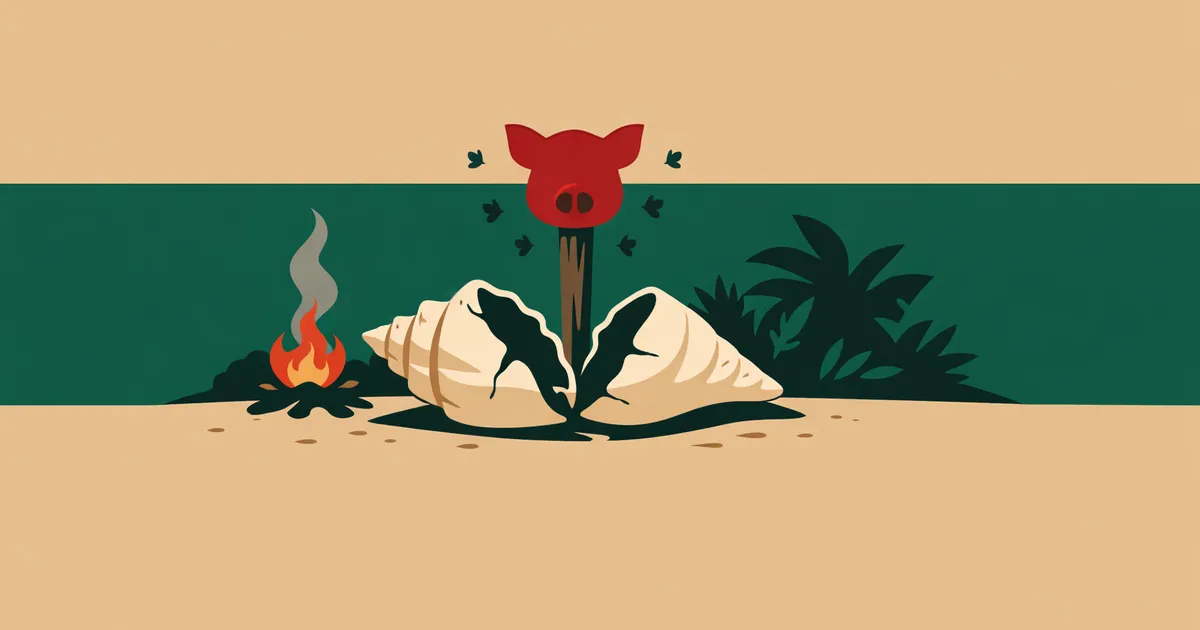
Jack offers the head as a gift to the beast — an attempt to appease the creature he claims is hunting them. The offering reveals how the boys' fear has evolved into a religious structure: they have created a deity (the beast), a priesthood (Jack's hunters), and now a sacrificial practice. The mounted head becomes the "Lord of the Flies" — a translation of Beelzebub, a name for the devil. Jack's offering is also a display of power and territorial marking, establishing his authority over the jungle clearing.
Chapters 9-10
17. Why do the boys kill Simon?
The boys are in the midst of a frenzied ritual dance during a thunderstorm when Simon crawls out of the forest. In the darkness, the rain, and the collective hysteria of the chant ("Kill the beast! Cut his throat! Spill his blood!"), the boys mistake Simon for the beast — or choose not to recognize him. They attack with hands and teeth. Golding leaves deliberately ambiguous whether this is a case of mistaken identity or willful violence enabled by the ritual's momentum. Both readings implicate the entire group, including Ralph and Piggy, who were present at the edge of the circle.
Simon's death is the novel's moral catastrophe, and Golding constructs it to deny every character a clean conscience. Ralph and Piggy were at the feast. They participated, at least peripherally, in the dance. The next morning, both boys struggle to confront what happened — Piggy rationalizes it as an accident, while Ralph can barely bring himself to use the word "murder." Golding's technique here is devastating: by making Simon's death a collective act rather than an individual crime, he eliminates the possibility of blame being confined to Jack's tribe. The entire group is complicit, which means the entire group has crossed a line from which there is no return. This is Golding's answer to the question "who is responsible?" — everyone. And his follow-up question is even harder: if everyone is responsible, is anyone redeemable?
18. How do Ralph and Piggy react differently to Simon's death the morning after?
Piggy rationalizes: he insists it was an accident, that they were on the outside of the circle, that the darkness and storm made it impossible to know what was happening. Ralph is more honest — he knows what they did — but can barely force himself to say the word "murder." He keeps starting to acknowledge the truth and then retreating from it. Their different responses reflect their different coping mechanisms: Piggy, the rationalist, constructs a logical defense against guilt; Ralph, who operates more on feeling, cannot escape the emotional reality of what happened. Neither response is adequate, and Golding presents both as forms of denial.
19. What does Samneric's forced allegiance to Jack's tribe reveal about the nature of loyalty under coercion?
When the twins are captured at Castle Rock after Piggy's death, they are forced — through violence and the threat of further violence — to join Jack's tribe. Their loyalty to Ralph was genuine but conditional on safety; once the cost of loyalty becomes physical pain, they comply. Sam and Eric's capitulation is not cowardice so much as realism — they are children facing an armed group, and resistance would mean death. Golding uses the twins to show that loyalty, like civilization itself, requires a minimum level of safety to survive. Strip away that safety, and even genuine loyalty gives way to self-preservation.
20. Why does Jack's tribe steal Piggy's glasses instead of the conch?
Jack's raiders ignore the conch — the symbol of democratic authority and legitimate governance — and take Piggy's glasses, which are the practical tool for making fire. This choice reveals where real power lies in the novel's political structure. The conch represents procedural legitimacy, which Jack has already rejected. The glasses represent material capability — the ability to cook meat, to create warmth, to control a critical resource. Jack's theft is Golding's commentary on authoritarian politics: regimes don't seize constitutions or voting rights. They seize control of resources, technology, and the means of production.
Chapters 11-12
21. What is the significance of the conch being destroyed at the same moment Piggy dies?
The conch and Piggy represent the two pillars of rational civilization: procedure (the conch's rules of discourse) and intellect (Piggy's analytical mind). Their simultaneous destruction marks the complete extinction of democratic order on the island. Golding describes the conch exploding "into a thousand white fragments" — language that echoes a bomb blast, connecting the island's collapse to the global war that frames the novel. After this moment, nothing stands between the boys and total savagery.
Golding stages Piggy's death with the precision of a dramatist. Piggy walks to Castle Rock carrying the conch, still believing in its authority, still insisting that "right is right." He makes his final speech — a plea for reason in a world that has abandoned it — and Roger drops the boulder. The rock kills Piggy and shatters the conch in the same blow. This simultaneity is not coincidence; it's Golding's argument made physical. Reason (Piggy) and its institutional framework (the conch) cannot survive independently. An idea without enforcement is a speech in front of a boulder. Golding gives Piggy the novel's most articulate defense of civilized values and then kills him mid-sentence, demonstrating that eloquence without power is, in the end, just noise.
22. What does the naval officer's arrival at the end of the novel represent?
The officer is not a straightforward rescuer. He commands a warship engaged in the same nuclear war that stranded the boys. His casual reference to The Coral Island — asking if the boys have been "having a bit of a war" like Ballantyne's heroes — shows that the adult world operates under the same naive assumptions about British civility that the novel has demolished. The "rescue" transfers the boys from one theater of violence to another. Golding's final irony is that the adult world the boys longed to rejoin is doing on a global scale exactly what the boys did on the island.
23. What does "a stick sharpened at both ends" signify, and why does it terrify Ralph?
Sam and Eric warn Ralph that Roger has "sharpened a stick at both ends." Ralph understands the reference: the same type of stick was used to mount the sow's head as an offering to the beast. The sharpened stick means Ralph is to be the next offering — one end for mounting his head, the other for planting in the ground. The phrase signals that the boys have fully crossed the line from hunting animals to hunting humans, and that the ritualistic logic of sacrifice now extends to people. For Ralph, it means his death has been planned not as an act of anger but as a ceremony.
24. What does Ralph's weeping at the end signify?
Ralph cries "for the end of innocence, the darkness of man's heart, and the fall through the air of the true, wise friend called Piggy." This is not a child's fear-crying or relief-crying. It is grief — for lost innocence, for what he now understands about human nature, and for Piggy specifically. Ralph has gained knowledge that cannot be given back: the understanding that people are capable of terrible things, including himself. The other boys weep too, but Golding specifies Ralph's grief as unique in its comprehension. Ralph alone understands the full meaning of what happened on the island.
Thematic Questions
25. What is the significance of the novel's title, and how does it connect to the story's themes?
"Lord of the Flies" is the English translation of the Hebrew word Beelzebub, a name for the devil. In the novel, the title refers literally to the severed pig's head that Jack mounts on a stake, which attracts swarms of flies and "speaks" to Simon in a hallucination. The title connects the boys' island experience to ancient ideas about evil — specifically, the idea that evil is not an external force but something that lives within human beings. By naming the novel after a devil figure that turns out to be something the boys themselves created, Golding frames the entire story as an argument about the origin of evil.
26. How does Golding use the conch shell's fate to track the decline of civilization on the island?
The conch begins as the symbol of democratic order — it calls assemblies and grants speaking rights. In the early chapters, it commands genuine respect. By Chapter 5, Jack can defy it openly. By Chapter 10, Jack's raiders ignore it entirely when they steal the glasses. In Chapter 11, Roger's boulder shatters it simultaneously with killing Piggy. The conch's declining authority mirrors the group's declining commitment to democratic governance: the symbol loses power precisely because the consensus it depends on has evaporated. Golding uses the conch to show that symbols of authority have no inherent power — they work only as long as people collectively agree to honor them.
27. How does Golding use the island's geography to reinforce the novel's themes?
The island's physical spaces map onto moral and political territories. The beach and platform (where assemblies are held) represent democratic, communal space. The mountaintop signal fire represents hope and connection to the outside world. The jungle is a space of transformation — where Jack hunts, where Simon retreats, where the sow is killed. Castle Rock, Jack's fortress, is barren and defensible — a space organized for power and control rather than community. As the novel progresses, the boys move from open, communal spaces to enclosed, hierarchical ones, and the geography tracks their political and moral regression.
Golding's spatial design is more sophisticated than a simple mapping of places to values. The jungle, for instance, is both Simon's sanctuary (his hidden clearing with butterflies) and the site of the sow's brutal killing. The same space accommodates the novel's gentlest character and its most savage act. This dual coding suggests that the island is morally neutral — a blank surface onto which the boys project their own impulses. The mountaintop undergoes a similar transformation: initially the site of the signal fire (hope), it becomes the location of the dead paratrooper (fear) and a place the boys are too terrified to visit. Golding argues through geography that places don't have inherent moral qualities; they acquire the character of the people who use them. The island doesn't corrupt the boys. The boys corrupt the island.
28. Is the "beast" real? Argue your answer using evidence from multiple chapters.
The beast is not physically real — the "beast from air" is a dead paratrooper, and the "beast from water" is never more than a littlun's fear. But Golding argues through Simon and the Lord of the Flies that the beast is real in a different sense: it is the human capacity for violence and cruelty that lives inside every boy on the island. The beast's evolution across the novel — from vague childhood fear to political tool to religious idol — shows how imagined threats become functionally real when a community organizes itself around them. By the time Roger kills Piggy, the beast has become real not as a creature but as a pattern of behavior the boys can no longer control.
The question of the beast's reality is Golding's central philosophical puzzle, and the novel answers it on two levels simultaneously. On the literal level, the beast does not exist. Every physical candidate is debunked: the snake-thing is never found, the sea creature is a projection of fear, and the mountaintop beast is a decomposing soldier. Simon confirms this when he discovers the paratrooper in Chapter 9. But on the allegorical level, the beast is the most real thing in the novel. It is "mankind's essential illness" — the innate capacity for destruction that Simon perceives in Chapter 5 and the Lord of the Flies confirms in Chapter 8. The novel's tragedy is that the literal truth (there is no beast) and the allegorical truth (the beast is everywhere) cannot coexist in the boys' understanding. Learning that the paratrooper is just a dead man would eliminate the external beast but not the internal one, and the internal one is what actually kills Simon and Piggy.
29. How does Golding challenge the idea that children are inherently innocent?
Golding systematically undermines romantic notions of childhood purity. The boys import cruelty from the very beginning — Piggy is mocked, the littluns are ignored, social hierarchies based on appearance and class are enforced immediately. The progression from these "civilized" cruelties to murder is presented as a continuum, not a rupture. Roger's stone-throwing scene is the key: his restraint in Chapter 4 is conditioned, not innate, meaning the violence he commits in Chapter 11 was always available to him. Golding's argument is that innocence is a product of circumstance (safety, supervision, consequences), not a natural state that must be corrupted by external forces.
30. Compare how Ralph and Jack each use fear of the beast for political purposes.
Ralph tries to use reason against fear: the beast isn't real, focus on the fire, rescue is what matters. This approach fails because fear is not rational and cannot be countered with rational arguments. Jack uses fear productively: he claims the beast is real, positions himself as the one who can protect against it, and uses the beast's existence to justify his authority, his hunts, and eventually his sacrificial rituals. Ralph's response to fear is denial; Jack's response is exploitation. Golding's political point is that leaders who engage with fear — even dishonestly — are more effective in crisis than leaders who dismiss it.
The divergence between Ralph and Jack on the question of fear is the novel's clearest political allegory. Ralph represents liberal democracy's preferred response to irrational fear: education, reason, transparency. He tries to convince the boys that the beast doesn't exist, which is true but irrelevant — the fear exists whether the beast does or not, and addressing the beast's reality doesn't address the fear's reality. Jack represents authoritarianism's response: validate the fear, name an enemy, promise protection, demand loyalty. Jack never claims the beast is imaginary. He claims he can fight it, which is false but emotionally satisfying. The dead paratrooper is the perfect test case: when Simon discovers the truth (the beast is a dead man), the truth serves no one's political interests. Ralph would be vindicated, but the fear would persist. Jack would lose his justification for power. The community would lose the organizing principle around which its new social order has been built. Simon is killed before he can deliver this news, and Golding implies that even if he had survived, the truth might not have mattered.
31. What role does ritual play in the boys' descent into violence?
Ritual — specifically the hunting chant and dance — provides a mechanism for collective violence that no individual boy could commit alone. The chant ("Kill the pig. Cut her throat. Spill her blood.") begins as a celebration and becomes an incantation that dissolves individual identity into group identity. Each repetition lowers inhibitions. The mock hunt with Robert (Chapter 7) shows the ritual working on a human target for the first time. Simon's murder (Chapter 9) shows the ritual's endpoint: a boy killed in a dance the participants may not have fully understood as real. Golding presents ritual as morally neutral technology — it can bond a community around shared purpose or around shared violence, and on the island, it evolves toward the latter.
32. Does the ending of Lord of the Flies offer any hope, or is it purely pessimistic?
The naval officer's arrival saves Ralph's life but does not resolve the novel's questions. The officer represents the same civilization that produced the war stranding the boys, and his warship is engaged in the very violence the boys enacted. Ralph's weeping shows that at least one person understands what happened, which could be read as hope — understanding is the first step toward preventing repetition. But the officer's discomfort and the other boys' unreflective weeping suggest that Ralph's understanding is exceptional, not shared. Golding offers no confident answer: the novel ends on an image of burning forest, a warship, and a boy who knows too much. Whether that knowledge leads anywhere is left to the reader.
The ending resists both optimistic and pessimistic closure, which may be its greatest achievement. A purely pessimistic reading notes that the boys are "rescued" into a world at war, that the officer represents the same failures at a larger scale, and that nothing has been learned. A cautiously hopeful reading notes that Ralph weeps with genuine comprehension — he understands "the darkness of man's heart" — and that this understanding distinguishes him from the officer, who cannot face the boys' grief. Golding seems to position understanding as necessary but insufficient: Ralph knows the truth, but knowing doesn't undo Piggy's death or Simon's murder. The novel's final sentence focuses on the officer turning away from the boys to look at his "trim cruiser" — an image of an adult choosing not to see what the children have become, which is to say, what adults already are. If there is hope in the novel, it lives only in the fragile, painful recognition that Ralph achieves and the officer avoids. Whether that recognition can be translated into action is a question Golding leaves open — perhaps because he wasn't sure of the answer himself.