Characters
Napoleon
Napoleon is the pig who ends up running everything. Described early on as "a large, rather fierce-looking Berkshire boar, not much of a talker, but with a reputation for getting his own way," he lets others do the visible work of the revolution while quietly positioning himself to inherit its power. He does not write the Commandments, does not lead the Battle of the Cowshed, does not design the windmill. What he does is take nine puppies from their mothers and raise them in private -- and that single act of patient, hidden preparation matters more than anything Snowball ever builds or argues for. Napoleon understands something the other animals do not: that power flows not from ideas or eloquence but from the willingness to use force at the right moment.
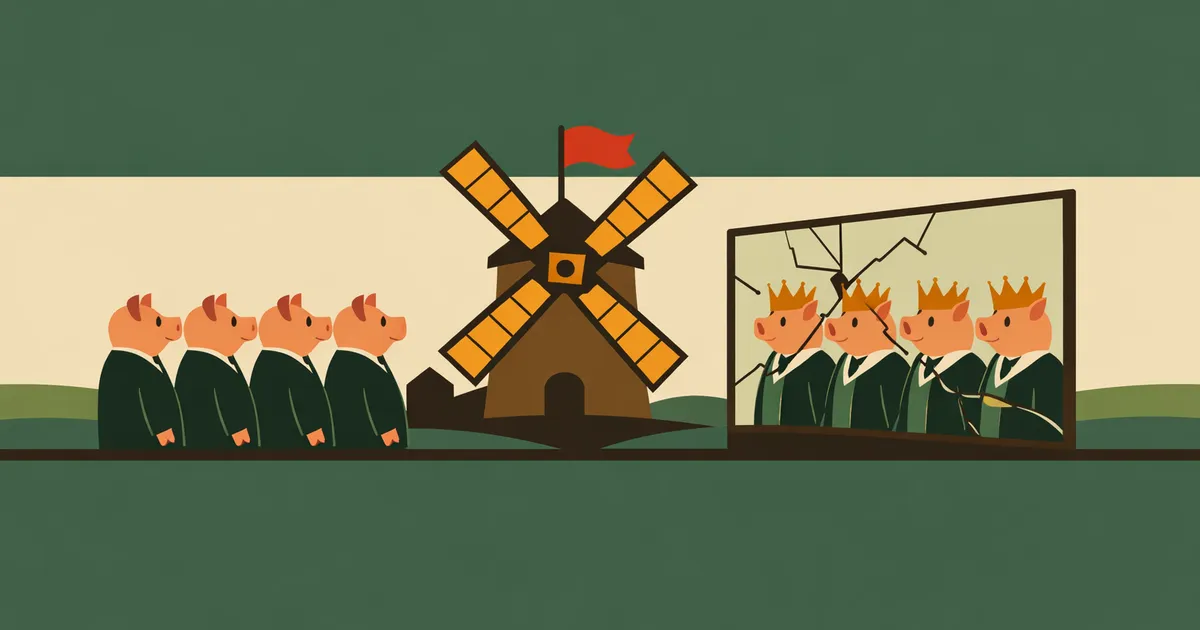
After driving Snowball from the farm with his trained dogs, Napoleon dismantles every democratic structure the revolution created. He abolishes the Sunday Meetings, centralizes decision-making among the pigs, and progressively rewrites the Seven Commandments to accommodate each new privilege he claims. He sleeps in beds, drinks alcohol, trades with humans, and eventually walks on two legs carrying a whip. By the final chapter, he has renamed Animal Farm back to the Manor Farm and is playing cards with the neighboring farmers. The animals watching through the window can no longer tell him apart from the men.
Napoleon's trajectory maps directly onto Stalin's consolidation of power in the Soviet Union, but Orwell makes the character work on purely narrative terms as well. Napoleon's most revealing quality is not cruelty but patience. While Snowball throws himself into committees, speeches, and grand designs, Napoleon "took no interest in Snowball's committees" and instead focused on the education -- really the indoctrination -- of the puppies. This distinction between public performance and private consolidation is the heart of his character. He grasps that institutional power matters more than popular support, and he builds his power base where no one is watching.
The scene where Napoleon urinates on Snowball's windmill plans, then later claims those same plans as his own, captures his governing method in miniature. He does not need to be right; he needs to control what counts as right. Squealer provides the rationalizations, the dogs provide the threat, and Napoleon provides the will. His speeches are always "short and to the point" because he has no interest in persuasion. Persuasion implies the possibility that the audience might disagree, and Napoleon's regime eliminates that possibility at its root. His declaration at the final dinner party -- that "Animal Farm" will henceforth be called "The Manor Farm" -- is not an act of carelessness but of supreme confidence. He no longer needs the revolution's language because he no longer needs the revolution's legitimacy.
What makes Napoleon genuinely unsettling rather than merely villainous is how ordinary his methods are. He does not seize power through genius or supernatural malice. He does it by controlling food distribution, monopolizing education, deploying violence selectively, and ensuring that the only version of history available is the one he approves. The banality is the point.
Boxer
Boxer is the farm's strongest animal and its most dedicated worker -- an enormous cart-horse, "nearly eighteen hands high, and as strong as any two ordinary horses put together." He is the first to arrive at every job and the last to leave. During the revolution's early days, when the farm genuinely thrives, Boxer is the reason. His motto, "I will work harder!", becomes his answer to every crisis, every setback, every confusion he cannot resolve through thought.
He is also, fatally, the most trusting. After Napoleon expels Snowball and abolishes democratic debate, Boxer is "vaguely troubled" but cannot formulate an objection. He adopts a second motto instead: "Napoleon is always right." These two phrases define his tragedy. One represents genuine virtue -- the willingness to give everything for a cause. The other represents the surrender of judgment that allows virtue to be exploited. Boxer works himself to literal collapse dragging stone for the windmill, and when his lungs finally give out, Napoleon sells him to the horse slaughterer. A crate of whisky arrives at the farmhouse shortly after.
Old Major's speech in Chapter I contains an inadvertent prophecy aimed directly at Boxer: "You, Boxer, the very day that those great muscles of yours lose their power, Jones will sell you to the knacker, who will cut your throat and boil you down for the foxhounds." The revolution was supposed to prevent exactly this fate. That Napoleon enacts it -- that the pigs do precisely what the humans would have done -- is the novella's most emotionally devastating irony. Boxer's faith in the revolution does not save him from the revolution's betrayal; it is the mechanism through which the betrayal operates. He cannot resist what he cannot recognize.
The moment in Chapter VII when Boxer pushes back against Squealer's revisionist history of the Battle of the Cowshed -- "I do not believe that. Snowball fought bravely at the Battle of the Cowshed. I saw him myself" -- is the closest any working animal comes to genuine political resistance. Boxer trusts his own memory and says so plainly. But when Squealer invokes Napoleon's authority, Boxer capitulates: "If Comrade Napoleon says it, it must be right." The collapse happens in a single exchange. Boxer's physical strength is useless against a system that demands he choose between his own experience and the leader's pronouncements. Orwell gives him the capacity for doubt but not the intellectual tools to sustain it, and the effect is less contempt for Boxer than grief at a system designed to exploit exactly his kind of loyalty.
His response to the mass executions is equally revealing. Where Clover mourns in silence and Benjamin maintains his cynical distance, Boxer concludes: "It must be due to some fault in ourselves. The solution, as I see it, is to work harder." He cannot conceive of a framework in which the leadership might be wrong, so he turns the blame inward. Orwell understood that totalitarian regimes do not survive purely on fear -- they survive because people like Boxer genuinely believe that obedience and sacrifice will eventually produce the promised future.
Snowball
Snowball is the revolution's idealist and organizer -- "a more vivacious pig than Napoleon, quicker in speech and more inventive." He writes the Seven Commandments on the barn wall, designs the flag, establishes literacy classes, forms committees, plans the windmill, and leads the military defense of the farm at the Battle of the Cowshed. He charges directly at Jones, taking a blast of shot across his back, and engineers the tactical ambush that wins the fight. In the months after the revolution, he is everywhere at once, trying to make Animalism into something real.
He is also gone by Chapter V, chased off the farm by Napoleon's dogs in the middle of a speech he was winning. After his expulsion, he becomes something arguably more important to the story: a ghost. Napoleon transforms the absent Snowball into a universal scapegoat, blaming him for every broken window, every lost key, every bad harvest. The regime needs Snowball more as an enemy than Animalism ever needed him as a leader.
Snowball's role in the allegory corresponds to Leon Trotsky, but his literary function extends beyond historical parallel. He represents a particular kind of political figure: the intellectual revolutionary who believes the revolution's stated goals are its actual goals. His committees are earnest and mostly failures. His windmill plan is genuinely visionary but also impractical in ways he does not fully confront -- "How these were to be procured, Snowball did not say" when it came to dynamos and cables. Orwell treats Snowball with more sympathy than Napoleon but not with uncritical admiration. The character's limitations matter: his dismissal of Boxer's guilt over the stable-lad -- "War is war. The only good human being is a dead one" -- reveals a streak of ideological rigidity that mirrors, in softer form, the absolutism Napoleon will later weaponize.
After his expulsion, Snowball becomes a study in how authoritarian regimes manufacture enemies. The accusations escalate with each retelling: first a political rival, then a saboteur, then Jones's secret agent "from the very beginning." By Chapter IX, Squealer has revised history so thoroughly that Napoleon -- who was nowhere near the fighting -- supposedly led the charge at the Battle of the Cowshed with the cry "Death to Humanity!" while Snowball fought openly on the human side. The absurdity of these claims does not weaken them. It strengthens them, because accepting obvious falsehoods is a deeper form of submission than accepting plausible ones. Snowball's real role in the story is not what he did while present but what his absence makes possible.
Squealer
Squealer is a small, fat pig with "very round cheeks, twinkling eyes, nimble movements, and a shrill voice." The other animals say he "could turn black into white," and that reputation turns out to be less a joke than a job description. He is Napoleon's propagandist, the voice that follows every seizure of privilege with an explanation so fluid, so confident, so laced with statistics and rhetorical questions that the other animals find themselves agreeing before they have finished thinking.
His technique never really changes. Assert that the pigs need whatever they have just taken. Invoke science or expertise the other animals cannot verify. Then deliver the kill shot: "Surely, comrades, you do not want Jones back?" This formula works for milk, for apples, for beds, for alcohol, for the abolition of democratic meetings. It works because it reduces every political question to a single binary -- the pigs or Jones -- and the animals, who remember Jones, always choose the pigs.
Squealer embodies Orwell's argument that totalitarianism depends on language as much as force. The dogs provide the physical threat, but Squealer provides something more insidious: the framework that makes the threat feel reasonable. His explanation of Napoleon's reversal on the windmill is a masterclass in doublethink. Napoleon opposed the windmill, then adopted it, and Squealer reframes this contradiction as strategic genius: "He had SEEMED to oppose the windmill, simply as a manoeuvre to get rid of Snowball." He then names this process -- "Tactics, comrades, tactics!" -- and the act of naming it makes it sound legitimate. The word becomes a container for what would otherwise be recognized as a naked lie.
His most consequential work is the gradual rewriting of the Seven Commandments. The additions -- "with sheets," "to excess," "without cause" -- are small enough to make the animals question their own memories rather than the wall. When Clover checks the Fourth Commandment and finds words she does not remember, she has no recourse. Benjamin can read, but Benjamin will not speak. Muriel tries but lacks the confidence. Squealer controls the only authoritative text, and his control over the written word effectively controls the past. The scene in Chapter IX where he fabricates Boxer's deathbed speech -- complete with "Forward, comrades!" and "Napoleon is always right!" -- is propaganda at its most grotesque, turning the regime's most loyal victim into a posthumous endorsement of the regime that killed him. Squealer does not simply lie. He constructs a reality in which the truth has no institutional support, and the lie is the only story available.
Old Major
Old Major dies in Chapter II, just three nights after his great barn speech, and never sees the revolution he inspires. But his brief presence shapes everything that follows. He is twelve years old, "a majestic-looking pig, with a wise and benevolent appearance," and the farm respects him enough that every animal is "quite ready to lose an hour's sleep in order to hear what he had to say." His speech is the novella's founding document -- a diagnosis of exploitation, a call to rebellion, and a set of principles that the pigs will spend the rest of the book dismantling.
His argument is both powerful and incomplete. He correctly identifies the source of the animals' misery -- "Man is the only creature that consumes without producing" -- and his description of their exploitation is precise, specific, even moving. He names Clover's four lost foals. He predicts Boxer's fate at the knacker's. He sees clearly. But his warnings about the revolution's dangers are general where they need to be specific. "No animal must ever tyrannise over his own kind" turns out to be easy to proclaim and impossible to enforce when some animals are smarter than others and literacy is unevenly distributed.
Old Major dies before a single practical question of governance arises, and that timing defines his role in the story. He is the theorist, the Marx of the farmyard, who provides the intellectual architecture for revolution but never has to face what comes after. His speech blends genuine insight with a critical blind spot: he assumes that removing the oppressor will automatically produce equality, without accounting for the power dynamics that emerge within the liberated group itself. The vote on whether rats are comrades exposes this gap in real time. The question fractures the unity Major has just proclaimed, and the cat's voting on both sides foreshadows the opportunism that will characterize the pigs' rule. Major's vision is not wrong, exactly, but it is fatally abstract.
"Beasts of England," the song he teaches the animals, is his most lasting contribution and also his most ambiguous one. The song survives his death, spreads beyond the farm, and sustains the animals through their worst hardships. But Napoleon abolishes it immediately after the purges in Chapter VII, and the animals lose the one shared text that connected them to the revolution's original meaning. Major gave the animals a language for their aspirations. What he could not give them was the political literacy to defend those aspirations against the pigs who would co-opt them. The skull set up on a stump at the foot of the flagstaff -- where animals are required to file past it "in a reverent manner" -- becomes the final emblem of how regimes transform founding ideals into instruments of obedience.
Benjamin
Benjamin is the oldest animal on the farm and the only one who never changes. Before the revolution, after the revolution, during the purges, through the years of grinding labor -- "he did his work in the same slow obstinate way, never shirking and never volunteering for extra work either." He can read as well as any pig but never exercises the ability. When asked if life has improved since Jones left, he offers only: "Donkeys live a long time. None of you has ever seen a dead donkey." He refuses to join either faction in the windmill debate, refuses to express an opinion about the revolution, and refuses to be either hopeful or afraid. His cynicism is total, and it is entirely useless.
The single exception comes too late to matter. When the van arrives to take the broken Boxer away, Benjamin reads the lettering on its side -- "'Alfred Simmonds, Horse Slaughterer and Glue Boiler, Willingdon'" -- and for the first and only time in the novella, he runs. He gallops. He shouts. It is the most Benjamin has ever done, and it changes nothing. The van drives away. Boxer dies. And Benjamin returns to being "more morose and taciturn than ever."
Benjamin presents one of the novella's thorniest interpretive questions: is his cynicism a form of wisdom or a form of complicity? He sees more clearly than any other non-pig animal. He knows things are wrong. He can read the Commandments and would recognize their alteration. But he says nothing, does nothing, and treats his own clarity as a private possession rather than a political responsibility. His line about donkeys living a long time reads, in context, less like philosophical detachment and more like a rationalization for inaction -- he has the luxury of waiting things out because he expects to outlive the consequences.
Orwell positions Benjamin as the knowing bystander, the figure who understands what is happening but whose understanding changes nothing because it never translates into action. His devotion to Boxer -- the two of them spend their Sundays "grazing side by side and never speaking" -- makes his silence during Boxer's exploitation all the more damning. He watches Boxer work himself to collapse, warns him privately, but never confronts the system that demands the sacrifice. The final chapter finds him "much the same as ever, except for being a little greyer about the muzzle, and, since Boxer's death, more morose and taciturn than ever." He has survived everything. He has prevented nothing. When Clover leads him to the barn wall to read the single remaining Commandment -- "All animals are equal, but some animals are more equal than others" -- he reads it aloud without comment. He already knew.
Clover
Clover is a "stout motherly mare approaching middle life, who had never quite got her figure back after her fourth foal." From the opening scene, where she makes a protective wall around a brood of motherless ducklings with her foreleg, her defining quality is care -- for Boxer, for Mollie, for the weaker animals, for the memory of what the revolution was supposed to mean. She is not brilliant. She learned the whole alphabet but could not put words together. Yet her emotional intelligence is sharper than any other working animal's, and Orwell uses her repeatedly as the book's moral register.
She confronts Mollie about the hidden sugar and ribbons. She checks the Commandments on the barn wall when something feels wrong, even though she cannot fully read them. She tends Boxer's wounds and sits with him in his stall after his collapse. In the final chapter, old and stiff-jointed, she leads Benjamin to the wall to read what the Seven Commandments have become. Clover is always the first to sense that something has been lost, even when she cannot name what it is.
Clover's passage on the knoll after the Chapter VII purges is the emotional center of Animal Farm, and its power comes from the gap between what she feels and what she can express. Orwell narrates her thoughts in indirect speech: "If she could have spoken her thoughts, it would have been to say that this was not what they had aimed at when they had set themselves years ago to work for the overthrow of the human race." The conditional phrasing -- "if she could have" -- is crucial. Clover possesses moral clarity without the vocabulary to make it politically effective. She knows the pile of corpses at Napoleon's feet is a betrayal of everything Old Major promised. She remembers protecting the ducklings on the night of that first speech. But she "lacked the words to express" her understanding, and in the novella's political economy, inarticulacy is powerlessness.
Orwell traces this directly to structural inequality, not individual limitation. The pigs monopolized literacy from the beginning, and the gap between those who can read and those who cannot is the gap between those who can challenge the official narrative and those who must accept it. Clover checks the Commandments but cannot verify them. She senses the additions but cannot prove them. Her recourse is feeling, not argument, and feeling -- however accurate -- does not constitute political opposition in a system that controls the means of expression. Orwell gives her the novella's most humane moment: singing "Beasts of England" through tears as a substitute for the words she cannot find. The regime abolishes even that, replacing it with a hymn to Napoleon. Clover endures to the end, two years past retirement age and still working, her eyes "dimmer than ever." She is the last animal who remembers what the farm was supposed to be, and she has no way to pass that memory on intact.