Exam & Discussion Questions
These are the questions teachers consistently return to when teaching Animal Farm — in class discussion, on quizzes, and on unit exams — along with model answers you can study from and adapt.
Chapter 1
1. What argument does Old Major make in his speech, and what does he say the animals must do?
Old Major argues that the animals' misery is not natural but the result of human exploitation: Man takes the products of the animals' labor and gives back only enough to keep them alive. His prescription is Rebellion — the animals must overthrow Man and run the farm themselves. He ends by teaching the animals "Beasts of England," a song that imagines a world freed from human tyranny.
2. How does Old Major's speech establish the allegorical framework that the rest of the novella follows?
Old Major names Man as the sole enemy, describes the animals' condition as one of pure exploitation, and prescribes Rebellion as the solution. In doing so, he maps the logic of Marxist class analysis onto animal life: a ruling class that extracts value from labor and returns only enough to sustain the laborers. Every character and event that follows corresponds to a real historical figure or development. Old Major himself represents Karl Marx (and to a degree Lenin) — the founding theorist whose ideas outlive him and get reshaped by those who come after. The speech matters not just as plot but as the allegorical key to everything that follows.
Orwell was careful about where the allegorical correspondences were precise and where they were loose. Old Major's death before the Rebellion echoes both Marx (who died before the 1917 Revolution) and Lenin (whose vision was distorted after his death). Napoleon maps directly onto Stalin — the bureaucrat who outmaneuvered the more ideologically engaged Trotsky/Snowball. Squealer corresponds to the Soviet propaganda apparatus and its figures like Molotov. The dogs are the secret police. Boxer embodies the Soviet working class: immensely productive, fiercely loyal, easily deceived, and ultimately expendable. Orwell did not intend a one-to-one allegory for every detail, but these core correspondences are tight enough that understanding them is required to fully read the novella's satirical argument.
3. What is the effect of Old Major's warning that the animals must not come to resemble Man? How does the rest of the novella treat that warning?
Old Major's warning is the moral center of the entire book: "No animal must ever tyrannise over his own kind." Every chapter that follows is essentially a record of how thoroughly that warning is ignored. The pigs adopt human habits one by one — sleeping in beds, trading with humans, walking on two legs, carrying whips — and each adoption is presented as either necessary or inevitable. The warning matters because it was explicit, remembered by the animals, and violated anyway.
Old Major's injunctions at the end of Chapter I function as a prophetic checklist that the novella systematically reverses. He names specific prohibitions: no living in houses, no sleeping in beds, no wearing clothes, no drinking alcohol, no engaging in trade, no killing other animals. By Chapter X, every single one of these prohibitions has been violated by the pigs. Orwell's construction is deliberate — the reader can trace each violation back to this founding speech, measuring the distance between the revolution's stated principles and its actual results.
The warning not to "tyrannise over his own kind" is particularly charged because it comes from Major himself, the revolution's moral authority. His credibility is not undermined within the text — he dies before the corruption begins, which is itself a structural choice. Orwell preserves the original ideals as genuinely good by keeping Major untainted. What fails is not the diagnosis but the institutional design: the animals never build mechanisms to enforce their founding principles or check the power of those who claim to act on behalf of everyone.
Chapter 2
4. Why does the Rebellion happen when it does, and what does this tell us about the revolution's foundations?
The Rebellion is not planned — it happens spontaneously when Jones forgets to feed the animals, a cow breaks down the door of the store-shed, and the animals collectively fight back when Jones and his men try to whip them into submission. The timing reveals that the revolution has no strategic program, only grievances. The animals act from hunger and instinct, not from the pigs' months of Animalism meetings. This spontaneity matters because it leaves a vacuum of institutional authority that the pigs immediately move to fill.
5. What happens to the milk at the end of Chapter 2, and why does Orwell position it where he does?
When the animals return from the hayfield that evening, the milk has disappeared — mixed into the pigs' mash, as Chapter 3 reveals. Orwell places this detail at the very end of the chapter, after the animals' first joyful morning of liberation, as a quiet but devastating note. No confrontation occurs, no pig announces a decision. The milk simply vanishes. It is the novella's first act of appropriation by the leadership class, and Orwell's understatement is the point: the theft is rendered normal before the reader — or the animals — have time to object.
6. What does the pigs' ability to read and write, and the other animals' inability to do so, set up for the rest of the novella?
After the Rebellion, the pigs paint the Seven Commandments on the barn wall. Most animals cannot read them fluently: Boxer cannot get past the letter D, the hens and ducks cannot remember more than a single letter, Clover recognizes letters but cannot put them together. Only the pigs read at full literacy. This gap — established casually in Chapter 2 — is the structural foundation for every abuse of authority that follows. The Commandments can only be verified by reading the barn wall. The barn wall is controlled by the pigs. An animal who cannot read cannot check whether what they remember matches what is written. This is not an accident of education; it becomes the primary mechanism of the regime's control over the past.
Chapter 3
7. What are Boxer's two personal mottos, and what do they represent about his character?
Boxer's mottos are "I will work harder!" and, later, "Napoleon is always right." The first reflects his genuine selflessness and physical dedication — he gets up earlier than any other animal, works at the hardest spots, and never complains. The second reflects his intellectual limitation: he has no framework for evaluating Napoleon's decisions and defaults to unconditional trust. Together the mottos explain why Boxer is both the revolution's most valuable asset and its most tragic victim.
8. Why does Napoleon take the nine puppies away from their mothers, and how does this action fit his broader pattern of behavior?
Napoleon tells the other animals he wants to take responsibility for the puppies' education, framing the removal as a benevolent act. In reality, he is building a private army loyal only to him, trained in secret, outside the community's knowledge. The action fits a pattern that runs through Napoleon's behavior from the start: he consolidates resources and power quietly, without announcing his intentions, and he operates outside the collective structures that ostensibly govern the farm. The Sunday Meetings, Snowball's committees, the Seven Commandments — Napoleon's relationship to each of these is one of private circumvention rather than open opposition.
9. Squealer justifies the pigs' appropriation of the milk and apples with the argument that pigs need extra nutrition for their "brainwork." What makes this argument effective, and what does it reveal about how propaganda functions in the novella?
The argument works because it contains a grain of plausibility — pigs are smarter, pigs do organize the farm — and because it ends with a threat rather than a reason: "Surely, comrades, you do not want Jones back?" This closing question forecloses debate by converting any objection into a vote for Jones's return. The structure of the argument — assertion of special need, appeal to collective danger, rhetorical question that eliminates alternatives — becomes Squealer's standard formula throughout the novella.
Squealer's speech in Chapter 3 is the novella's first extended demonstration of propaganda as a political tool, and Orwell constructs it with surgical precision. The claim that "milk and apples contain substances absolutely necessary to the well-being of a pig" invokes the authority of science ("this has been proved by Science, comrades") without citing any actual evidence — the animals cannot check the claim and lack the critical vocabulary to question it. The rhetorical shift from scientific authority to collective fear ("Jones would come back!") is the decisive move: it reframes a material question (who gets to eat what) as a security question (who keeps the revolution safe). Once the argument is on that terrain, the animals have already lost, because they genuinely do not want Jones back.
What makes this chapter significant is that Snowball participates in the decision alongside Napoleon. Both pigs agree that the milk and apples should go to the pigs. This complicates any reading that frames Snowball as simply the "good" alternative — the corruption is structural, present from the earliest days of animal self-governance, not a personal failing introduced by Napoleon alone.
Chapter 4
10. How does Snowball organize the defense of Animal Farm in the Battle of the Cowshed?
Snowball draws on Julius Caesar's military campaigns, which he has studied in a book found in the farmhouse. He designs a feigned retreat — using the geese and sheep to harass the attackers, then pulling them into the yard where the horses, cows, and pigs wait in ambush. The plan works: Jones is knocked down, the stable-lad is stunned, and the men retreat in panic. Snowball himself charges directly at Jones and takes a pellet wound. The victory establishes Animal Farm's military credibility and earns Snowball and Boxer the decoration "Animal Hero, First Class."
11. How do Boxer and Snowball respond differently to the possibility that Boxer has killed a boy during the battle, and what does this exchange reveal about their characters?
Boxer is devastated — "I had no intention of doing that. I forgot that I was wearing iron shoes." His concern for the stable-lad's life is immediate and genuine. Snowball dismisses his concern: "War is war. The only good human being is a dead one." The exchange draws a sharp contrast between Boxer's moral instinct, which persists even toward enemies, and Snowball's ideological ruthlessness, which converts any individual human into an abstraction. Notably, the stable-lad is later revealed to have only been stunned, but Snowball's dismissal of Boxer's concern stands regardless.
12. After the Battle of the Cowshed, Mr. Jones fades from the story — yet his name remains powerful. How do the pigs use Jones as a political tool even after his defeat?
Jones's actual presence diminishes after Chapter 4, but his name becomes more politically useful as the novella progresses. Whenever animals question the pigs' decisions — about the milk and apples, the windmill, trade with humans — Squealer's clinching move is always the same: "Surely, comrades, you do not want Jones to come back?" Jones is no longer a threat but a specter, conjured precisely when the animals are closest to thinking critically. His name functions as an off-switch for doubt. Orwell shows that a defeated enemy is in some ways more valuable to a regime than an active one: the memory of oppression can be weaponized indefinitely to justify the present order.
13. What is the significance of the slogan "Four legs good, two legs bad," and how does its eventual change to "Four legs good, two legs better" mark the revolution's final betrayal?
The slogan is introduced in Chapter 3 as a simplified version of Animalism for animals who cannot remember the Seven Commandments. Snowball reasons that it captures "the essential principle of Animalism" — anything on four legs or wings is a comrade; anything on two legs is an enemy. It is an intellectual compression that makes ideology portable and repeatable. The sheep in particular adopt it as a chant, bleating it to drown out any inconvenient speech. By Chapter 10, when the pigs emerge walking upright on two legs, the sheep bleat the new version — "Four legs good, two legs better" — apparently having been taught the revision in secret. The change is the novella's most economical summary of the revolution's collapse: the very slogan designed to prevent the animals from becoming human is rewritten to celebrate it.
The slogan's transformation works on two levels simultaneously. On the surface, it tracks the pigs' physical transition to bipedalism — the most visible sign of their adoption of human habits. But it also demonstrates Orwell's argument about how propaganda corrupts thought by replacing it. The animals never interrogated the original slogan; they simply repeated it. Having replaced critical thought with repetition, they have no defense when the slogan itself is changed. The sheep cannot evaluate whether the new version is consistent with Animalism because they never understood Animalism — only the words. Squealer's revision process is therefore complete before any animal notices: the mechanism of control has been converted from enforcing one principle to enforcing its opposite, and the animals comply because they were trained to comply, not to think.
Chapter 5
14. What is the windmill debate, and why does Napoleon ultimately win it?
Snowball proposes building a windmill on the farm's highest knoll, arguing it will generate electricity, power machines, and reduce the animals' workload to three days a week. Napoleon opposes it, saying food production must come first. The farm divides into factions. Napoleon wins not through argument but through violence: at the Sunday Meeting where the vote is about to go Snowball's way, he summons his nine dogs, who chase Snowball off the farm. Three weeks later, Napoleon announces that the windmill will be built after all — and Squealer explains that Napoleon had supported it all along.
15. What changes does Napoleon make to Animal Farm's governance after Snowball's expulsion?
Napoleon abolishes the Sunday Meetings and replaces them with a committee of pigs who meet privately and communicate decisions to the other animals. He mounts Major's skull on a stump at the foot of the flagpole as an object of reverence. He physically stations himself and the dogs on the raised platform where Major once spoke, occupying the space of the revolution's founder while reversing everything the founder said. Democratic debate is replaced by announcements, and the four young porkers who squeal in protest are immediately silenced by the dogs' growls.
16. Boxer responds to Snowball's expulsion and the abolition of the Meetings by adopting the motto "Napoleon is always right." What does this moment reveal about the relationship between loyalty and critical thinking?
Boxer's adoption of the motto is not cynical — he genuinely believes in Napoleon and genuinely cannot formulate a counter-argument. The text shows him trying: "He set his ears back, shook his forelock several times, and tried hard to marshal his thoughts; but in the end he could not think of anything to say." His failure is not a failure of character but a failure of vocabulary and conceptual tools. Boxer is the regime's greatest supporter and greatest victim precisely because his loyalty has no critical component — it cannot distinguish between a leader worth following and one who should be questioned.
The expulsion of Snowball in Chapter 5 is the novella's structural turning point, and Orwell stages it as a deliberate inversion of democratic process. The vote is about to go Snowball's way — "in a moment Snowball's eloquence had carried them away" — when Napoleon's signal transforms political debate into a demonstration of physical force. The nine dogs are the private army Napoleon has been building since Chapter 3, raised in secret, loyal only to him. Their emergence at this precise moment makes the political argument: violence does not need to be constant to reshape political life. A single overwhelming demonstration, timed correctly, is sufficient to silence all future opposition.
Squealer's subsequent rewriting of the episode — explaining that opposing the windmill was "tactics," that Napoleon had in fact invented it, that Snowball had stolen the plans — introduces the novella's most corrosive mechanism of control. The animals' inability to refute this version is not primarily about intelligence; it is about access to information. There is no independent record, no second source, no institutional check on what Napoleon says is true. Squealer's question, "Are you certain that this is not something that you have dreamed, comrades?" exploits this asymmetry precisely. The animals' trust in their own memories is systematically undermined, and once that trust is gone, the pigs can rewrite the past at will.
Chapter 6
17. How does Napoleon justify engaging in trade with humans, and what is significant about how this rule change is handled?
Napoleon announces that Animal Farm will sell hay and wheat to neighboring farms, and later eggs. When the animals feel uneasy — they remember passing a resolution against trade — Squealer assures them that no such resolution was ever passed, that it is "pure imagination, probably traceable in the beginning to lies circulated by Snowball." His clinching question is the same one he always uses: "Are you certain that this is not something that you have dreamed, comrades? Have you any record of such a resolution? Is it written down anywhere?" Since nothing was written down, the animals are satisfied they were mistaken.
18. How does the pigs' move into the farmhouse get justified, and what happens when Clover checks the Fourth Commandment?
Squealer argues that the pigs, as the farm's brainworkers, need a quiet place to work, and that it is fitting for a Leader to live in a house rather than a sty. When Clover checks the barn wall about sleeping in beds, Muriel reads aloud: "No animal shall sleep in a bed with sheets." Clover cannot quite remember the word "sheets" being there, but since it is written on the wall, she accepts it. This is the novella's first explicit demonstration of Commandment alteration — the quiet addition of two words that transform an absolute prohibition into a technical one.
19. The windmill is destroyed in a storm. How does Napoleon respond, and what does his response reveal about how the regime handles failure?
Napoleon blames Snowball immediately and without evidence, announcing a death sentence on him and offering rewards for his capture. He then orders reconstruction to begin at once. The response demonstrates the regime's standard formula for failure: identify an external enemy, convert the disaster into evidence of that enemy's treachery, and redirect the animals' energy into renewed sacrifice. The walls were actually too thin — the human farmers say so — but acknowledging that would require acknowledging Napoleon's error. Instead, the failure becomes proof of Snowball's malice and a justification for working harder.
Chapter 7
20. What triggers the hen rebellion, and how does Napoleon suppress it?
Napoleon orders the hens to surrender their eggs for sale to fund grain purchases. The hens, preparing for the spring sitting, fly to the rafters and smash their eggs on the floor rather than hand them over. Napoleon's response is immediate and ruthless: he cuts off the hens' food supply entirely and decrees that any animal feeding a hen faces death. After five days and nine deaths, the surviving hens capitulate. Their deaths are officially attributed to disease, and Mr. Whymper is never told.
21. What happens at the mass execution scene in Chapter 7, and what is Clover's reaction afterward?
After the four pigs who protested the abolition of the Meetings confess to collaborating with Snowball, the dogs tear their throats out. More confessions follow — hens, a goose, sheep — and each confessor is killed. When it is over, Clover and the other surviving animals gather on the knoll. Clover cannot speak her thoughts, but Orwell renders them: she knows this is not what they had aimed at, that this is not the society she and the others had imagined when they first worked for the Rebellion. She begins to sing "Beasts of England" — and Squealer arrives to announce the song has been abolished.
22. Why is "Beasts of England" abolished immediately after the executions, and what replaces it?
Squealer explains that "Beasts of England" was the song of the Rebellion, and since the Rebellion is now complete, the song is no longer needed. Minimus has composed a replacement — "Animal Farm, Animal Farm, / Never through me shalt thou come to harm!" — which the animals are required to sing on Sundays. The abolition is timed immediately after the executions: with the animals traumatized and silent, the one shared text that connected them to the original vision of liberation is removed. The replacement song makes no promises and names no hopes. It is devotional without being aspirational.
The mass execution scene in Chapter 7 is the novella's darkest passage and its most direct parallel to Stalin's Moscow show trials of 1936–38. In those trials, veteran Bolsheviks confessed to elaborate fabrications — sabotage, collaboration with foreign powers, plotting against Stalin — and were then executed. The confessions in Animal Farm are grotesquely disproportionate: a goose confesses to secreting six ears of corn, a sheep to urinating in the drinking pool. This disproportion is the point. The purge is not about specific crimes; it is about demonstrating that Napoleon's authority reaches into every corner of animal life, including the most intimate. The animals who confess are not guilty of anything meaningful. They confess because refusal is impossible.
Clover's silent anguish on the knoll is the novella's most affecting passage precisely because she cannot articulate it. She knows something has gone wrong. She remembers the original vision — "a society of animals set free from hunger and the whip, all equal, each working according to his capacity, the strong protecting the weak." She cannot mount a critique because the pigs have progressively stripped the political vocabulary from the animals' world. She has no language for what she is feeling, and the abolition of "Beasts of England" immediately afterward removes the one symbolic resource that might have allowed her to connect with others who feel the same way. Squealer's timing is not incidental — it is strategic.
Chapter 8
23. How does the alteration of the Sixth Commandment work, and what does it reveal about the animals' relationship to written authority?
After the executions, some animals recall that the Sixth Commandment says "No animal shall kill any other animal." Clover asks Benjamin to read it for her; he refuses, so she fetches Muriel. Muriel reads: "No animal shall kill any other animal without cause." The final two words had somehow slipped out of the animals' memory. But since the wall says what it says, the executions are retrospectively justified — there was clearly cause. The episode shows how the pigs' control of the written record allows them to make any action legal by altering the law.
24. Frederick pays Napoleon in forged banknotes for the timber. How does Napoleon respond, and how does Squealer reframe the subsequent Battle of the Windmill?
Napoleon pronounces a death sentence on Frederick and the animals fight back when Frederick's men blow up the second windmill. The battle is costly — several animals are killed and nearly everyone is wounded — but the men retreat. Boxer, bleeding and exhausted, notes simply: "We have won back what we had before." Squealer's response — "That is our victory" — is the novella's sharpest four-word summary of how propaganda works: a return to the status quo ante is declared a triumph, and two years of sacrificial labor have produced nothing.
25. How does Napoleon's cult of personality develop in Chapter 8?
Napoleon acquires an elaborate set of titles — "Father of All Animals," "Terror of Mankind," "Ducklings' Friend" — and his name is credited for every good thing on the farm ("Under the guidance of our Leader, Comrade Napoleon, I have laid five eggs in six days"). Minimus composes a fawning poem inscribed on the barn wall opposite the Seven Commandments, accompanied by a painted portrait of Napoleon. He appears in public less frequently, attends with an escort of dogs and a cockerel that announces his arrival. Each of these elements — the titles, the poem, the portrait, the ceremonial entrance — mirrors the apparatus of Stalinist personality cult.
Chapter 9
26. What is the "Spontaneous Demonstration," and what purpose does it serve?
The Spontaneous Demonstration is a weekly march around the farm where animals parade in military formation while Squealer reads statistics proving that production has increased. Napoleon has commanded that it happen; the name "spontaneous" is therefore a deliberate contradiction. The demonstrations serve multiple functions: they fill time that might otherwise be spent in reflection, they provide collective emotional release that mimics genuine celebration, and they reinforce the narrative that the animals are masters of their own fate. The sheep are the demonstrations' most devoted participants, silencing any quiet complaint with "Four legs good, two legs bad!"
27. Why does Orwell bring Moses the raven back in Chapter 9, and what does the pigs' tolerance of him reveal?
Moses reappears telling the same stories of Sugarcandy Mountain he always told — a paradise of clover fields and linseed cake where animals go after death. The pigs officially dismiss his stories as lies but allow him to stay on the farm and give him a daily gill of beer. The detail is a precise observation about totalitarian regimes and religion: a belief in afterlife compensation makes the present more bearable, which makes the ruled easier to manage. The pigs do not need the animals to believe in Sugarcandy Mountain; they just need them not to object too loudly to their conditions.
28. How is Boxer sent to his death, and what does the manner of his departure reveal about the regime?
Napoleon announces that Boxer will be sent to a hospital in Willingdon for treatment. The van that arrives is labeled "Alfred Simmonds, Horse Slaughterer and Glue Boiler." Benjamin reads this aloud — the only time in the novella he chooses to speak rather than stay silent — but it is too late. Boxer tries to kick his way free but is too weak. Squealer later explains that the van had previously belonged to the knacker and had not yet been repainted. The animals believe him. The manner of Boxer's death reveals the regime's ruthlessness: its most faithful, most productive worker is literally sold for slaughter, and the transaction is covered with a story that is transparently false but goes unchallenged.
Boxer's fate is the novella's most devastating irony. His two mottos — "I will work harder" and "Napoleon is always right" — represent the two halves of what makes him the regime's ideal subject: maximum productive output combined with zero critical capacity. He works himself past the point of recovery, refuses every warning, and frames his own deterioration as a personal failing rather than a systemic one ("it must be due to some fault in ourselves"). The regime exploits his body completely and then, when that body is exhausted, extracts one final piece of value by selling him to the knacker. The whisky the pigs purchase with the proceeds arrives days later.
Benjamin's decision to read the van's lettering is the single moment in the novella where informed inaction breaks down into action — and it comes too late to matter. Benjamin has been able to read as well as any pig throughout the story. He has seen through every lie. His "donkeys live a long time" passivity is not ignorance but a deliberate choice to withhold his knowledge. Orwell positions his one act of engagement as the novella's sharpest indictment of that choice: knowing the truth and declining to use it is not neutrality. By the time Benjamin acts, Boxer is already in the van, already past saving.
Chapter 10
29. How has Animal Farm changed in the years covered by Chapter 10?
The farm is larger, more prosperous on paper, and better organized — but the animals are no better off. The windmill has been completed and is used to mill corn for profit rather than to generate electricity as Snowball originally envisioned. The retirement pasture was never created. Animals who knew the old days are mostly dead. The new animals who have been born or purchased accept the pigs' authority without question and cannot learn the alphabet past the letter B. The Seven Commandments have been replaced by a single maxim: "All animals are equal, but some animals are more equal than others."
30. What happens at the card game dinner party, and why does the novella end there?
The pigs invite neighboring farmers for a tour of inspection and a dinner party. At the table, Mr. Pilkington toasts Animal Farm and praises the pigs for achieving lower rations and longer working hours than any farm in the county. Napoleon responds by renaming the property the Manor Farm — its original name. The card game that follows erupts into a quarrel over an ace of spades played simultaneously by Napoleon and Pilkington. The watching animals look from pig to man and cannot tell which is which. Orwell ends there because the image says everything: the rulers have become what they overthrew, the ruled remain exactly where they started, and the revolution has completed its full circle back to the status quo.
31. What is the significance of the farm being renamed the Manor Farm at the end?
The farm was renamed Animal Farm in Chapter 2 to mark the beginning of animal self-governance. Its renaming back to the Manor Farm closes a structural circle: the entire revolutionary period is rendered a parenthesis in an unbroken history of exploitation. The new name also signals Napoleon's final rejection of any pretense that his rule has anything to do with Animalism. He is aligning himself with the neighboring human farmers as a fellow property owner, not as the leader of a workers' revolution. The name change is the last in a long series of reversals, and Orwell gives it the weight it deserves by placing it in the final chapter, just before the image of pigs and humans becoming indistinguishable.
Chapter 10 compresses years into a few pages, accelerating time to show how complete and irreversible the transformation has become. The technique is significant: Orwell does not show the individual decisions that led to each deterioration but presents their cumulative result. The animals who remain cannot compare the present to the past because most of them never knew it, and the few who did — Clover, Benjamin — can no longer hold onto it clearly. Squealer's statistics fill the space where memory might otherwise function.
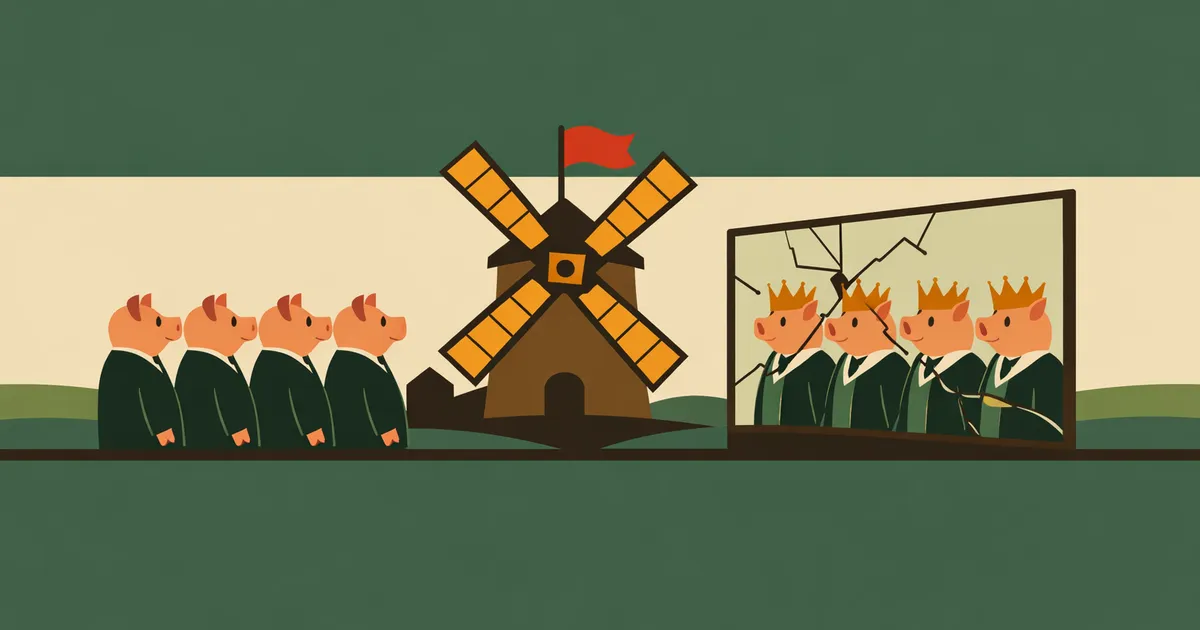
The final scene's power depends on the slow build of the chapter. By the time the pigs emerge walking upright in Chapter 10, the reader has watched them appropriate every human practice Old Major explicitly warned against. The pigs wearing human clothes, reading human newspapers, and fraternizing with human farmers is not a shock — it is a culmination. What is shocking is the precision of the final sentence: "The creatures outside looked from pig to man, and from man to pig, and from pig to man again; but already it was impossible to say which was which." The ambiguity is not metaphorical. The pigs have so thoroughly adopted the posture, habits, and interests of their former oppressors that the distinction has dissolved. Pilkington's witticism — "If you have your lower animals to contend with, we have our lower classes!" — makes the parallel explicit: what has changed is not the structure of exploitation but only who sits at the top of it.
Thematic Questions
32. How does the novella use the progressive alteration of the Seven Commandments to track the revolution's decline?
Each Commandment alteration marks a specific stage in the pigs' consolidation of power. The first is the quietest — the milk simply disappears. Then "with sheets" is added to the bed prohibition. "Without cause" is appended to the rule against killing. "To excess" qualifies the alcohol ban. Finally the Seven Commandments are replaced by a single self-contradicting maxim. The progression works because each individual change is small enough to be dismissed or rationalized, but the cumulative effect is total — from a set of principles designed to protect all animals equally, to a statement that openly enshrines inequality.
The Commandments function in the novella as a stand-in for constitutional law, and their progressive alteration dramatizes a specific theory of how authoritarian power operates: not through sudden, visible seizure but through incremental modification of the norms that make collective judgment possible. Each alteration exploits the animals' limited literacy — Clover can recognize letters but cannot read fluently, Boxer cannot get past the letter D — and their lack of any written record of the original text other than the barn wall itself, which the pigs control. Squealer's consistent question, "Have you any record of such a resolution? Is it written down anywhere?" is not a request for evidence; it is a demonstration that the regime holds a monopoly on the written record and therefore on authorized memory.
The replacement of the Seven Commandments with "All animals are equal, but some animals are more equal than others" is the logical endpoint of this process. The final maxim does not even pretend to be a principle; it is a naked statement of hierarchy dressed in the grammar of equality. Its self-contradiction is not a flaw but the point: it is a text that cannot be used to mount a critique of anything the pigs do, because it already contains the pigs' response to any critique. Orwell was precise about this. In his own political writing, he identified the deliberate corruption of language as one of the primary weapons of totalitarianism — not just lying about facts, but degrading the words people use to think and argue so that they cannot formulate opposition at all.
33. Benjamin is the only animal on the farm who understands exactly what is happening throughout. What is Orwell saying through his consistent refusal to speak or act?
Benjamin's intelligence is established early — "Benjamin could read as well as any pig" — and his cynicism is consistent: "Donkeys live a long time. None of you has ever seen a dead donkey." He never joins any faction, never endorses any propaganda, and never actively resists any injustice. His one act of engagement is reading the lettering on Boxer's van — and it comes too late. Benjamin represents the failure of the intelligent observer who declines to use their understanding on behalf of others.
The standard reading of Benjamin is that he embodies Orwell's critique of passive leftist intellectuals — those who see through propaganda clearly enough, know what tyranny looks like, and still decline to commit to resistance. Orwell was writing partly about himself: a man of the left who watched the Soviet Union betray socialist principles, who documented that betrayal meticulously, and who still had to reckon with the question of whether seeing clearly is sufficient. Benjamin's answer is implicitly no — but the novella does not let him off easily by making him simply cowardly. His passivity has a philosophical basis ("things never had been, nor ever could be much better or much worse"), and Orwell presents it with enough sympathy to make it recognizable as a real position rather than a cartoon of intellectual failure.
What the novella does not do is let Benjamin's cynicism stand as wisdom. His one action — galloping across the farm to read the van's lettering — is urgent, desperate, and futile. The combination of urgency and futility is the point: a lifetime of knowing without acting produces a single moment of acting when it is too late to matter. Orwell gives Benjamin no redemption and no satisfaction. He survives; that is all.
34. How does the figure of Mollie function in the novella's political argument?
Mollie is the white mare who cares primarily about sugar, ribbons, and having her nose stroked. She asks about ribbons when Snowball explains the principles of Animalism. She hides during the Battle of the Cowshed. She is discovered fraternizing with one of Pilkington's men and defects to pull a human's cart, where she is spotted looking content, wearing a scarlet ribbon. None of the animals ever mentions her again.
Mollie represents those who collaborate with the old order — or any order that offers personal comfort — rather than commit to collective liberation. She is the political reading's petite bourgeoisie: unwilling to sacrifice immediate privilege for long-term freedom, susceptible to the attention of those in power, willing to trade independence for comfort. Orwell does not condemn her harshly — the text treats her with a kind of rueful affection. She likes ribbons; she is not evil.
What she reveals is that the revolution demands a kind of sacrifice that not all animals are willing to make, and that ideological commitment and material self-interest are in constant tension. The other animals' decision never to mention her again is its own comment: the revolution cannot accommodate those who choose comfort over principle, and the response is not punishment but erasure. Mollie exits the narrative the same way many inconvenient historical figures exit official revolutionary histories.
35. The novella's structure is circular — it begins and ends with Manor Farm. What is Orwell arguing through this circularity?
The farm begins as Manor Farm under human ownership, is renamed Animal Farm after the Rebellion, and ends as the Manor Farm again. The circle suggests that the revolution has not transformed the farm but only rotated who is at the top. The animals who were exploited under Jones are exploited under Napoleon. The name has changed twice; the conditions of labor have not.
The circular structure is the novella's formal argument, and it operates on two levels simultaneously. On one level, it is a specific satirical claim about the Soviet Union: that Stalinism reproduced the class structure it claimed to overthrow, substituting a party bureaucracy for the Tsar's court while keeping the peasantry in essentially the same condition. On another level, it is a general claim about revolution under conditions of institutional failure: without checks on the power of those who claim to lead in the name of the collective, any revolution tends toward the reproduction of hierarchy rather than its elimination.
The question the circular structure raises without quite answering is whether the outcome was inevitable. Old Major's speech is presented as largely correct in its analysis of exploitation. The first summer under animal rule is genuinely better than life under Jones — the animals eat more, work more purposefully, experience something like dignity. The slide into tyranny follows identifiable steps: the pigs claiming the milk and apples, Napoleon secretly raising the dogs, the abolition of the Sunday Meetings. Each step is a specific choice, not a structural necessity. Orwell's decision to present the betrayal as a series of choices rather than an inevitability is what keeps the novella from being simply a conservative argument against all change. The circle closes, but it closes because of specific decisions made by specific actors — not because revolution is always doomed by nature.
36. How does the novella treat the question of memory — and what does the progressive failure of the animals' collective memory reveal?
From the disappearance of the milk in Chapter 2 to the impossibility of remembering life under Jones by Chapter 10, the animals' memory degrades systematically throughout the novella. Each degradation coincides with a political development that benefits the pigs: they cannot remember the resolution against trade, cannot recall whether the Commandments said "without sheets" or not, eventually lose the capacity to compare the present to the past at all.
Orwell's treatment of memory in Animal Farm is more sophisticated than it might initially appear. The animals do not simply forget — they are actively worked on. Squealer's repeated question, "Are you certain that this is not something that you have dreamed, comrades?", is a technique for inserting doubt into the space between memory and certainty. The animals' limited literacy means they cannot verify their recollections against any independent written record. The barn wall, which holds the only authoritative text, is controlled by the pigs. The pigeons who once spread news of the Rebellion now carry only approved messages. The institutional conditions for collective memory — shared texts, independent records, multiple sources — have been systematically dismantled.
The animals who remember the most clearly — Clover and Benjamin — are also the most politically hamstrung. Clover remembers, but "lacked the words to express" her understanding. Benjamin remembers everything but withholds his knowledge. The combination of memory without language and language without engagement produces, in both cases, an inability to act. Orwell was writing before the cognitive science of memory had developed far, but his intuition is sound: collective memory is not just a matter of individual recall. It depends on social structures — records, shared narratives, the ability to compare notes — that authoritarian systems deliberately dismantle. By the time Napoleon renames the farm the Manor Farm, the animals cannot even remember clearly enough to register how far they have traveled from where they started.
37. Compare Snowball and Napoleon as leaders. Is Snowball simply the "good" version of Napoleon, or does the comparison reveal something more complicated?
Snowball is smarter, more dynamic, and more committed to the collective project — his literacy campaigns, the windmill plan, and his bravery at the Battle of the Cowshed all demonstrate genuine engagement with animal welfare. Napoleon is quieter, more calculating, and interested in power rather than ideology. The contrast is real, but treating it as a simple good-versus-evil binary misses a key detail: in Chapter 3, Snowball agrees with Napoleon that the milk and apples should go to the pigs. Both pigs choose class privilege over principle at the first opportunity. The difference between them is one of method and ambition, not of fundamental values.
Orwell's treatment of the Snowball-Napoleon rivalry is his most politically nuanced move. Snowball represents a version of the Trotskyist left — genuinely committed to the ideals of the revolution, skilled at argument and organization, ultimately defeated by the party apparatus. But Orwell does not present Snowball as the revolution's lost good alternative. His participation in the milk and apples decision, his willingness to use the same rhetorical tools as Napoleon (science, Animalism, appeals to collective good), and his own emerging dominance in the Sunday Meetings suggest that Snowball's rule would have been better but not different in kind. The corruption is not a matter of one bad actor replacing a good one. It is structural: whoever controls the farm's decision-making apparatus will be tempted toward self-interest, and without institutional checks, that temptation will eventually prevail. Napoleon wins because he understands this first.
38. How does Orwell use Squealer to show that controlling language is a form of political power?
Squealer's role is to convert the pigs' decisions into the animals' beliefs. He does this through a consistent set of techniques: appeals to authority ("it has been proved by Science"), false statistics, the invocation of Jones as a threat, questions that undermine memory ("have you any record of such a resolution?"), and the simplest tool of all — repetition. The sheep's bleating is Squealer's work compressed to its minimum form: a slogan that occupies the space where critical thought might otherwise occur. Squealer never physically forces any animal to accept anything. He makes acceptance feel inevitable.
Orwell's portrayal of Squealer anticipates what he would argue more directly in "Politics and the English Language" (1946): that the corruption of language enables the corruption of politics. A ruling class that controls what words mean — that can make "victory" describe a return to the status quo, "necessary" cover theft, and "enemy" apply to whoever the leader names — has already won the argument before it begins. Squealer's most sophisticated move is not lying outright but ensuring that the terms of debate always favor the pigs. When he asks "Surely, comrades, you do not want Jones to come back?" he has not described Napoleon's policy; he has made any alternative to that policy unthinkable. The question does not invite an answer — it forecloses one. This is Orwell's precise definition of propaganda: not false information, but the use of language to make certain thoughts impossible.
39. The novella is explicitly a political allegory of the Soviet Union, but what is its broader argument about power and corruption — one that extends beyond any specific historical moment?
At its most specific, Animal Farm is a satire of Stalinism. But Orwell insisted it was also a more general warning: that any revolution relying on the goodwill of those who seize its leadership, without structural mechanisms to check their power, is vulnerable to the same betrayal. The specific historical parallels are Orwell's vehicle; the novella's argument is that the problem is not Stalin or Napoleon as individuals — it is the absence of institutions capable of constraining any leader who decides their interests differ from everyone else's.
Orwell wrote in a letter that the book's central thesis was that "the corruptibility of the revolution by those who carry it out." He did not write that all revolutions fail, or that the pigs were inevitably going to become what they became. The first summer under animal rule genuinely is better: the animals work more, eat better, experience something resembling dignity. The fall is traced through specific decisions — the milk, the puppies, the Sunday Meetings — each of which was a choice, not a fate. This framing is crucial to the novella's political seriousness. If corruption were inevitable, the book would be a conservative argument against all change. Because it is a series of identifiable choices made by specific actors, it is instead an argument about what conditions allow power to be abused. The missing conditions in Animal Farm are precisely the ones that democratic theory has developed over centuries: separation of powers, independent records, free speech, the right of appeal. The pigs' first act after the Rebellion is to replace genuine collective governance with their own exclusive committee — and everything that follows is downstream of that single substitution.