Summary
Overview
Animal Farm tells the story of a group of barnyard animals who overthrow their drunken, neglectful human owner and attempt to run the farm themselves on principles of equality and shared labor. What begins as a hopeful experiment in self-governance gradually curdles into something worse than what it replaced. The pigs, who appoint themselves leaders on account of their intelligence, slowly accumulate privileges, rewrite the rules, and crush all dissent, until the farm's original ideals are unrecognizable. The central conflict is not really between the animals and humans -- it is between the revolution's promises and its betrayal by those who seize power in its name.
Set on an English farm that cycles through seasons of backbreaking labor, the story spans several years and tracks a full political arc: uprising, consolidation, purges, propaganda, and finally the quiet absorption of the new rulers into the class they once overthrew. The animals' struggles are concrete and physical -- hauling stone, rationing food, surviving winters -- but every hardship carries political weight. Orwell's genius is making that weight feel inevitable rather than imposed.
The book has endured because its lessons keep proving relevant. Written during World War II as a direct satire of the Soviet Union under Stalin, Animal Farm has outlived that specific context. Its portrait of how language can be weaponized, how memory can be manipulated, and how idealism can be hollowed out from within speaks to any situation where power concentrates in the hands of a few who claim to act for the many.
Animal Farm is that rare thing in twentieth-century literature: a political allegory that also works entirely on its own terms as a fable. Published in 1945, after being rejected by multiple publishers wary of offending Britain's wartime ally the Soviet Union, the novella compresses the arc of the Russian Revolution -- from the idealism of Marx and Lenin through Stalin's reign of terror -- into roughly a hundred pages of deceptively simple prose. Orwell chose the fable form deliberately. The short sentences, the fairy-tale clarity, the absence of psychological interiority in the characters -- these are not limitations but structural choices that allow the political argument to emerge from plot and action rather than from editorializing. The reader is never told that propaganda is dangerous; the reader watches Squealer convince an entire farm that their memories are wrong.
Within Orwell's body of work, Animal Farm functions as the companion piece to Nineteen Eighty-Four, published four years later. Where Nineteen Eighty-Four examines totalitarianism from inside the mind of a single citizen, Animal Farm examines it from the outside, showing how an entire society can be reshaped step by step without any single moment dramatic enough to provoke resistance. The novella's structure mirrors this: each chapter introduces a slightly worse violation of the original principles, and each violation is rationalized just enough to prevent revolt. The cumulative effect is a narrative that feels less like a plot and more like a slow constriction. Orwell strips the fable of the genre's traditional moral lesson at the end -- there is no redemption, no moment of awakening. The final image of pigs and humans becoming indistinguishable is not a resolution but a diagnosis.
The Spark of Rebellion (Chapters 1-2)
The story opens on Manor Farm, where the animals live under the rule of Mr. Jones, a farmer who has descended into alcoholism and neglect. One night, an aging prize boar named Old Major calls the animals together and delivers a speech that changes everything. He argues that their misery is not natural but manufactured -- that human beings exploit animal labor, take the products, and give back barely enough to keep them alive. His solution is revolution: remove Man, and the animals can live in freedom and equality. He teaches them a song called "Beasts of England," a vision of a liberated future, and the animals sing it with such fervor that Jones fires his gun from the bedroom window to silence them. Three nights later, Old Major dies peacefully in his sleep.
Over the following months, three pigs take up Major's cause. Napoleon, a large Berkshire boar described as not much of a talker but with a reputation for getting his own way, and Snowball, a quicker and more inventive pig, become the leading figures. A third pig, Squealer, earns a reputation for persuasiveness so potent that the other animals say he could turn black into white. Together they codify Major's ideas into a system called Animalism and hold secret meetings in the barn. The Rebellion itself happens spontaneously: Jones gets drunk, forgets to feed the animals, and when he and his men try to whip them back into line, the animals fight back and drive them off the farm. They rename it Animal Farm and paint Seven Commandments on the barn wall, the last and most important being "All animals are equal." The chapter ends on a small but telling note -- Napoleon diverts the other animals to the hayfield while the milk from the cows quietly disappears.
These opening chapters establish the novella's allegorical framework with remarkable efficiency. Old Major's speech parallels Marx's critique of capitalism: labor produces all value, yet the laborer keeps none of it. His insistence on animal unity and his warnings against adopting human vices function as the ideological foundation that the rest of the book will systematically dismantle. Orwell plants the seeds of corruption in the same breath as the ideals -- the vote on whether rats are comrades reveals how easily abstract principles fracture when applied to specific cases, and the cat's voting on both sides foreshadows the opportunism that will define Animal Farm's future leadership.
The Rebellion itself is conspicuously unplanned, arriving not from organized action but from hunger and spontaneous rage. This matters structurally because it means the revolution has no program beyond its grievances. The pigs fill that vacuum immediately, revealing how intellectual authority converts to political authority the moment institutions need to be built. The disappearance of the milk at the end of Chapter II is the novella's first act of appropriation by the leadership class, and Orwell positions it with devastating understatement -- the animals simply notice, upon returning from the hayfield, that the milk is gone. No scene of theft, no confrontation. Just an absence that everyone registers and no one challenges.
The Golden Age and Its Cracks (Chapters 3-4)
The first summer under animal rule is genuinely good. The harvest is bigger than any under Jones, every animal works according to their ability, and the food supply improves. Boxer the cart-horse becomes the engine of the farm's success, working harder than any two animals combined and adopting "I will work harder!" as his personal motto. Sundays feature a flag-raising ceremony, debates in the Meeting, and the singing of "Beasts of England." But the cracks show early. The pigs supervise rather than labor. Napoleon and Snowball disagree on virtually everything. And when the pigs claim the milk and windfall apples for themselves, Squealer justifies it with a formula that will be repeated throughout the book: the pigs need these things to do their brainwork, and without them, Jones might come back.
Meanwhile, the revolution's fame spreads. Neighboring farmers Mr. Pilkington of Foxwood and Mr. Frederick of Pinchfield spread rumors that the animals practice cannibalism and torture, but "Beasts of England" catches fire across the countryside. In October, Jones and a group of men from both neighboring farms attempt to retake the property. Snowball, who has studied Julius Caesar's military campaigns, leads the defense in what becomes known as the Battle of the Cowshed. He engineers a tactical retreat that lures the men into an ambush, and Boxer fights with terrifying strength, knocking a stable-lad unconscious with a single blow. The animals win decisively. Snowball and Boxer receive the decoration "Animal Hero, First Class." But even in victory, character differences emerge: Boxer is horrified at the thought he may have killed the boy, while Snowball dismisses his concern with "War is war. The only good human being is a dead one."
The Golden Age chapters perform a crucial double function in the novella's architecture. On the surface, they demonstrate that the revolution's ideals are not inherently false -- the animals genuinely produce more, eat better, and experience something like dignity for the first time. This is not satire of idealism itself but of the specific mechanisms by which idealism gets co-opted. The pigs' claim to the milk and apples is the prototype for every subsequent privilege grab: assert a special need, invoke a shared enemy, and rely on the other animals' inability to articulate a counter-argument. Squealer's rhetorical weapon -- "Surely, comrades, you do not want Jones back?" -- reduces every political question to a binary that forecloses genuine debate.
Two details planted in these chapters carry enormous weight later. Napoleon's quiet removal of nine puppies from their mothers Jessie and Bluebell, supposedly to educate them privately, receives only a brief mention before the narrative moves on. These puppies will reappear as the enforcers of his dictatorship. And the sheep's fondness for bleating "Four legs good, two legs bad" at all hours establishes them as a ready-made instrument for drowning out dissent -- a role they fulfill at every critical political moment in the book. Orwell understood that totalitarianism requires not just force but noise, the constant repetition that fills the space where thought might otherwise occur.
Napoleon's Takeover (Chapters 5-6)
The conflict between Napoleon and Snowball reaches its climax over the question of a windmill. Snowball envisions it as a transformative project -- electricity would power machines, reduce labor, and give the animals a three-day work week. Napoleon opposes it, arguing that food production should come first. The farm divides into factions. Then, at the Sunday Meeting where the vote is about to go in Snowball's favor, Napoleon lets out a high-pitched whimper, and nine enormous dogs -- the puppies he raised in secret -- charge into the barn and chase Snowball off the farm. He barely escapes through a hole in the hedge and is never seen again.
With Snowball gone, Napoleon abolishes the Sunday Meetings, centralizes all decisions in a committee of pigs, and installs old Major's skull on a stump at the foot of the flagstaff as an object of reverence. Three weeks later, he announces that the windmill will be built after all. Squealer explains that Napoleon had secretly supported the idea all along and that the plans were actually stolen from Napoleon by Snowball. The animals work a sixty-hour week, with "voluntary" Sunday labor enforced by the threat of halved rations. To procure materials, Napoleon breaks another founding principle by engaging in trade with humans through a solicitor named Mr. Whymper. The pigs move into the farmhouse and begin sleeping in beds. When Clover checks the Fourth Commandment, she finds it now reads "No animal shall sleep in a bed with sheets" -- words she cannot quite remember being there before. By November, a violent storm destroys the half-built windmill. Napoleon blames Snowball, pronounces a death sentence on him, and orders the rebuilding to begin immediately.
Napoleon's expulsion of Snowball is the novella's decisive turning point, the moment where political competition gives way to dictatorship. The scene's construction is deliberate: Snowball is mid-speech, the audience is persuaded, and the democratic process is about to deliver a verdict -- and then physical force renders all of it irrelevant. The nine dogs are Napoleon's private army, raised outside the community's awareness, loyal only to him. Orwell's point is precise: violence does not need to be constant to be effective. A single demonstration of overwhelming force, directed at the right moment, can silence a population indefinitely. The four young porkers who squeal in protest are immediately cowed by the dogs' growls, and after that, no pig ever publicly disagrees with Napoleon again.
The gradual alteration of the Seven Commandments, beginning with the addition of "with sheets" to the bed prohibition, introduces the novella's most chilling mechanism of control: the rewriting of shared memory. The animals cannot quite remember what the Commandments originally said, and since the only written record is the barn wall -- which the pigs control -- they have no way to verify their own recollections. Squealer's question, "Are you certain that this is not something that you have dreamed, comrades?" is not merely rhetorical. It is a deliberate assault on the animals' capacity to trust their own experience. The destruction of the windmill and its immediate attribution to Snowball follows the same logic: the external enemy justifies internal sacrifice and prevents the animals from asking whether the walls were simply too thin.
Terror and Propaganda (Chapters 7-8)
The winter after the windmill's destruction is brutal. Food runs dangerously short, and Napoleon orchestrates an elaborate deception: nearly empty grain bins are topped with sand to fool Whymper into reporting that Animal Farm is thriving. When Napoleon orders the hens to surrender their eggs for sale, they stage the first rebellion since Jones was expelled -- flying to the rafters and smashing their eggs on the floor. Napoleon cuts off their food supply. Nine hens die before the rest capitulate. Their deaths are blamed on disease.
Then the purges begin. Squealer announces that Snowball was Jones's secret agent from the very start, that he deliberately tried to sabotage the Battle of the Cowshed, and that documents prove it. Boxer pushes back -- "Snowball fought bravely at the Battle of the Cowshed. I saw him myself" -- but Squealer insists that Napoleon has declared it so, and Boxer accepts: "If Comrade Napoleon says it, it must be right." Days later, Napoleon summons all the animals to the yard. His dogs drag four pigs forward -- the same ones who protested when the Meetings were abolished -- and they confess to collaborating with Snowball. The dogs tear their throats out. Then come more confessions: hens, a goose, sheep, each admitting to crimes inspired by Snowball. All are killed. The pile of corpses grows, and the smell of blood hangs in the air. Afterward, the surviving animals huddle together on the knoll, and Clover silently mourns the distance between what they fought for and what they have. When she begins to sing "Beasts of England," Squealer arrives to announce that the song has been abolished. The Rebellion, he says, is complete.
In the months that follow, Napoleon's cult of personality swells. He acquires titles like "Father of All Animals" and "Ducklings' Friend." Minimus composes a fawning poem inscribed on the barn wall opposite the Commandments. The second windmill is finished, only for Frederick -- who cheated Napoleon with forged banknotes in a timber deal -- to attack the farm and blow it up with explosives. The animals drive the men off at terrible cost: a cow, three sheep, and two geese are killed, and nearly everyone is wounded. Squealer declares it a glorious victory. Napoleon creates a new decoration and awards it to himself. The Fifth Commandment quietly acquires two new words: "to excess."
Chapter VII's mass execution scene is the emotional center of the novella and its most direct parallel to the Moscow show trials of 1936-38, in which Stalin's political opponents confessed to fabricated crimes before being killed. The confessions in Animal Farm are grotesquely disproportionate -- a goose confesses to secreting six ears of corn, a sheep confesses to urinating in the drinking pool -- and this disproportion is the point. The purge is not about justice or even plausible guilt; it is about establishing that Napoleon's power extends to the most intimate domains of life. The moment the dogs lunge at Boxer and he pins one to the ground, only to release it at Napoleon's command, crystallizes the farm's new power structure: even the strongest animal defers to the dictator, not out of conviction but out of a confused loyalty that has nowhere else to go.
Clover's silent anguish on the knoll is Orwell's most affecting passage, precisely because she cannot articulate what she feels. She knows this is wrong, she remembers the original vision, but she lacks the language to formulate a critique -- and this is not accidental. The pigs have systematically impoverished the other animals' political vocabulary. The abolition of "Beasts of England" immediately after the purge completes this process: the one shared text that connected the animals to their revolutionary ideals is erased and replaced with a vapid hymn to Napoleon. The Battle of the Windmill in Chapter VIII extends the pattern of sacrifice reframed as triumph. Boxer's quiet realization that "we have won back what we had before" is the most lucid political statement any non-pig animal makes in the entire book, and Squealer's reply -- "That is our victory" -- captures, in four words, how propaganda transforms loss into gain.
The Final Betrayal (Chapters 9-10)
Boxer's split hoof from the battle heals slowly, but he refuses to rest, determined to see the windmill rebuilt before his retirement at age twelve. Rations are cut again for everyone except the pigs and dogs. Napoleon fathers thirty-one piglets and begins planning a schoolhouse exclusively for them. New rules mandate that all animals must step aside when a pig approaches on a path, and pigs gain the privilege of wearing green ribbons on their tails. Moses the raven reappears with his tales of Sugarcandy Mountain -- the paradise where animals go after death -- and the pigs tolerate him, even giving him a daily ration of beer. One evening Boxer collapses at the quarry, his lungs giving out. He is carried to his stall, where Clover and Benjamin tend to him. Napoleon announces that Boxer will be sent to a hospital in Willingdon. But when the van arrives, Benjamin reads the lettering on its side: "Alfred Simmonds, Horse Slaughterer and Glue Boiler." The animals cry out, Clover chases the van, and Boxer tries to kick his way free, but he is too weak. Squealer later explains that the van had been bought by the veterinary surgeon who simply had not yet repainted it. The animals believe him. Days later, a crate of whisky is delivered to the farmhouse.
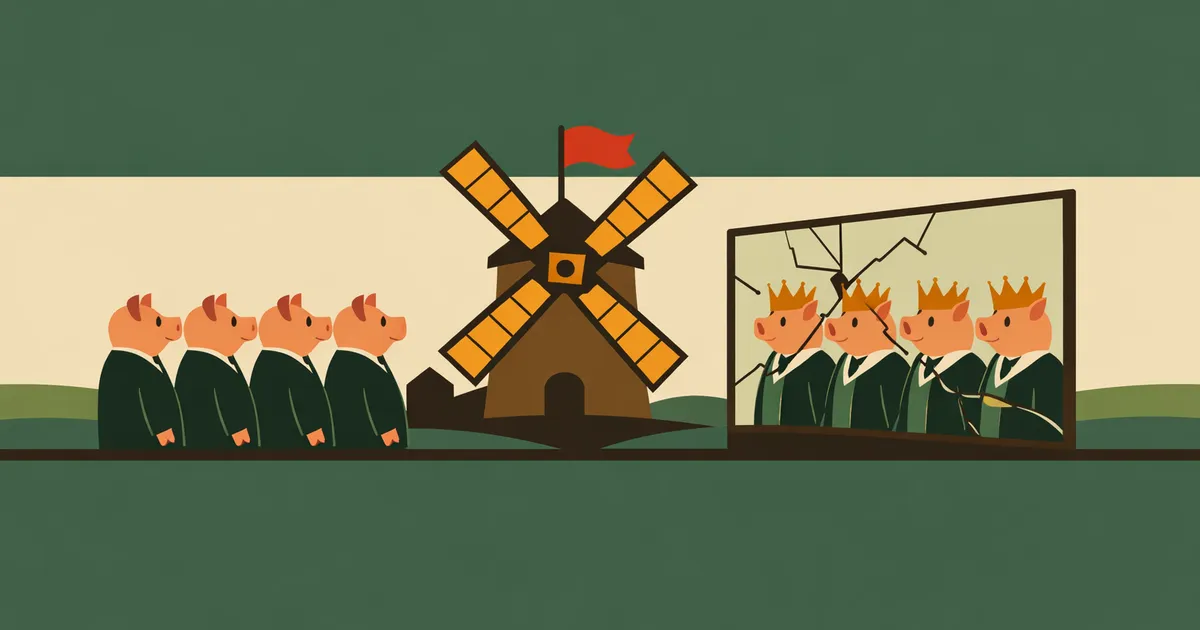
Years pass. Most of the animals who knew the old days are dead. The windmill is finally completed but is used for milling corn to generate profit, not for electrical power as Snowball once envisioned. The farm is richer, but the animals are not. One evening, the pigs emerge from the farmhouse walking upright on their hind legs. Napoleon carries a whip. The sheep, coached by Squealer, begin chanting "Four legs good, two legs better!" The Seven Commandments have been replaced by a single maxim: "All animals are equal, but some animals are more equal than others." The pigs wear human clothes, subscribe to human newspapers, and invite neighboring farmers to inspect the farm. At a dinner party, Mr. Pilkington toasts Animal Farm and praises the pigs for achieving lower rations and longer working hours than any farm in the county. Napoleon responds by renaming the property the Manor Farm -- its original name. The animals watch through the window as pigs and humans play cards together, quarreling over a game. The final sentence lands like a verdict: "The creatures outside looked from pig to man, and from man to pig, and from pig to man again; but already it was impossible to say which was which."
Boxer's fate is the novella's cruelest irony and its most emotionally devastating sequence. He is the revolution's most faithful believer: he works the hardest, questions the least, and trusts most completely. His two mottos -- "I will work harder" and "Napoleon is always right" -- represent the tragedy of loyalty without critical thought. The regime exploits his body until it breaks, then sells him for whisky money while narrating his death as a noble end attended by loving comrades. Orwell forces the reader to confront a specific mechanism of totalitarianism: the system does not merely fail its most devoted adherents but actively consumes them. Benjamin's reaction -- his unprecedented gallop, his furious reading of the van's lettering -- is the single moment in the novella where the cynical, knowing observer breaks his silence, and it comes too late to change anything.
The final chapter compresses years into pages, accelerating time to show how complete the transformation has become. The windmill's conversion from a utopian project into a profit-generating mill is the material expression of the revolution's betrayal: the same labor, the same sacrifice, redirected entirely to benefit the ruling class. Napoleon's renaming of Animal Farm back to the Manor Farm closes a structural circle that began with the renaming in Chapter II, rendering the entire revolutionary period a parenthesis in an unbroken history of exploitation. The card game between pigs and humans is Orwell's final image, and it works on multiple levels. The quarrel over the ace of spades suggests that the alliance between the new tyrants and the old ones is inherently unstable -- they are partners in exploitation but competitors for its spoils. And the animals' inability to tell pig from man is not a failure of vision but a statement of fact: the rulers have become what they overthrew, and the ruled remain exactly where they started.