Key Quotes
"Man is the only creature that consumes without producing. He does not give milk, he does not lay eggs, he is too weak to pull the plough, he cannot run fast enough to catch rabbits. Yet he is lord of all the animals."
Speaker: Old Major (Chapter I)
Old Major delivers this line during his barn speech, the event that plants the seed for the entire revolution. In plain terms, he is making an economic argument: humans take everything and contribute nothing. The animals do all the labor -- growing food, producing milk and eggs, hauling loads -- while Jones profits from their work and gives back only enough to keep them alive. It is the clearest articulation of why the animals should rebel, and it frames the conflict in terms any listener (animal or human) can grasp immediately.
The rhetorical structure of this passage mirrors the techniques of political manifesto writing: a series of concrete, undeniable observations ("He does not give milk, he does not lay eggs") building to an abstract conclusion about power. Old Major's logic is deliberately simple, almost catechistic, because his audience lacks the education to follow complex argument. The repetition of "he does not... he does not... he is too weak... he cannot" creates a rhythmic accumulation that makes the final "Yet he is lord of all the animals" land with the force of a paradox exposed. The word "yet" carries enormous weight -- it is the hinge between observable fact and political outrage.
What makes this quote essential to the novella's architecture is that its logic, while emotionally compelling, contains the flaw that will undo the revolution. Old Major defines exploitation purely as consuming without producing, which allows the pigs -- who also consume without producing once they assume managerial roles -- to escape the critique entirely. Squealer's later justification for taking the milk and apples ("We pigs are brainworkers") is already implicit in this gap. Orwell does not make Old Major a fraud; he makes him a sincere thinker whose framework is incomplete, and that incompleteness is where tyranny finds its opening.
"Four legs good, two legs bad."
Speaker: The sheep, originally formulated by Snowball (Chapter III)
Snowball coins this slogan as a simplified version of the Seven Commandments, intended for animals too slow to memorize all seven rules. The sheep adopt it with particular enthusiasm, bleating it for hours at a time. On the surface, it is a useful mnemonic -- a way to reduce a political philosophy to its most basic principle. But the slogan quickly becomes something else entirely: a tool for shutting down debate. Whenever a discussion threatens to go in a direction the pigs dislike, the sheep drown it out with this chant.
Totalitarian regimes do not succeed through force alone -- they require noise. The sheep's chant functions as what propaganda theorists would later call a "thought-terminating cliche": a phrase so simple and rhythmic that it fills the space where critical thinking might otherwise occur. Every time the four young porkers try to protest Napoleon's decisions in Chapter V, the sheep's bleating smothers the attempt. The slogan does not refute the objection; it simply makes the objection inaudible. This is a precise observation about how political language operates in authoritarian systems -- not by winning arguments but by preventing them from happening.
The quote also carries structural significance because of its transformation in Chapter X, when the sheep begin chanting "Four legs good, two legs better!" after the pigs walk upright. The original slogan was reductive but at least pointed at a real distinction between oppressor and oppressed. Its inversion demonstrates that the content of propaganda is irrelevant; what matters is the act of repetition itself. The sheep chant the new version with the same fervor as the old, because they were never processing meaning -- they were performing obedience. Orwell's bitter joke is that the very instrument designed to protect the revolution becomes the instrument that seals its betrayal.
"Surely, comrades, you do not want Jones back?"
Speaker: Squealer (Chapter III, repeated throughout)
Squealer first deploys this line when explaining why the pigs deserve the milk and apples. It becomes his signature rhetorical move, repeated in various forms whenever the animals raise doubts about the pigs' growing privileges. The question works because it reframes every political disagreement as a binary choice: accept what the pigs are doing, or face the return of human tyranny. There is no room for a third option -- no space to argue that the pigs could lead differently, or that the milk could be shared. You either agree, or you want Jones back.
This is Orwell's most economical illustration of how propaganda forecloses genuine political debate. The rhetorical question is a classic false dilemma: it presents two options as though they are the only possibilities, when in reality the animals could object to the pigs' privileges without wanting human rule restored. But the question succeeds because it exploits a legitimate fear. The animals genuinely do not want Jones back, and their inability to separate that fear from the specific policy being justified paralyzes their capacity for dissent. Squealer does not need to prove that sharing the apples would bring Jones back; he only needs to invoke the possibility, and the animals' anxiety does the rest.
What makes the line especially corrosive is its repeatability. Each time Squealer uses it, the scope of what it justifies expands -- from milk and apples in Chapter III to the abolition of democratic meetings in Chapter V to the pigs sleeping in beds in Chapter VI. The argument never changes, but the stakes keep rising. By the time the animals might recognize the pattern, they have already conceded so much ground that resistance feels impossible. Orwell captures how authoritarian rhetoric works through incremental normalization: each small concession makes the next one easier to extract.
"I will work harder!"
Speaker: Boxer (Chapter III, repeated throughout)
Boxer adopts this as his personal motto from the very first harvest onward. Whenever the farm faces a setback -- food shortages, the windmill's destruction, the increasing demands of Napoleon's regime -- Boxer's response is always the same: work harder. It is not a slogan imposed from above but one he chooses freely, born from genuine commitment to the collective good. For most of the book, it reads as admirable. Boxer is the farm's engine, the animal whose labor makes everything possible.
Boxer's motto is the novella's most tragic phrase precisely because it is sincere. Unlike Squealer's manipulative rhetoric, Boxer's "I will work harder" comes from authentic loyalty and an honest belief that individual effort can solve collective problems. The tragedy lies in how the regime exploits this belief without ever needing to coerce it. Napoleon does not force Boxer to work sixty-hour weeks or haul boulders in the dark -- Boxer volunteers. The system consumes his body while he consumes its ideology, and neither process requires a moment of overt cruelty until the knacker's van arrives.
Orwell uses Boxer to diagnose a specific political vulnerability: the danger of loyalty without critical thought. Paired with his second motto, "Napoleon is always right," Boxer's "I will work harder" represents the citizen who responds to every institutional failure by blaming himself rather than questioning the institution. When the purges happen in Chapter VII and Boxer cannot understand the violence he has witnessed, his response is telling: "It must be due to some fault in ourselves. The solution, as I see it, is to work harder." He personalizes a systemic problem, and in doing so, he absolves the very power structure that will eventually sell him for whisky money. The motto's final appearance -- whispered soundlessly at the quarry in Chapter IX, when Boxer's voice has literally given out -- is Orwell's image of devotion ground down to nothing.
"If Comrade Napoleon says it, it must be right."
Speaker: Boxer (Chapter V)
Boxer speaks this line after Napoleon expels Snowball and abolishes the Sunday meetings. He is troubled by what has happened -- his ears go back, he shakes his forelock, he tries to organize his thoughts -- but he cannot formulate an objection. So he falls back on trust. From this point forward, "Napoleon is always right" becomes his second motto, paired with "I will work harder." Together, the two phrases define Boxer's worldview: do not question authority, and compensate for any doubts by increasing your own effort.
The moment Boxer adopts this maxim is the moment the revolution's fate is sealed. Boxer is not merely the farm's strongest worker; he is its moral center, the animal the others respect most. When even he capitulates to Napoleon's authority -- not out of fear but out of a confused sense of duty -- the possibility of organized resistance effectively dies. The four young porkers who protested were silenced by the dogs' growls, but Boxer silences himself, which is far more significant. Orwell shows that dictatorships are sustained not only by the violent suppression of dissent but by the voluntary submission of those who could resist if they chose to.
The line also illuminates Orwell's understanding of the relationship between intellectual capacity and political agency. Boxer is not stupid in a simple sense -- he works through the problem, tries to think it through, gives it genuine effort. But he lacks the conceptual tools to articulate what he instinctively feels is wrong, and in the absence of that vocabulary, he defaults to deference. The pigs have systematically ensured that the other animals cannot develop such tools: the education programs fail, literacy remains low, and political discussion is confined to slogans. Boxer's submission is not a character flaw but the intended outcome of a system designed to produce exactly this kind of obedient bewilderment.
"Are you certain that this is not something that you have dreamed, comrades?"
Speaker: Squealer (Chapter VI)
Squealer asks this when the animals vaguely recall having passed a resolution against engaging in trade with humans. They feel certain it happened, but they have no written record to prove it. Squealer's question does not deny their memory outright -- it does something more insidious. It introduces doubt into their ability to trust their own experience. Since the only written record of the farm's rules is the barn wall, which the pigs control, the animals have no independent source to check against. They let the matter drop.
This line is the novella's most chilling single sentence about the nature of totalitarian control. Squealer is not lying in the conventional sense -- he is attacking the very foundation of shared truth. If the animals cannot trust their own memories, they have no basis for making any political claim at all. Every grievance, every recollection of how things used to be, becomes vulnerable to the same question: are you sure that really happened? The technique does not require the animals to believe Squealer is right; it only requires them to doubt whether they themselves are. That sliver of uncertainty is enough to prevent action.
Orwell would explore this mechanism at greater length in Nineteen Eighty-Four through the concept of doublethink, but its appearance here is arguably more powerful for being so casual. Squealer does not deliver this line in a dramatic speech -- he tosses it off during a routine round of the farm, attended by two or three dogs whose presence is mentioned almost as an afterthought. The combination of an epistemological assault disguised as a friendly question and the implied physical threat of the dogs captures how totalitarian regimes operate on multiple registers simultaneously: they attack your mind while reminding your body what happens to dissenters.
"I do not understand it. I would not have believed that such things could happen on our farm. It must be due to some fault in ourselves. The solution, as I see it, is to work harder."
Speaker: Boxer (Chapter VII)
Boxer speaks these words immediately after the mass executions, standing among his traumatized comrades on the knoll. He has just witnessed Napoleon's dogs tear the throats out of pigs, hens, a goose, and sheep who confessed to various crimes. The air smells of blood. The other animals are shaken and silent. And Boxer's response is to blame himself and go back to the quarry. He cannot make sense of what he has seen, so he retreats to the only framework he has: if something is wrong, the answer is more work.
This is the passage where Boxer's two mottos converge into a single, devastating statement. "It must be due to some fault in ourselves" exonerates the leadership by directing the blame inward, toward the very community that has just been terrorized. "The solution, as I see it, is to work harder" converts political horror into personal obligation. Boxer has witnessed a purge -- the elimination of political dissent through spectacular violence -- and his takeaway is that he needs to wake up an hour earlier. The gap between the enormity of what has happened and the inadequacy of his response is where Orwell's satire cuts deepest.
The passage also functions as a structural hinge in the novella. Before the executions, the reader might have viewed Boxer's work ethic as purely noble. After this moment, it becomes impossible to see it without recognizing its complicity. Boxer is not a collaborator in any conscious sense, but his refusal to question -- his insistence on translating every crisis into a demand on his own body rather than a demand on those in power -- is exactly what the regime needs. He is the ideal subject of a dictatorship: infinitely productive, infinitely loyal, and incapable of connecting his suffering to its cause. Orwell does not mock Boxer for this. The tone is one of grief, not contempt.
"Then we have won back what we had before."
Speaker: Boxer (Chapter VIII)
Boxer says this after the Battle of the Windmill. Frederick's men have attacked the farm, blown up the windmill with explosives, and been driven off at terrible cost -- dead animals, wounds everywhere, and the windmill reduced to rubble. When Squealer arrives to celebrate the "victory" and the animals hear the gun being fired in celebration, Boxer cuts through the propaganda with the simplest possible observation: they have not gained anything. They have merely recovered the ground they already held, minus the windmill they spent two years building.
Squealer's reply -- "That is our victory" -- might be the most revealing four-word sentence in the book. Set against Boxer's blunt honesty, it exposes the regime's core technique: controlling the language in which events are described. Boxer has articulated the exact truth of the situation: the battle was not a triumph but a restoration of the status quo, achieved at enormous cost. The windmill is gone. Animals are dead. Everyone is wounded. And the regime's response is to rebrand this devastation as a glorious achievement. The exchange captures in miniature how totalitarian states manufacture consent: by controlling the language in which events are described, they control the events themselves.
What makes the moment so striking is that Boxer does not press the point. He states the fact, hears Squealer's reframing, and moves on. The insight flickers and goes out. Orwell suggests that the capacity for critical thought exists even in the most loyal and least intellectual characters -- but without a community that supports and develops such thinking, individual flashes of clarity change nothing. Boxer's observation dies in the air because no other animal picks it up, builds on it, or uses it to question the broader pattern. The infrastructure of dissent has been so thoroughly dismantled that even an unanswerable truth can be absorbed and neutralized by four words of confident assertion.
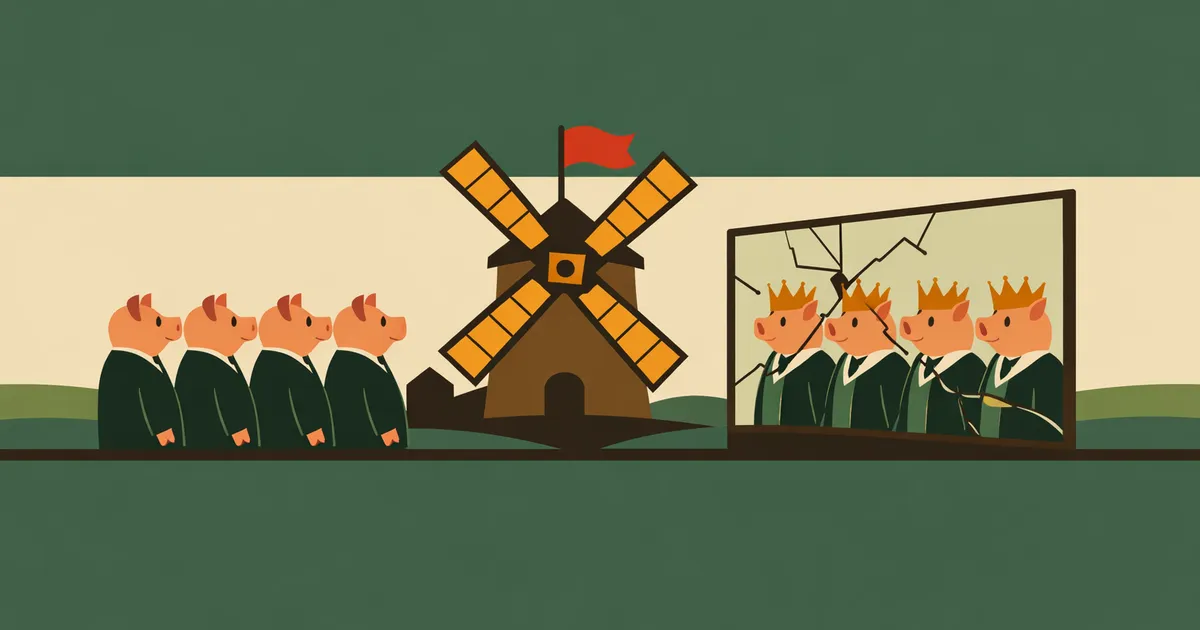
"The creatures outside looked from pig to man, and from man to pig, and from pig to man again; but already it was impossible to say which was which."
Speaker: Narrator (Chapter X)
This is the novella's final sentence. The animals are peering through the farmhouse window at a dinner party where Napoleon and the neighboring human farmers are playing cards and drinking together. A quarrel breaks out over a game -- both Napoleon and Pilkington have played an ace of spades -- and as the animals watch the shouting faces, they can no longer tell the pigs apart from the humans. The revolution has come full circle. The new rulers have become indistinguishable from the old ones.
Orwell ends the novella not with a bang but with a perceptual collapse. The sentence's rhythm -- "from pig to man, and from man to pig, and from pig to man again" -- enacts the confusion it describes, rocking the reader back and forth between the two categories until the distinction dissolves. The word "already" is crucial: it implies that the transformation was not sudden but gradual, that the animals are only now seeing what has been true for some time. The card game is not the moment the pigs become human; it is the moment the pretense of difference finally becomes unsustainable.
The quarrel over the ace of spades adds a final, bitter layer. Even in their alliance, pigs and humans cheat each other -- they are united by exploitation but divided by greed. Orwell denies the reader any consolation that the new order might at least be stable. The ruling classes will always fight among themselves over the spoils, and the creatures outside the window -- the working animals, the ordinary citizens -- will always be the ones who pay for it. The novella offers no redemption, no awakening, no hint that the animals will ever break free. It closes not with a moral but with a diagnosis, and the reader is left standing outside that window alongside Clover and Benjamin, watching the faces blur.