Themes & Motifs
The Corruption of Power
Animal Farm's central argument is not that revolutions fail -- it's that power, once concentrated, follows a specific trajectory toward abuse regardless of the ideals that brought it into being. The pigs begin as organizers and educators, translating Old Major's vision into a workable system. Within weeks they've claimed the milk and apples for themselves. Within months Napoleon has raised a private army. Within a year he's executing dissenters. The speed of this descent matters: Orwell compresses the arc of the Russian Revolution into a single farm's calendar to show how quickly high-minded leadership curdles into tyranny when no structures exist to check it.
What makes the corruption so effective as a narrative engine is that no single step feels dramatic enough to provoke resistance. The pigs don't seize power in one move. They take the milk. Then the apples. Then the farmhouse. Then the beds. Then the alcohol. Each grab is small enough to rationalize, and Squealer is always there with an explanation that sounds just plausible enough. By the time Napoleon is walking on two legs and carrying a whip, the animals have been conditioned through dozens of minor capitulations to accept the unthinkable.
Orwell structures the novella so that Napoleon's rise follows a pattern of institutional capture rather than simple force. The key turning point is Chapter V, when the nine dogs -- raised in secret from Jessie and Bluebell's puppies -- chase Snowball off the farm at the precise moment democratic debate is about to deliver a verdict Napoleon would lose. The scene unfolds with merciless economy: Snowball is mid-speech, the audience is persuaded, and then physical force makes all of it irrelevant. But Napoleon does not rule by force alone after this moment. He dismantles the Sunday Meetings, centralizes decisions in a committee of pigs, and installs old Major's skull as an object of ritualized reverence -- converting revolutionary memory into an instrument of obedience.
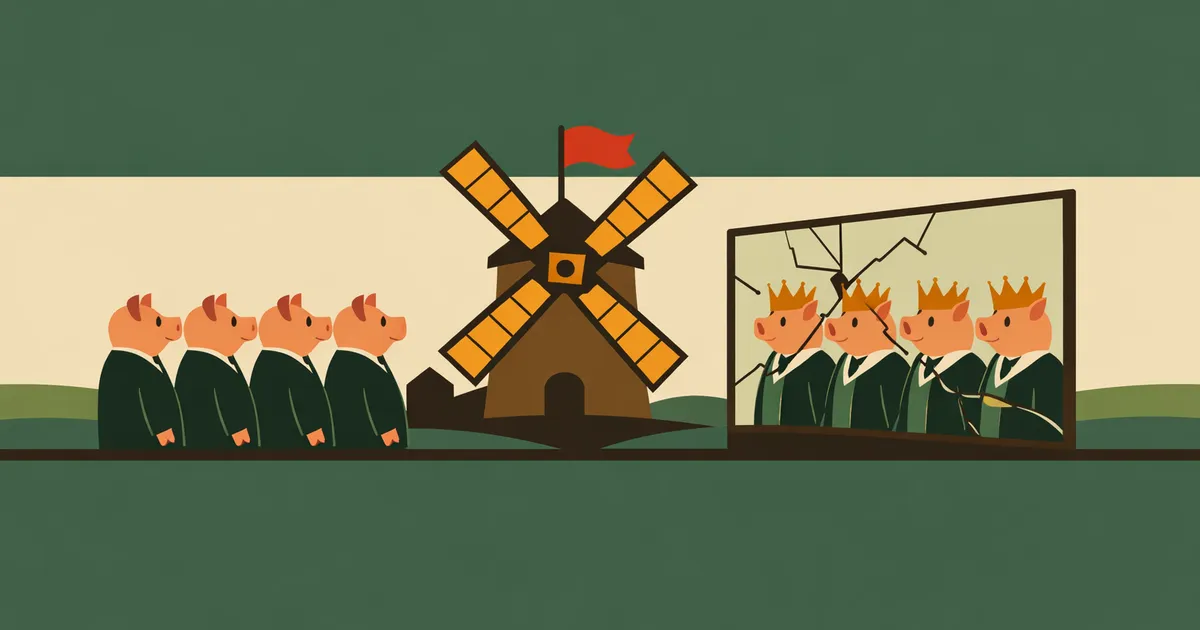
The subtlety of Orwell's portrayal lies in how Napoleon consolidates power through bureaucracy and habit rather than through constant violence. After the initial purges of Chapter VII, terror becomes ambient rather than active. The dogs are always present but rarely need to attack. Napoleon retreats into the farmhouse, issues orders through intermediaries, and cultivates an elaborate cult of personality -- the titles ("Father of All Animals, Ducklings' Friend"), the poem by Minimus inscribed on the barn wall, the gun fired on his birthday. These rituals serve a precise political function: they replace the animals' relationship with their own revolution with a relationship to a single leader. The transition from "All animals are equal" to "All animals are equal, but some animals are more equal than others" is not a sudden betrayal but the final articulation of a process that began the day Napoleon stood in front of the milk buckets and said, "Never mind the milk, comrades."
Orwell drew directly on the trajectory of Stalin's Soviet Union, but the novella's power extends beyond that specific allegory. The pattern it describes -- idealistic revolution, consolidation by a small cadre, elimination of rivals, rewriting of foundational principles -- has repeated across enough political contexts that the book functions less as historical satire than as a structural diagram of how power corrupts collective movements from within.
Language as a Weapon
Squealer is described, on his first appearance, as a pig who "could turn black into white." That reputation turns out to be less a joke than a literal job description. While Napoleon's dogs enforce obedience through violence, Squealer enforces it through something harder to resist: he makes the animals doubt their own perceptions. When the Commandments are altered, Squealer does not argue that the changes are justified. He asks whether the animals are "certain that this is not something that you have dreamed." The question targets not their opinions but their memory, their grasp on what is real.
Consider how many forms of linguistic manipulation Orwell packs into this slim novella. Squealer tells outright lies -- Snowball was always a traitor, the van marked "Horse Slaughterer" actually belonged to a veterinarian. He deploys euphemisms -- ration cuts become "readjustments." He recruits the sheep as biological loudspeakers, their endless bleating of "Four legs good, two legs bad" filling the space where debate might occur and drowning out every attempt at dissent. Squealer's speeches invariably end by invoking the specter of Jones's return, collapsing every question about the present into a binary choice between the current regime and the old one.
Orwell understood propaganda not merely as lying but as the control of the framework within which truth and falsehood are evaluated. Squealer's most devastating technique is not fabrication but the manipulation of categories. When the pigs move into the farmhouse and sleep in beds, the Fourth Commandment acquires the words "with sheets." Squealer then redefines "bed" itself: "A bed merely means a place to sleep in. A pile of straw in a stall is a bed, properly regarded." The logic is circular and unanswerable because it operates at the level of definition rather than argument. The animals cannot contest it because they lack the linguistic sophistication to identify the sleight of hand, and because the only written record of the original Commandment -- the barn wall -- has already been altered.
The abolition of "Beasts of England" in Chapter VII represents the regime's most strategically significant act of linguistic control. The song is banned immediately after the mass executions, at the moment when the surviving animals most need a shared vocabulary of dissent. Squealer declares that "the Rebellion is now completed" and that the song "has no longer any purpose" -- a claim that simultaneously declares the revolution finished and strips the animals of the one text that connected them to its original vision. The replacement hymn, Minimus's vapid composition praising Napoleon, performs the opposite function of "Beasts of England": where the old song expressed collective aspiration, the new one channels all feeling toward a single leader.
The culmination of this process arrives in Chapter IX, when Squealer reads out lists of figures "proving" that production has increased by hundreds of percent while the animals grow visibly thinner. The narrator observes, with devastating restraint, that "the animals saw no reason to disbelieve him, especially as they could no longer remember very clearly what conditions had been like before the Rebellion." This is not stupidity. It is the engineered outcome of a regime that has systematically degraded every independent source of knowledge -- historical memory, written records, shared songs, even the meaning of individual words -- until Squealer's statistics are the only framework left.
The Betrayal of the Working Class
Boxer gets up earlier than anyone else and goes to bed later. He hauls stone for the windmill by moonlight. He volunteers for every task and takes the hardest share of every burden. And when his lungs finally collapse at the quarry, Napoleon sells him to the knacker. Orwell's portrait of the laboring body under a system that extracts maximum value while offering nothing in return centers almost entirely on this one horse. His two mottos -- "I will work harder" and "Napoleon is always right" -- represent the twin pillars of his exploitation: physical dedication and political trust. Every time the farm faces a crisis, Boxer's response is to get up earlier, haul more stone, push harder. He never questions whether the crisis was manufactured, whether the labor is fairly distributed, or whether his sacrifices benefit anyone besides the pigs. His loyalty is total, and the system repays it by selling him to the knacker when his lungs give out.
The other animals fare little better. The hens are forced to surrender their eggs -- an act they call murder -- and when they resist, Napoleon starves them until nine die. The general population works sixty-hour weeks on declining rations while the pigs grow fat on milk, apples, and eventually beer and whisky. By Chapter X, Pilkington toasts the pigs for achieving "lower rations and longer working hours than any farm in the county." The revolution that promised liberation from exploitation has produced exploitation more efficient than anything Jones managed.
Orwell was a democratic socialist, and Animal Farm is often misread as an anti-socialist text when it is more precisely an indictment of how revolutionary movements betray their working-class base. The novella tracks a specific economic pattern: the surplus value that once went to Jones now goes to the pigs, and the workers' material conditions remain unchanged or worsen. The windmill -- Snowball's utopian project promising electricity, mechanization, and a three-day work week -- is eventually built, but it mills corn for profit rather than generating the power that would have eased the animals' labor. The dream of liberation through technology becomes, in the pigs' hands, simply a more sophisticated means of extraction.
Boxer's death in Chapter IX is the novella's most emotionally concentrated expression of this theme. He collapses at the quarry, his lungs destroyed by years of overwork, still murmuring about seeing the windmill completed. When the van from "Alfred Simmonds, Horse Slaughterer and Glue Boiler" arrives, Benjamin breaks his lifelong silence to read the lettering aloud -- the single moment in the book when the cynical observer acts on his knowledge, and it changes nothing. Squealer's subsequent lie -- that the van had been bought by a veterinary surgeon who hadn't yet repainted it -- is accepted by the animals. Days later, a crate of whisky is delivered to the farmhouse. Orwell leaves the connection unstated, trusting the reader to complete it: Boxer's body has been converted into the pigs' pleasure. The system does not merely fail its most devoted adherent; it literally consumes him.
The structural parallel between the animals' condition under Jones and their condition under Napoleon is made explicit in the final chapter, when the farm is described as "more prosperous now, and better organised" while "somehow it seemed as though the farm had grown richer without making the animals themselves any richer." The animals' lives are unchanged: "They were generally hungry, they slept on straw, they drank from the pool, they laboured in the fields; in winter they were troubled by the cold, and in summer by the flies." The revolution has rotated the personnel at the top without altering the structure beneath.
The Erasure of Memory
In Chapter VIII, Squealer is found at the base of the barn wall at midnight, stunned from a fall, with a ladder, a lantern, and a pot of white paint beside him. Benjamin stares at the scene and says nothing. The other animals "could form no idea as to what this meant." That image -- the regime literally repainting reality in the dark -- captures a theme that runs deeper than propaganda. It is a deliberate campaign to make the population incapable of comparing their present to any alternative -- including the one they themselves once lived. The Commandments are altered incrementally. The history of the Battle of the Cowshed is rewritten until Snowball, who led the defense, becomes a traitor who fought on Jones's side. "Beasts of England" is banned. And by the final chapter, "there was no one who remembered the old days before the Rebellion, except Clover, Benjamin, Moses the raven, and a number of the pigs." The pigs remember, of course. They choose not to share.
This theme is easy to miss on a first reading because Orwell embeds it in small, almost casual details rather than dramatic set pieces. When Clover goes to check the Fourth Commandment and finds the added words "with sheets," she "had not remembered that the Fourth Commandment mentioned sheets; but as it was there on the wall, it must have done so." The moment is devastating in its quietness. Clover's own experience tells her something is wrong, but the written record -- which the pigs control -- overrides her memory, and she lacks the literacy to identify the discrepancy independently.
Orwell positions literacy as the decisive factor in the power imbalance between the pigs and the other animals. The pigs "could already read and write perfectly." Boxer never gets past the letter D. The sheep cannot learn the Seven Commandments at all and are given the simplified slogan "Four legs good, two legs bad" -- which Squealer later teaches them to replace with "Four legs good, two legs better" when the political requirements shift. The barn wall, where the Commandments are inscribed, functions as the farm's only constitutional document, and because the pigs alone can write, they hold a monopoly on its contents. The scene in Chapter VIII where Squealer is found at the base of the barn wall at midnight, stunned from a fall, with a ladder, a lantern, and a pot of white paint beside him, is Orwell at his most mordantly funny. Benjamin nods knowingly and says nothing. The other animals "could form no idea as to what this meant."
The cumulative effect of memory erasure is visible in the final chapter's remarkable passage about the animals' relationship to their own history. They "racked their dim memories and tried to determine whether in the early days of the Rebellion, when Jones's expulsion was still recent, things had been better or worse than now. They could not remember." The only standard of comparison available to them is "Squealer's lists of figures, which invariably demonstrated that everything was getting better and better." Orwell is describing a population that has been cut off from the empirical basis for political judgment. They cannot evaluate the present because the past has been made inaccessible -- not through some dramatic act of censorship but through the slow, grinding erosion of every independent record, every shared story, every song that might have anchored their collective memory to something the regime did not control.
The historical parallel to Stalinist historiography is direct: the Soviet regime famously airbrushed purged officials from photographs and rewrote encyclopedias to reflect current political orthodoxy. But Orwell's treatment transcends the specific allegory. The animals' predicament -- knowing that something is wrong without being able to articulate what, or prove it, or even fully remember it -- captures a universal condition of populations under information control. Clover's inarticulate grief on the knoll after the executions, where "she lacked the words to express" what she felt, is not a failure of intelligence. It is the intended product of a system designed to leave its subjects without the conceptual tools to resist.
The Complicity of the Bystander
Benjamin the donkey sees everything and says nothing. He is the most intelligent animal on the farm after the pigs -- he can read as well as any of them -- and he understands from the beginning that the revolution will change nothing. "Donkeys live a long time. None of you has ever seen a dead donkey," he tells the others when asked if things have improved. His cynicism is proven right at every turn. And yet his refusal to act makes him complicit in the very outcomes he predicts. He breaks his silence exactly once, galloping after the van that carries Boxer to the knacker, screaming at the animals to read the lettering on its side. It is the most dramatic moment of his life, and it accomplishes nothing.
Benjamin represents a type Orwell found almost as dangerous as the tyrant: the intelligent observer who opts out. But the novella distributes complicity more broadly than that. The sheep bleat on cue, drowning out dissent at every critical moment -- not because they understand what they're doing, but because they've been conditioned to respond. Mollie defects to the human world for sugar and ribbons. The cat votes on both sides of the rats question and vanishes whenever work or political commitment is required. Even Clover, who senses that things have gone terribly wrong, concludes after the purges that "before all else it was needful to prevent the return of the human beings" and resolves to "remain faithful, work hard, carry out the orders that were given to her, and accept the leadership of Napoleon." Each animal has reasons. None of those reasons prevent the catastrophe.
Orwell constructs the farm's population as a taxonomy of political responses to authoritarianism, and the novella's pessimism lies in the fact that none of them -- not resistance, not loyalty, not cynicism, not disengagement -- proves adequate. Boxer's absolute loyalty gets him sold to the glue factory. The four young porkers who protest the abolition of the Meetings are dragged before Napoleon in Chapter VII and have their throats torn out. Benjamin's knowing silence preserves his life but costs him the one relationship he values. The hens' rebellion is crushed by starvation. Orwell is not arguing that resistance is futile in some abstract sense; he is showing that once a regime has consolidated its monopoly on force and information, the individual responses available to subjects are all insufficient.
The sheep deserve particular attention as an instrument of complicity. Their bleating of "Four legs good, two legs bad" begins as a genuine if simplistic expression of Animalist principles, but it is weaponized almost immediately. In Chapter V, when the four young porkers try to protest Napoleon's abolition of democratic debate, "the sheep broke out into a tremendous bleating of 'Four legs good, two legs bad!' which went on for nearly a quarter of an hour and put an end to any chance of discussion." The sheep are not co-conspirators. They are a tool -- biological noise machines that the pigs deploy to fill the silence where political thought might otherwise occur. Their final transformation, chanting "Four legs good, two legs better!" after Squealer's week of private coaching, reveals the full cynicism of how the regime uses the most credulous members of the population as instruments against the rest.
The novella's final image -- the animals watching through the farmhouse window as pigs and humans play cards, unable to distinguish between them -- implicates the bystanders one last time. The animals "crept silently away" when the quarrel breaks out, returning to their stalls, their turnip fields, their unchanged lives. They have watched the entire transformation from liberation to re-enslavement, and they are still watching. Orwell offers no redemption arc, no moment of collective awakening. The bystanders remain bystanders. The revolution eats itself. And the creatures outside look from pig to man, and from man to pig, and already it is impossible to say which is which.