Context
About the Author
George Orwell was the pen name of Eric Arthur Blair, born in 1903 in Motihari, British India, to a family employed in the colonial civil service. He returned to England as a young child and was educated at Eton, but rather than attending university he joined the Indian Imperial Police in Burma -- an experience that left him with a deep hatred of imperialism and class systems. By his late twenties he had abandoned colonial service to become a writer, deliberately immersing himself in poverty (documented in Down and Out in Paris and London, 1933) and traveling to the industrial north of England to witness working-class conditions firsthand (The Road to Wigan Pier, 1937). Orwell was a committed democratic socialist who despised totalitarianism in all its forms, and that double commitment -- to equality and to individual freedom -- runs through everything he wrote. Animal Farm, published in August 1945, was the book that made him famous, though he had been writing novels, essays, and journalism for over a decade.
The experience that most directly shaped Animal Farm was Orwell's participation in the Spanish Civil War. In late 1936, he traveled to Spain to fight against Franco's fascists and joined the POUM militia, a small Marxist group allied with the anarchists. He was shot through the throat by a sniper and nearly killed. But the wound was not what radicalized him most -- it was watching the Soviet-backed Communist Party suppress its own allies on the Republican side, arresting and executing members of the POUM on fabricated charges of fascist collaboration. Orwell and his wife Eileen barely escaped Spain alive. That firsthand encounter with Stalinist methods -- the lies, the show trials, the rewriting of history -- gave Animal Farm its emotional core and its forensic understanding of how revolutionary movements devour themselves.
Orwell's political writing after Spain became increasingly focused on the gap between socialist ideals and Soviet reality, a distinction that much of the British left in the 1930s and 1940s refused to acknowledge. Homage to Catalonia (1938), his memoir of the Spanish war, documented how the Communist Party's official narrative of events in Barcelona bore almost no resemblance to what he had witnessed. The experience taught him something that became central to Animal Farm: that the control of information is the first and most essential tool of authoritarian power. When Squealer rewrites the Commandments or declares that Snowball was always a traitor, Orwell is drawing directly on his experience of watching newspapers print accounts of events he knew to be fabricated.
Animal Farm sits between the documentary realism of Orwell's 1930s work and the full-scale dystopian vision of Nineteen Eighty-Four (1949), and it draws from both modes. The two books attack the same problem from opposite angles: Animal Farm shows how a free society becomes totalitarian through incremental betrayals, while Nineteen Eighty-Four depicts the finished product -- a state where the process is already complete and resistance is nearly impossible. Orwell's choice of the fable form for Animal Farm was deliberate and strategic. He wanted a text that could reach readers who would never pick up a political treatise, and he wanted it short enough that its argument would be impossible to evade. The fairy-tale simplicity of the prose -- short sentences, concrete images, no psychological interiority -- is not a concession to a popular audience but a literary choice that forces the political argument to emerge from action rather than commentary. Orwell described the book in his 1946 essay "Why I Write" as the first work in which he had succeeded in fusing political purpose with artistic purpose, and that fusion is what gives Animal Farm its lasting power.
Historical Background
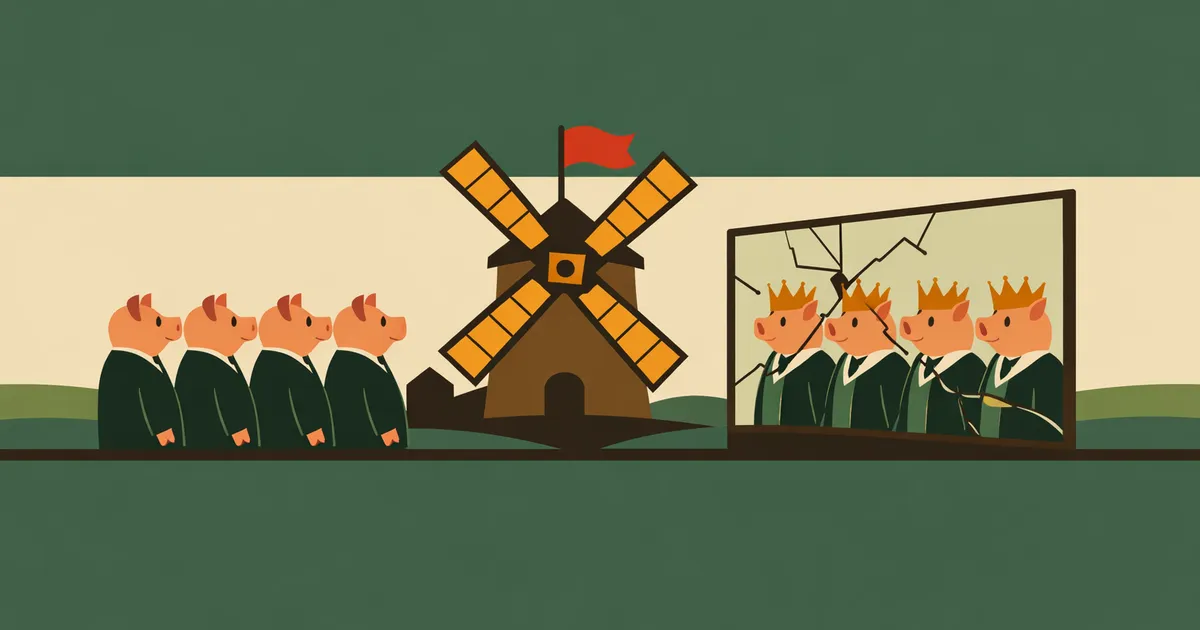
Animal Farm is a direct allegory of the Russian Revolution of 1917 and its aftermath under Joseph Stalin. The parallels are specific: Old Major represents a composite of Karl Marx and Vladimir Lenin, Napoleon maps onto Stalin, Snowball onto Leon Trotsky, and the arc from revolutionary idealism to totalitarian nightmare follows the trajectory of Soviet history from roughly 1917 to the Tehran Conference of 1943. Orwell began writing the book in November 1943, at a moment when the Soviet Union was Britain's indispensable wartime ally against Nazi Germany. Stalin was "Uncle Joe" in the British press, and criticism of the USSR was treated as practically treasonous. This political climate made the book extraordinarily difficult to publish -- four major publishers rejected it, including Victor Gollancz (Orwell's usual publisher) and Jonathan Cape, who accepted it and then reversed the decision after consulting the Ministry of Information. T.S. Eliot, rejecting it on behalf of Faber and Faber, wrote that the book's problem was not its quality but its politics: he found it unconvincing that the pigs should be the villains, suggesting that what was needed was "more public-spirited pigs."
Orwell finally placed the book with the small publisher Secker and Warburg, and it appeared in August 1945 -- just as the war ended and the wartime alliance with the USSR began to fracture. The timing proved perfect. Within months, Churchill delivered his "Iron Curtain" speech, the Cold War began in earnest, and Animal Farm became a bestseller on both sides of the Atlantic. By 1947, it had been translated into dozens of languages, and the CIA later covertly funded an animated film adaptation in 1954. The book Orwell struggled to publish because it criticized the left's sacred cow became, somewhat ironically, a weapon of the political right during the Cold War -- a use that would have appalled him.
The allegorical correspondences between Animal Farm and Soviet history reward close attention. The Battle of the Cowshed parallels the Russian Civil War and foreign interventions of 1918-21, while Napoleon's expulsion of Snowball mirrors Stalin's exile of Trotsky in 1929. Two correspondences are worth developing in detail. The mass confessions and executions in Chapter VII map onto the Moscow show trials of 1936-38, in which old Bolsheviks confessed to absurd charges before being shot -- and Orwell captures the psychological surrealism of the events with particular force, staging them as a scene of almost ritual violence that the animals witness but cannot comprehend. The deal with Frederick (who represents Hitler) and his subsequent attack on the farm parallels the Molotov-Ribbentrop Pact and the Nazi invasion of 1941, and Orwell's treatment here is especially sharp: Napoleon's insistence that the banknotes were genuine, even as they are revealed as forgeries, dramatizes the humiliation a regime suffers when its own propaganda backfires. The windmill's destruction and rebuilding tracks Stalin's Five-Year Plans, and the final card game mirrors the fraying alliance between the USSR and the Western powers at Tehran and Yalta.
The book's reception history reveals how thoroughly political context shapes literary interpretation. During the Cold War, Animal Farm was read primarily as an anti-communist text, championed by conservatives and distributed by Western intelligence agencies as propaganda. This reading, while not wrong, is incomplete -- Orwell was attacking Stalinism specifically, not socialism broadly, and he wrote a preface (unpublished in his lifetime) titled "The Freedom of the Press" that criticized not Soviet censorship but British self-censorship, the voluntary suppression of inconvenient truths by a supposedly free media. In postcolonial criticism, scholars have noted that the fable's framework -- animals as an oppressed class exploited by humans -- carries uncomfortable echoes of colonial and racial hierarchies that Orwell, despite his anti-imperialism, did not fully interrogate. More recently, the book has been read as a study of how language constructs political reality, a theme that connects it to contemporary concerns about propaganda, disinformation, and the erosion of shared factual ground. Each generation finds in Animal Farm the version of political corruption most relevant to its own moment, which is precisely why the book has outlasted the specific historical events that inspired it.