Characters
Gene Forrester
Gene is the narrator, and the narrator has a problem: he is also the villain. When the book opens, he is a man in his early thirties who has driven back to the Devon School in bad November weather to look at a tree and a staircase. Fifteen years earlier, during the summer of 1942, he was a sixteen-year-old scholarship type — quick, watchful, a little sarcastic, more comfortable with a Latin text than on a playing field. He was also Phineas's roommate and, in his own secret reading of things, Phineas's rival. Everything he tells us is filtered through the guilt he has spent fifteen years trying to metabolize. When he describes Finny's charisma, he is always also describing the pressure that charisma put on him. When he describes the summer session, he is always also describing the mental bookkeeping — Finny is winning at sports, so I must win at grades — that led him to jounce a limb.
Gene's defining trait is a gap between what he says and what he means. He calls 1942 "my sarcastic summer" and then admits, a page later, that sarcasm is "the protest of people who are weak." He is always catching himself like this, a beat late, after the damage. The novel's quiet engine is Gene's slow, reluctant movement from self-deception to self-knowledge.
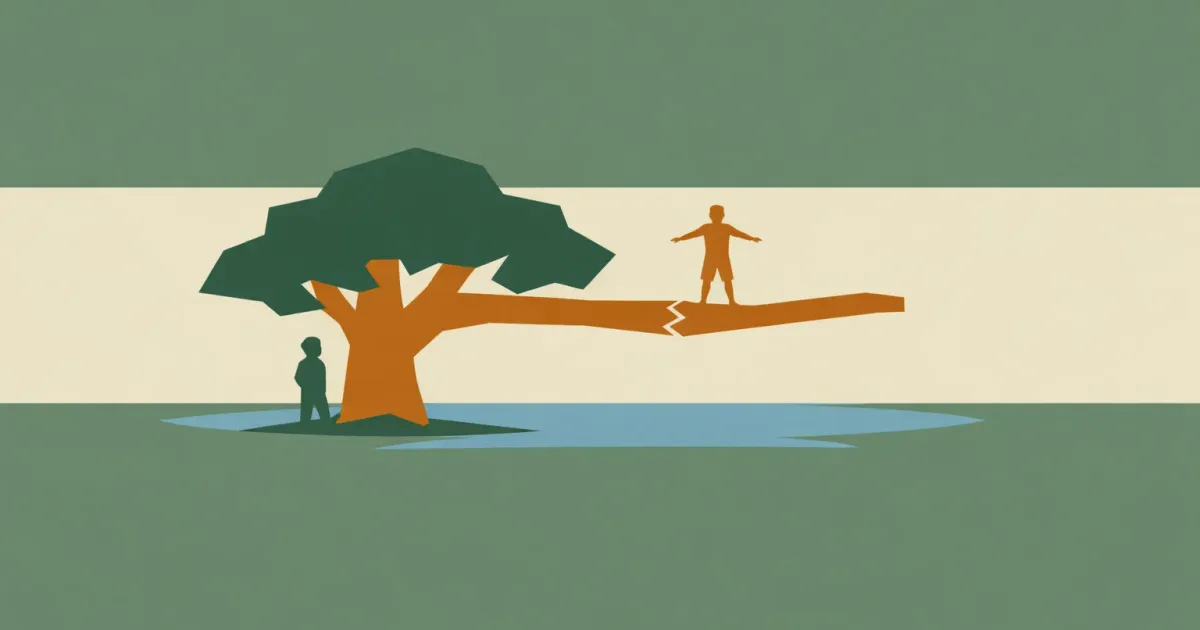
Gene's arc is the novel. He begins it believing Finny is his enemy; he ends it understanding that he was Finny's. The hinge is the confession scene in Boston, where he tells Finny flatly, "I jounced the limb. I caused it. I deliberately jounced the limb so you would fall off," and Finny refuses to accept it — "You damn fool. Sit down, you damn fool." Knowles uses that refusal to trap Gene inside his own guilt for another year. Because Finny will not play the role of accuser, Gene cannot play the role of penitent, and the confession goes stale inside him. It finally comes out again in the Infirmary, reworded: "some ignorance inside me, some crazy thing inside me, something blind." The revision is Gene's whole moral progress in a single phrase. He has stopped claiming he hated Finny — a claim that preserves a kind of coherent, manageable self — and started naming something harder, an ignorance that acted without his permission.
Gene's relationship with Finny is one of the most psychologically precise portraits of adolescent envy in American fiction, and Knowles refuses to let it settle into a simple explanation. When Gene puts on Finny's pink shirt after the accident and stares at the mirror — "I was Phineas, Phineas to the life" — Knowles shows how envy and love can share a single motion. Gene doesn't only want to beat Finny; he wants to be him, and when that proves impossible, he wants to destroy him, and when that proves impossible, he wants to become him another way, by taking on sports at Finny's direction. The novel's most devastating line about Gene may be his own retrospective admission: "there was always something deadly lurking in anything I wanted, anything I loved. And if it wasn't there, as for example with Phineas, then I put it there myself."
Gene's narration is famously unreliable but unreliable in an unusual direction. He does not hide the facts from the reader; he hides them from himself, and the reader watches the seal crack. The adult voice that opens and closes the book is older, calmer, and aware that "wars were not made by generations and their special stupidities, but that wars were made instead by something ignorant in the human heart." That line is Gene's verdict on himself — the private war he killed his enemy in was the one he fought against Phineas, and he has been living inside its aftermath ever since.
Phineas (Finny)
Finny is the best athlete in the school, the best conversationalist in any room, and the only character in the book who seems to be genuinely at home in his own body. He is sixteen and moves, Gene tells us, not like someone walking but like someone flowing. He invents rules to break and then breaks them with such charm that even the substitute headmaster laughs when caught. He wears a pink shirt as an "emblem" of American bombing raids. He uses the Devon School tie as a belt. He breaks the school swimming record on a whim and refuses to let Gene tell anyone. He invents the Super Suicide Society of the Summer Session and requires its members to jump from a forbidden tree over the river. None of this reads as show-off: Finny has almost no self-consciousness. He does what occurs to him, and what occurs to him turns out to be, nearly every time, more interesting than what anyone else is doing.
What makes Finny matter, though, isn't his charm — it's his refusal to see enemies. When Gene confesses in Boston that he deliberately jounced the limb, Finny shouts him down. It is not that he disbelieves the facts; it is that he cannot organize the world in a way that contains them.
Finny is the novel's vision of prelapsarian innocence, and the book is the story of how that innocence is destroyed. Knowles is careful to make Finny morally complicated — he breaks rules constantly, he lies smoothly to adults, he bullies Gene into stunts he doesn't want to do — but the one thing Finny cannot do is register malice in another person. Gene catches this when he notices, after the fall, that Finny is "too loyal to anything connected with himself" to imagine his roommate had pushed him. That loyalty is simultaneously Finny's most attractive quality and his fatal flaw. It keeps him from protecting himself against the one person positioned to hurt him most.
Finny's arc is a long, excruciating concession to reality. In the summer he jumps from the tree. In the fall he breaks his leg and is sent home. In the winter he returns on crutches and builds, with Gene, an elaborate shared fiction: that the war is a hoax perpetrated by "fat old men," that the 1944 Olympics will happen on schedule, that he can train Gene to compete in his place. That fiction runs the Winter Session — Gene running predawn laps around an elm, Finny coaching from below. It cracks once, quickly, in the locker room when Gene asks why Finny alone has seen through the war and Finny snaps out, "Because I've suffered." It cracks for good when Gene tells him about Leper's breakdown. "When I heard that about Leper, then I knew that the war was real, this war and all the wars." After that, Finny abandons the fantasy in a single ironic sentence — "Sure. There isn't any war" — and Knowles marks it as the death of the book's last protected space.
Finny's death is written with deliberate flatness. Dr. Stanpole describes the mechanism in dry medical vocabulary — marrow entered the bloodstream and stopped the heart — and refuses to give it any larger meaning. "There is only one explanation," he says, and then says it twice. The effect is devastating precisely because the novel has spent so long making Finny seem mythic. He survives the fall from the tree. He survives the cast, the operation, the long convalescence. He does not survive the ordinary complications of a minor second break, and the ordinariness is the point. The closing chapter reframes him as the one person in the book "who never was afraid," the one person who "never hated anyone," and therefore the one person who had no defense against an enemy he could not see. Gene's closing grief is not just for a friend; it is for a whole way of being in the world that the war, and Gene, took out of it.
Brinker Hadley
Brinker is the class operator — the politicking, confident senior who runs clubs with names like the Golden Fleece Debating Society and has keys to buildings he has no business being in. He is the sort of boy who plants himself at the center of things because he cannot imagine not being the center of things. When Gene returns to Devon in the fall, Brinker has taken Leper's old suite for his "headquarters," complete with files and visitors. His roommate, Gene notes, is a frightened boy named Brownie Perkins who will never intrude on him. Almost everyone at Devon likes Brinker. He is funny in a dry, senatorial way — he writes a poem called the Shortest War Poem Ever Written, "The War / Is a bore" — and he takes his own authority absolutely for granted.
That assumption is what makes him dangerous to Gene. Brinker arrives at the theory that Gene engineered Finny's accident almost the first day of fall term, and he pursues it the way he pursues everything else: with the breezy confidence that he is performing a civic duty.
Brinker functions as the novel's prosecutor — the character whose role is to force the question of what really happened in the tree out into public air. Knowles gives him genuine intelligence. His wisecrack in the Butt Room about Gene "doing away with his roommate so he could have a whole room to himself" is phrased as a joke, but it is phrased as a joke he already knows is accurate, and he watches Gene closely while delivering it. His later decision to stage an amateur tribunal in the Assembly Hall — complete with graduation robes, a prayer to open, and questioners on a platform — is theater, but it is theater modeled on institutions he genuinely believes in. The novel is careful to make his motives legible and partly decent. He tells Gene it needs to be done "for Finny's good" and "for your own good," and within his own moral grammar, this is true.
What damns Brinker is the same thing that makes him effective: his inability to imagine that knowing might cost something. Gene reflects during the trial that Brinker "imagines himself Justice incarnate, balancing the scales" but has "forgotten that Justice incarnate is not only balancing the scales but also blindfolded." The critique lands because Brinker, unlike Gene, never doubts his own motives. When the inquiry ends in catastrophe — Finny's second fall on the marble stairs — Brinker is the one who has the composure to organize the rescue, and the novel gives him credit for it. But he is also the one who has loaded the gun, and Knowles does not let him forget it. In the closing chapters Brinker has shed his political ambitions, turned sour on his own father's chest-beating patriotism, and agreed to enlist in the Coast Guard the way one agrees to a punishment. The cynicism Gene once found charming has curdled into something smaller. Brinker, Gene eventually concludes, is one of the boys who "developed a careless general resentment" against the enemy he had to construct in order to survive. He is the novel's verdict on a certain kind of well-meaning institutional confidence — the boy who thinks a trial will clarify and instead destroys.
Elwin "Leper" Lepellier
Leper is the oddity of the class, gently mocked, mostly ignored, the boy who sketches birds in his notebook during chapel and spends the summer collecting snails. In the fall he skis alone across snow-covered fields looking for a beaver dam. He collects, watches, annotates. Everyone calls him Leper — not to his face as a cruelty, but because he has forgotten to answer to anything else. He is one of the most delicately drawn minor characters in mid-century American fiction, and his importance to the novel turns out to be wildly disproportionate to the amount of space he occupies in it.
What happens to Leper is the single most violent event in the book, and Knowles never puts it on a battlefield. Leper watches a ski-troop recruiting film and walks off campus into a uniform. A few months later he sends Gene a telegram saying he has "escaped." What he has escaped from is not the enemy but the army itself, which has taken him apart faster than anyone would have guessed.
Leper is the novel's early warning system — the character through whom the war actually enters the text. Knowles structures his progression as a series of small, understated moments. He is the only student who doesn't volunteer for the railroad-shoveling day because he has not bothered to listen to the announcement. He is the first of the class to enlist. He is the first to return, broken. The Vermont scene in which Gene visits him is arguably the novel's most harrowing sequence — the chilled dining room, the involuntary twitch of Leper's upper lip, the catalog of hallucinations at the Reception Center: the inedible food, the coughing man in the next cot, the corporal's face dissolving into a woman's face, a broom turning into a severed leg. When Gene asks what happened to him, Leper tells him about basic training in the flat, diagnostic vocabulary he has just learned — "psycho," "Section Eight," "nervous in the service" — and the language itself is part of what has broken him.
Leper is also the only character in the novel willing to say the thing everyone else has been avoiding. When Gene loses his temper, Leper looks at him steadily and delivers a verdict: "You always were a savage underneath. I always knew that only I never admitted it." A paragraph later he names the crime directly: "like that time you knocked Finny out of the tree." Gene kicks his chair over and runs, but the diagnosis is accurate and Leper is the only person in the book who makes it. Knowles is doing something sly here. The character everyone dismissed as harmless and ineffectual turns out to be the novel's truest witness. When Brinker hauls him into the Assembly Hall to testify at the trial, Leper's description of the two figures on the limb moving "like an engine" — first one sinks, then the other falls — is simultaneously a breakdown and a direct view of what happened. His madness is the only thing in the book capable of speaking the truth plainly, because he has lost the social reflex that keeps everyone else from saying it. He ends the novel as the one casualty the war has produced in Gene's circle before any of them reach the front, proof that the enemy has ways of getting at people long before they meet it in a uniform.
Cliff Quackenbush
Quackenbush is a small role with an outsized thematic function. He is the crew manager, a boy with a "firmly masculine" manner and a surname no one bothers to soften into a nickname, already thoroughly disliked by the time Gene meets him. When Gene turns up late to the Crew House in the fall, Quackenbush, who has sensed something to push against, pushes. Within minutes he has called Gene a "maimed son-of-a-bitch," and Gene, in the one scene where he physically acts out the guilt he cannot yet speak, hits him in the face and ends up wrestling him into the Naguamsett River.
Knowles uses Quackenbush to make explicit something the novel otherwise handles indirectly. Gene narrates the fight plainly: "I fought that battle, that first skirmish of a long campaign, for Finny. Until the back of my hand cracked against Quackenbush's face I had never pictured myself in the role of Finny's defender." But the admission that follows is the important one: "it didn't feel exactly as though I had done it for Phineas. It felt as though I had done it for myself." The fight is Gene's first recognition that the word "maimed" touches him personally — that he has already done something that makes him someone who hits back when the word is thrown around carelessly. Quackenbush, disliked for reasons neither boy can quite articulate, is the first mirror the winter hands Gene.
In the novel's closing meditation, Gene slots Quackenbush into the catalog of defensive postures: the boy who "strike[s] out at it always and everywhere" at the perceived enemy. He is the book's portrait of reflexive aggression as survival strategy — a boy who has been disliked so long that hostility is the only shape his contact with other people can take. Notably, Quackenbush's war plans are the most calculating of anyone's in the novel. He is cheerfully lining up two appointments to West Point with V-12 and dental school as fallbacks, a kind of cynicism about the war that Finny, for all his wilder theories, never stoops to. Quackenbush is small, but he is the type the book needs: the antithesis of Phineas, proof by contrast of how rare Finny's refusal to hate really was.
Mr. Ludsbury
Mr. Ludsbury is the Winter Session made human — tall, British-voiced, moving through Devon "like a high-masted clipper ship" in a fog. He is the dormitory master, the enforcer of rules that the boys spent the summer comfortably ignoring, and his first appearance in the fall is a small comic masterpiece: he looms at Gene, who is dripping wet from the fight with Quackenbush, and asks whether there has been "a cloudburst in your part of town." He hands down reprimands with a judge's pacing. He is the kind of master Finny takes a personal delight in baffling, as when Finny tells him, without hedging, that the boys are training for the 1944 Olympics and Mr. Ludsbury's face turns brick red.
Ludsbury is the novel's figure of institutional authority, and Knowles treats him with a mix of satire and faint sympathy. He represents the winter Devon — seven hundred boys marshaled into routine, continuity preached from the chapel, "the education of young men according to the unbroken traditions of Devon." When Gene returns in the fall, Ludsbury stands in for everything the summer session had suspended. He is not cruel, only correct, and the novel's quiet joke is that his correctness has no purchase on what is actually happening to the class under his care. He thinks gaming in the dormitory is the problem. He does not know that one of his boys has broken another's leg.
In the closing inventory of defenses against the perceived enemy, Gene places Ludsbury among those who rise above it: "How dare this threaten me, I am much too good for this sort of handling, I shall rise above this." He is the novel's figure of the adult who copes by asserting altitude — by refusing to acknowledge that anything this disorderly could really be happening to a school of this standing. Finny, in one of his stranger moments of insight, diagnoses Ludsbury in a single word: "Too thin." The fat-old-men conspiracy theory cannot account for him, and neither, really, can the novel's more serious machinery. Ludsbury is what happens when authority persists through a crisis by declining to notice it.