Summary
Overview
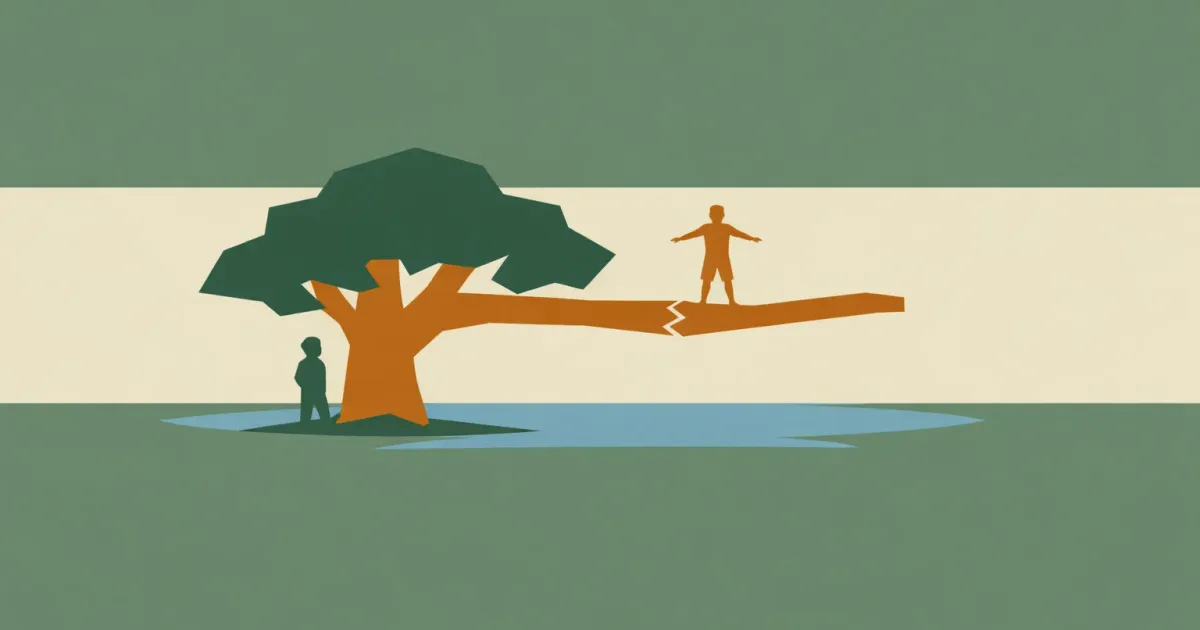
A Separate Peace is the story of a friendship that goes wrong, told by the friend who wrecked it. Gene Forrester, now fifteen years older and visibly unsettled, returns to the Devon School in New Hampshire to look at a tree and a flight of marble stairs. The tree is the one Phineas — "Finny," his roommate and the best athlete in the school — fell from during the summer of 1942. The stairs are where Finny fell the second time. Between those two falls lies almost everything the novel cares about: adolescence, envy, the shadow of World War II, and the private war Gene fights inside himself while the public war is still gathering overseas.
On the surface, it is a boarding-school novel. Boys play games, skip meals, rig elections, invent private clubs, sweat over Latin, get called into the headmaster's parlor. Underneath, it is a confession. Gene opens the book as a middle-aged man trying to understand why, on a bright afternoon on a limb above a river, he jounced the branch and sent his best friend crashing to the ground. The novel is his long, careful answer. Knowles lets Gene tell the story in a voice that is lyrical, guilty, and often unreliable, and one of the book's quiet thrills is watching the narrator catch up to what the reader has already half-guessed.
Knowles was writing, in 1959, about a generation he belonged to — the boys of 1943 who came of age while their older brothers shipped out. The war is everywhere in the book and almost nowhere: distant headlines, a troop train glimpsed through sleet, Leper Lepellier's nervous breakdown at a training camp in Vermont. What Gene eventually grasps is that his "enemy" was never in Europe or the Pacific. He killed his enemy, he tells us, at school.
A Separate Peace sits in the American tradition of the retrospective first-person confession — closer to The Great Gatsby or All the King's Men than to the boarding-school novels it superficially resembles. Knowles's structural gamble is to let his narrator hold off on the central fact for almost a hundred pages. The reader can sense Gene's guilt well before Gene admits it, which gives the middle chapters the queasy suspense of a trial at which the defendant is also the judge. When the admission finally comes — "I jounced the limb. I caused it. I deliberately jounced the limb so you would fall off" — it arrives as release rather than revelation, because Knowles has been loading every earlier scene with evidence.
The novel's most distinctive technical choice is its doubling. Two rivers frame the campus: the freshwater Devon of summer and the saline, tidal Naguamsett of winter. Two falls from the same tree bracket Finny's life. Two wars run through the book, the one everyone is mobilizing for and the one Gene fights alone. The title itself is a double: the "separate peace" is both the enchanted summer session Finny and Gene carve out of wartime America, and the private peace Gene has to make, years later, with what he did. Knowles's sentences often carry this same two-layered quality — a surface meaning for the sixteen-year-old narrator and a sadder meaning audible only to the adult looking back.
Within Knowles's small body of work, A Separate Peace is the outlier that eclipsed everything else. He returned to Devon repeatedly in later novels — most notably in Peace Breaks Out — but never again caught the fusion of myth and memoir that made the first book durable. Its survival on high school reading lists for more than sixty years rests partly on its length and accessibility, but more on the fact that it takes adolescent feeling seriously. Gene's envy is not a stage he grows out of; it is the kind of envy that breaks something permanent.
Summer Session: The Tree and the Fall (Chapters 1–5)
The novel opens with Gene returning to Devon after fifteen years and walking out to the riverside tree that dominated his memory. He finds it smaller and more ordinary than he remembered, and the present-tense frame dissolves into the summer of 1942. Gene is sixteen, rooming with Phineas, and caught up in Finny's gravitational pull. Finny invents the Super Suicide Society of the Summer Session, whose only requirement is a leap from a high branch of the forbidden tree into the river below. He wears a pink shirt as "an emblem" of American bombing raids and talks his way out of trouble by sheer charisma, even when he shows up to a tea at the substitute headmaster's house with the Devon School tie as a belt. He breaks the school swimming record on a whim and refuses to let Gene tell anyone. He drags Gene to the beach for an illegal overnight trip, on which Gene flunks his first trigonometry test.
Gene, quieter and more calculating, begins to suspect Finny of deliberately sabotaging his studies to keep him from being head of the class. The suspicion hardens into a conviction of mutual rivalry. Then one late-August evening, climbing the tree together for a "double jump," Gene bends his knees and jounces the limb. Finny falls to the bank and shatters his leg. Gene visits him first at the infirmary and then, weeks later, at his home outside Boston, where he tries to confess. Finny refuses to believe him — "Of course you didn't do it. You damn fool. Sit down, you damn fool" — and Gene leaves the confession suspended.
These opening chapters establish the novel's Edenic register, which the rest of the book will slowly corrode. Knowles frames the summer session explicitly as an exception — a stopgap program the school runs because of the war, with easygoing substitute masters and only two hundred boys on a campus built for far more. Gene calls this their "gypsy summer," and the language throughout these chapters leans pastoral: the river is clean, the grass is brushed with dew, the six o'clock bell tolls "civilized, calm, invincible, and final." The reader should notice how hard the prose is working to seal this summer off from the rest of the world. When Finny sleeps on his dune at the beach, Gene compares him to Lazarus — the novel's first hint that Finny exists, for Gene, somewhere between boyhood athlete and mythic figure.
The fall from the tree is the novel's hinge, and Knowles stages it with deliberate ambiguity. Gene's single sentence — "my knees bent and I jounced the limb" — is grammatically passive enough to leave room for the self-deception he will practice for the next hundred pages. Was it a conscious act or a "blind impulse"? The question is never fully resolved, and that's the point. The novel's moral interest is not in assigning blame but in watching Gene try to live with a moment he cannot fully recover or explain. The scene in Finny's Boston home — where Gene tries to confess and is shouted down by the person he has injured — marks the first of several moments when Finny's refusal to believe in evil becomes both his saving grace and his deadliest vulnerability.
Winter Session: Peace, Private and Conditional (Chapters 6–9)
The Winter Session returns the school to its usual seven-hundred-strong regimented self. Gene, now a senior, half-expects the summer's illusions to hold and finds they don't. He picks a fight with a crew manager named Quackenbush who calls him "maimed," and tumbles into the brackish Naguamsett River. He meets Brinker Hadley, a senatorial classmate who jokes in the Butt Room that Gene must have done away with Finny to get a single room, and the joke sets Gene running for the door. Finny calls long-distance that evening and, hearing that Gene has taken up crew-managing rather than a real sport, orders him to play sports in his place.
Finny returns to Devon in a cast, and the two of them build a strange private world together. Gene tutors Finny academically; Finny coaches Gene for the 1944 Olympics that Finny insists will happen and Gene knows will not. Finny floats a wilder theory — that the war itself is a hoax concocted by fat old men to keep boys out of their jobs. Gene half-believes it, not because the evidence is convincing but because his own happiness has briefly made peace seem natural again. The winter builds toward Finny's Winter Carnival — an afternoon of cider, snow statues, and a one-legged dance on the prize table — which is cut short by a telegram from Leper Lepellier, who has enlisted in the ski troops and now says he has "escaped."
These middle chapters dramatize what Gene later calls Finny's "choreography of peace" — the active, exhausting work of pretending that the larger war does not exist. Knowles handles this with real psychological subtlety. Finny's conspiracy theory is obviously absurd, and Gene knows it, but the prose keeps slipping into Finny's point of view because Gene wants to live there. The Olympic training sequences, with Gene running laps around the elm by the headmaster's house in the pre-dawn cold, are the book's most openly lyrical passages, and they exist precisely because both boys need them to exist. When Finny blurts out "Because I've suffered" in the locker room after Gene asks why he alone has seen through the war, the fantasy cracks for an instant — and both of them pretend not to notice.
Leper Lepellier functions as the novel's early warning system. In the summer he collected snails; in the fall he toured on skis alone; in the winter he watches a ski-troop recruiting film and walks away from Devon into a uniform. His enlistment is the first real intrusion of the war into the inner circle, and Knowles is careful to make it quiet rather than dramatic — just Leper's white cap bobbing out through a doorway. The Winter Carnival that immediately precedes Leper's telegram is one of the novel's most precisely crafted setpieces. Every element of it — the stolen cider, the Iliad set on fire to "open the Games," Finny's one-legged dance — is a deliberate parody of the rituals of real wartime mobilization happening elsewhere. It is peace staged as a performance, and the telegram that ends it is the reminder that the performance was never going to last.
Leper's Breakdown and the Trial (Chapters 10–11)
Gene travels overnight to Leper's family home in Vermont. What he finds there is not the friend he remembers. Leper has gone AWOL from a reception center rather than accept a Section Eight discharge, and his mind has come apart in ways that terrify Gene — faces changing into other faces, a broom turning into a severed leg. In the middle of their conversation, with something between cruelty and insight, Leper turns on Gene and accuses him of having knocked Finny out of the tree "like a savage underneath." Gene kicks him out of his chair and runs.
Back at Devon, Gene half-admits to Brinker and Finny that Leper has cracked. Finny, who has been tutoring Gene in sports and coaching the Olympic fantasy, accepts that the war is real. Brinker, meanwhile, has decided the accident a year earlier needs a proper reckoning. One night he and several classmates march Gene and Finny into the Assembly Room of the First Academy Building and stage an amateur tribunal. They question Finny, then Gene, and finally fetch Leper, who turns out to be hiding in the chapel. Leper describes two figures moving on the limb "like an engine" — one sinking, then the other falling — and the room understands what he is saying. Finny stands up, says "I don't care," and walks out. Moments later Gene hears him fall down the marble staircase.
The Vermont visit is the novel's most harrowing sequence and its most important structural pivot. Knowles had to make the war real without ever putting Gene in a foxhole, and he solves the problem by bringing a foxhole home. Leper's descriptions of basic training — the inedible food, the coughing man in the next cot, the corporal's face changing into a woman's — are the first moments in the book where language genuinely fails a character. Up to this point the novel has trafficked in controlled, retrospective sentences; Leper's speech runs over its banks. When Gene shouts "Shut up! I don't care!" and bolts across the field, he is running from something larger than Leper's madness. He is running from the possibility that the war will do to him what it has done to Leper.
The "trial" scene that follows is often read as melodramatic, but Knowles earns it by making it an amateur production staged by boys who have read about courtrooms. Brinker treats the inquiry as a civic duty; the questioners sit on a platform in graduation robes; the acoustics are bad. Everything about the staging is slightly off, which is precisely why it works on Finny. The decisive stroke is Leper's testimony, delivered in his new "confident, false voice" about "two shapes" moving "like an engine." It is half-crazy and wholly accurate, and Finny recognizes both halves at once. His walkout and fall on the marble stairs reverse the summer's fall in miniature — this time there is no river, no forgiveness, just cold stone.
Reconciliation and Aftermath (Chapters 12–13)
Finny's second break is cleaner than the first, and Dr. Stanpole is not initially worried. Gene sneaks out to the infirmary window that night and finds Finny lunging at him from the bed; they reconcile only the following morning, when Gene brings Finny's suitcase to his room. Finny admits he has been writing to every armed force in the world trying to enlist despite his leg, because only then would the war feel real. Gene tells him, gently, that he would make a mess of any army he joined — and that the jounce on the limb was not hate but "some ignorance inside me, some crazy thing inside me, something blind." Finny says he believes him. That afternoon, while Dr. Stanpole is setting the leg, marrow from the bone enters Finny's bloodstream and stops his heart.
Gene does not cry at the funeral. He feels, instead, that he is attending his own. The final chapter jumps ahead several weeks. Brinker's father delivers a self-satisfied speech about serving your country. An Army Air Force Parachute Riggers' school, sewing machines and all, moves onto the Far Common. Gene enlists in the Navy. Before he leaves campus, he walks out to the playing fields, where the riggers are doing calisthenics under a barking instructor, and realizes that his private war ended before his public war ever began. He killed his enemy at Devon. Phineas, he understands, was the one person he ever knew who never saw an enemy at all.
The novel's ending is deliberately quiet. Knowles resists the temptation to give Phineas a deathbed speech; Finny dies offstage, mid-procedure, from a complication so minor it feels almost accidental. The effect is devastating precisely because it is ordinary. Bone marrow entering a bloodstream is not a symbol so much as a fact, and the fact refuses to carry the metaphorical weight Gene keeps trying to put on it. "There is only one explanation," Dr. Stanpole says, and then offers the same explanation twice. The scene's flat medical vocabulary — "plasma," "psycho," "sulfa" — is the same vocabulary Gene says will shortly fill the newsreels. Finny dies from the war's language before he dies from anything else.
The coda reframes the entire novel. Gene's famous closing meditation — that wars are made not by generations but "by something ignorant in the human heart" — is the adult narrator's retrospective verdict, the lesson he has been circling for fifteen years. Everyone else in the book, he says, developed a defense against the perceived enemy: Quackenbush struck out, Brinker grew cynical, Leper collapsed, Mr. Ludsbury rose above. Only Phineas never recognized the enemy, and so only Phineas was destroyed by him. The formulation is careful, almost philosophical, and it doubles as Gene's confession and his self-condemnation. He was Phineas's enemy; Phineas never had one. That is the separate peace Gene has to live with, and the one the title finally names.