Context
About the Author
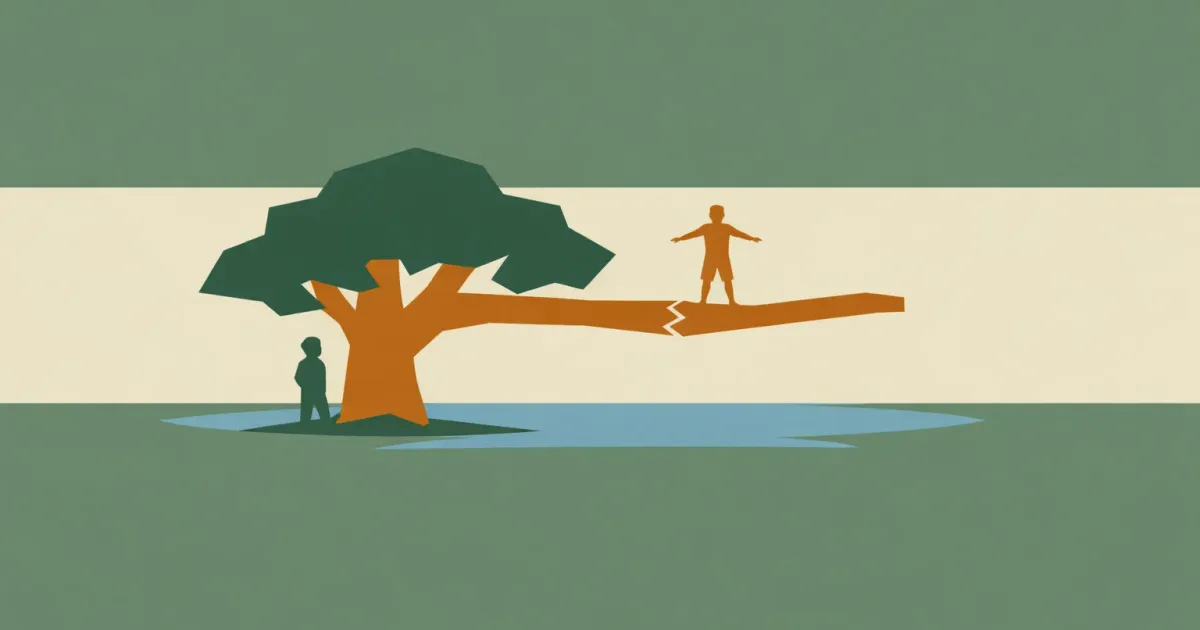
John Knowles (1926–2001) spent his sixteenth summer at Phillips Exeter Academy in New Hampshire on the same kind of accelerated wartime session his narrator describes. He was a West Virginia boy dropped into an old New England boarding school, a younger student in awe of classmates like Gore Vidal, and a writer-in-waiting who would spend the rest of his life being asked about one book. The Devon School is Exeter barely disguised. The tree by the river actually existed; Knowles later said he and a group of friends jumped from it during that 1943 summer session, though no one fell. Almost everything else in the novel, he insisted, was invention — which is what makes the question of its emotional autobiography so persistent.
After Exeter, Knowles served a short stint in the Army Air Forces, graduated from Yale in 1949, and drifted through journalism and travel writing. He lived in Europe for a while, partly on the encouragement of Thornton Wilder, who read his early stories and gave him the push he needed to take fiction seriously. A Separate Peace was his first published novel, and its success was immediate enough to trap him. None of the seven novels that followed — including a direct sequel, Peace Breaks Out, set at Devon a few years later — came close to matching its reach.
Knowles wrote A Separate Peace out of a specific, identifiable Exeter memory rather than a generalized nostalgia, and the difference shows on every page. His short story "Phineas," published in Cosmopolitan in 1956, contains in miniature the tree, the jounce, and the confession scene that would anchor the novel three years later. What the novel adds is the adult frame — the fifteen-years-later return to the campus — and the slow accretion of guilt that only a longer form could earn. The choice to fold an adolescent crisis inside a middle-aged narrator's voice is the book's most mature decision and probably the reason it has outlasted most of its peers on high school syllabi. Gene Forrester is not a coming-of-age narrator in the usual sense; he has already come of age, badly, and is trying to account for it.
Knowles's literary lineage runs less through J. D. Salinger, to whom he was often compared, than through Fitzgerald and Robert Penn Warren. The retrospective first-person confession, the myth-haunted friend who doesn't survive, the older narrator trying to understand his younger self's culpability — this is the template of The Great Gatsby and All the King's Men, scaled down to a prep-school campus. His friendship at Exeter and afterward with Gore Vidal, and his later social connection to Truman Capote, place him on the edge of a midcentury New York literary scene he never fully joined. The other Knowles novels — Morning in Antibes, Indian Summer, A Vein of Riches — were competent, sometimes elegant, and largely forgotten. A Separate Peace endured because Knowles found, once, the exact emotional pitch for a story that belonged to everyone in his generation and especially to him.
Historical Background
The novel is set across two Devon School sessions — summer 1942 and the 1942–43 academic year — and it was written in the late 1950s and published in 1959. That sixteen-year gap between the events described and the act of writing is not incidental. Knowles was looking back at his own adolescence the way his narrator does, through a postwar lens that had already watched the Cold War begin, Korea happen, and the bomb change what "war" meant. The boys in the book are the class of 1943, the last class young enough to spend a summer still pretending the war might not reach them and old enough that it did. By the time the novel ends, most of them are about to be drafted or enlisted; by the time Knowles wrote it, the survivors were in their thirties, raising children of their own and watching a new generation of draftable boys start to come up.
The specific historical pressure on the novel is the American home front's strange double life in 1942 and 1943. Boarding schools like Exeter ran accelerated summer sessions so that older boys could graduate and ship out; classmates watched each other disappear into the Army, the Navy, the Marines, the ski troops, the parachute riggers. Finny's pink shirt, meant as "an emblem" of the first Allied bombing raids over Central Europe, is a period detail Knowles expects his first readers to recognize immediately — the kind of small, absurd gesture by which teenagers tried to register a war they couldn't yet join. Leper's breakdown at a training camp in Vermont reflects the real-life phenomenon of the Section Eight psychiatric discharge, which by mid-1943 was discharging thousands of men for what the Army bluntly called "psychoneurosis."
The novel's original readers in 1959 encountered it as a World War II book written with enough hindsight to be about something other than combat — which was, at that moment, unusual. The dominant American war fiction of the 1940s and early 1950s had been written from the front, in the naturalist tradition of The Naked and the Dead and From Here to Eternity. Knowles's decision to stage his war novel at a boarding school, with no scenes of battle, no European setting, and no hero in uniform, was a quiet formal argument about where wars actually originate. The "enemy" in his title is an internal one, and Gene's closing meditation — that all the combatants of his generation had invented an enemy "where there was no enemy" — generalizes the private accident at the tree into a theory about how nations work themselves up to kill. This was a harder argument to make in the late 1940s, when the memory of a just war was still hot; by 1959, with Korea over and Vietnam not yet ignited, it found its audience.
Reception history tracks the book's shifting meanings. The British edition was published first, in 1959, by Secker & Warburg, and the Macmillan American edition followed in 1960; reviewers in both countries praised it warmly but modestly, comparing it favorably to The Catcher in the Rye without predicting its staying power. Its path into the high school canon was slow — it became a syllabus standard mostly in the late 1960s and 1970s, when teachers of the Vietnam generation found its account of a war nobody understood newly usable. Later criticism has pressed harder on what the novel does not say. The homoerotic charge between Gene and Phineas, obvious to many contemporary readers and almost never discussed in Knowles's lifetime, is now a standard angle in classroom analysis; so is the novel's almost total exclusion of women, people of color, and any world outside the Exeter bubble. Whether these absences are a limitation or a deliberate narrowing — Gene is, after all, a narrator whose field of vision has always been small — is the question most recent teaching of the book now asks.