Essay Prompts
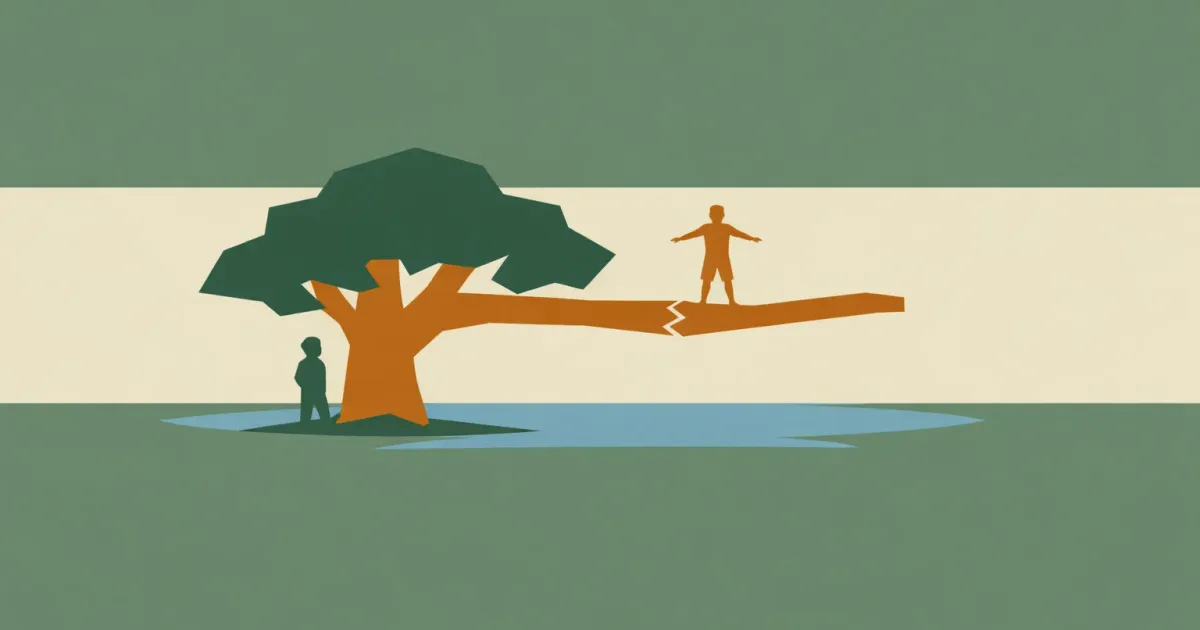
1. How Responsible Is Gene for What Happens on the Limb?
Question: Gene describes the moment on the tree as his "knees bent" and the limb "jounced" — grammar that hovers between intention and accident. Was the fall the result of a conscious choice, an unconscious impulse, or something the novel refuses to settle?
A solid approach here is to take a stand on whether Knowles wants the reader to treat Gene as a murderer, as someone guilty of manslaughter, or as a confused teenager whose body moved before his mind caught up. Focus on two scenes: the jounce itself at the end of Chapter 4, and Gene's attempted confession at Finny's Boston home in Chapter 5. Build your thesis around the gap between what Gene does and what Gene can bring himself to say. A strong version would argue that the novel deliberately keeps the verdict open so that responsibility — not guilt — becomes the real subject of the book. Use Gene's own shifting language (he calls it "some ignorance," "some crazy thing," "something blind") as evidence that he cannot find a single word for what he did.
A more sophisticated argument treats the ambiguity itself as the thesis. Knowles gives the reader three competing accounts of the same second: the moment as Gene experiences it (involuntary, almost dissociative), the moment as Finny witnesses it (impossible — his "you damn fool" refuses even to entertain malice), and the moment as Leper reconstructs it during the trial ("the one on the limb who moved first … sank down the trunk"). Each account is partial and each is narrated by an unreliable witness — Gene by guilt, Finny by denial, Leper by mental collapse. The essay's central claim can be that the novel is interested not in what legal category the act belongs to but in the moral category the narrator invents to survive it. A rigorous version would compare Gene's passive grammar ("the limb shook") with Brinker's forensic grammar at the tribunal ("what did you do next?") to argue that language, not law, is what decides responsibility in this book. For counter-argument, take seriously the reading that sees the jounce as premeditated: Gene has just said aloud, moments earlier, that he thought Finny was sabotaging his grades, and the novel has given him an accumulating record of resentment. The strongest essay will concede this reading and then push past it — arguing that Knowles is less concerned with whether Gene intended to hurt Finny than with why Gene continues, fifteen years later, to need the question to stay unanswered.
2. Finny and Gene as Doubles
Question: Many readers treat Finny and Gene as two halves of a single person — the dreamer and the realist, the body and the mind, the innocent and the fallen. Is this doubling a useful frame for reading the novel, or does it simplify what Knowles is actually doing?
Start by noticing how often the novel pairs the two boys physically and linguistically: they climb the tree together, Gene puts on Finny's clothes and feels briefly transformed into him ("I was Phineas, Phineas to the life"), Gene takes Finny's place in athletics and on the Olympic training field. A strong accessible thesis would argue that Finny represents the version of boyhood Gene wants to be and destroys because he cannot become, and that Finny's death leaves Gene permanently incomplete — "a part of Phineas" now living inside him. Use the gym scene in Chapter 8, where Gene chins himself on the exercise bar and Finny begins training him for the 1944 Olympics he knows Gene must run in his place, together with the moment at the funeral in Chapter 12 when Gene says he feels it is his own funeral, as your anchoring evidence.
A more ambitious essay interrogates the doubles frame rather than simply deploying it. The symmetry is seductive but partial: Finny is not only Gene's better self, he is also a genuinely separate person with his own psychology — a boy who refuses to admit enemies exist partly because he cannot afford to. A close reading of the "Because I've suffered" moment in the locker room, where Finny inadvertently confesses that his conspiracy theory about the war is a survival mechanism, complicates any reading that makes him pure innocence. Similarly, Gene's envy is not cleanly the shadow-side of Finny's generosity; it is a recognizably ordinary adolescent feeling that the novel refuses to let us exoticize. A rigorous thesis might argue that Knowles invokes the doubles tradition — Jekyll and Hyde, the divided self of American Romanticism — only to pull away from it, insisting on the particularity of each boy rather than collapsing them into allegory. Strong evidence includes the fact that Gene narrates while Finny cannot, a structural inequality no true doubling allows. The essay can close by suggesting that the novel's real interest is in the damage one particular, unrepeatable person can do to another — not in a neat thematic pairing.
3. The War That Is Everywhere and Nowhere
Question: World War II is the backdrop of A Separate Peace, but almost no wartime violence appears on the page. How does Knowles use the war as a structural and thematic device, and what does it mean that his protagonist experiences the conflict almost entirely through absence?
A direct approach is to argue that the war functions as a pressure rather than a plot — it shapes the characters' choices (Brinker's bravado, Leper's enlistment, Finny's denial, Gene's detachment) without ever intruding as spectacle. Organize the essay around three scenes where the war breaks through the insulation of Devon: Leper's enlistment after the ski-troop film, Gene's visit to the Lepellier home in Vermont, and the Parachute Riggers' school arriving on the Far Common in the final chapter. A solid thesis would be that Knowles deliberately keeps combat offstage so the novel can stage the real conflict — the "war" Gene fights inside himself — without being swallowed by the larger one.
A more sophisticated argument situates the novel within the postwar American tradition of writing about World War II from oblique angles. Knowles published the book in 1959, after the great combat novels (Mailer and Jones had already established the genre; Heller was imminent) had made the trenches and the Pacific familiar territory. His choice to write a home-front novel about the boys who were almost old enough — the last class to spend a full summer still inside childhood while the war drained their older brothers away — is a deliberate refusal of that tradition. Leper's breakdown is the novel's closest approach to combat, and it is significant that his trauma is bureaucratic and domestic rather than martial: he cracks in a reception center, hallucinates a corporal's face turning into a woman's, and flees to his mother's dining room. This is what war looks like when it arrives before the battlefield does. The essay can push further by analyzing how Knowles's sentence-level style quarantines the war — the distant troop train glimpsed through sleet, the newsreels reduced to vocabulary ("plasma, psycho, sulfa") — to argue that Gene's adult narration is itself a war artifact, the voice of a man who has learned to describe enormous events through small ones. The closing meditation that wars are made "by something ignorant in the human heart" can be read either as earned philosophical insight or as a too-neat displacement of political causes onto psychological ones. The strongest essays will weigh both possibilities.
4. Comparing Responses to Fear: Leper, Brinker, and Gene
Question: Every major boy at Devon develops a private strategy for handling the approach of the war. Compare how Leper Lepellier, Brinker Hadley, and Gene Forrester each manage their fear, and argue which of the three Knowles treats with the most sympathy.
Begin by naming each boy's strategy clearly. Leper tries to sidestep fear by enlisting early and choosing the most aesthetically appealing branch (ski troops); Brinker smothers fear with public performance — the Butt Room jokes, the mock tribunal, the patriotic speeches; Gene withdraws into Finny's invented peace and then, after Finny's death, enters the Navy quietly and without illusion. A strong thesis would argue that Knowles reserves his deepest sympathy for Gene, because Gene is the only one who eventually looks directly at his own fear instead of performing against it. Use Leper's hallucinations in Chapter 10, Brinker's cynical speech about his father's generation in Chapter 13, and Gene's admission to Finny in Chapter 12 ("it was just some ignorance inside me") as your three anchor passages.
A more nuanced essay resists assigning sympathies too neatly and instead reads the three strategies as a spectrum of failed responses — each illuminating the others by contrast. Leper's early enlistment is often read as naive, but a careful look at his Vermont monologue reveals a boy who has been quietly observant all along; his "escape" is not cowardice but the collapse of a sensibility too fine for military language. Brinker is easy to dislike, yet his turn at the end of the book — the bitter speech about fathers who talk about service while sending sons to die — is one of the novel's sharpest political moments, and it complicates any reading that treats him as pure bluster. Gene's final composure at the novel's close is itself questionable: is his calm the earned peace of a man who has faced his enemy, or the dissociation of a man still running from him? A strong essay might argue that Knowles refuses to rank these responses because he does not believe adolescence, or wartime, offers a "correct" way to be afraid. The comparison matters not because one boy gets it right but because together they map the narrow range of options available to a generation whose older brothers have already left. Consider bringing in Finny as a fourth term — the boy who refuses fear altogether and is destroyed by it — to complicate any claim that self-knowledge is the novel's preferred coping mechanism.
5. The Novel's Relationship to the Fall in Genesis
Question: A Separate Peace is saturated with the language of innocence and fall — the Edenic summer session, the forbidden tree, the expulsion into a harsher world. Does reading the novel as a retelling of Genesis deepen it, or does the biblical frame collapse under scrutiny?
A clear starting point is to map the parallels Knowles seems to invite. The summer session is repeatedly described in paradisal terms (the clean Devon River, the "gypsy summer," the sealed-off quality of the grounds); there is a literal forbidden tree the boys are not supposed to climb; the fall from that tree initiates the novel's long expulsion into winter, guilt, and war. A straightforward thesis would argue that Knowles adopts the Genesis framework to give his coming-of-age story mythic weight, casting Gene as a fallen Adam whose knowledge of his own capacity for harm is the knowledge that ends childhood.
A more rigorous essay tests the biblical frame against scenes where it strains. In Genesis, the fall is a fall upward into moral consciousness; in Knowles's novel, the fall is literal, physical, and catastrophic for the victim rather than the sinner. Finny, not Gene, is the one who hits the ground, and Finny is the only character in the book who never "recognizes an enemy" — the closest thing the novel has to a prelapsarian figure. If the Genesis parallel holds, it has to account for the strange fact that the innocent dies while the fallen lives on to narrate. A strong essay might argue that Knowles uses the biblical vocabulary to raise expectations he then deliberately disappoints: there is no redemption, no clear moment of moral clarity, no expulsion that confers wisdom. Gene's closing insight — that he killed his enemy at Devon — is both an acknowledgment of guilt and a refusal to accept the redemptive arc the Genesis frame would demand. The novel is closer, in this reading, to the American post-Edenic tradition (Hawthorne, Melville, early Fitzgerald) than to straight allegory: it borrows the furniture of the fall in order to suggest that moral knowledge, when it comes, arrives too late to save anyone. The strongest essays will also reckon with the two rivers — freshwater Devon and brackish Naguamsett — as a second, quieter frame that runs alongside the Edenic one, suggesting the fall from innocence is not a single event but a tidal, recurring condition.