Exam & Discussion Questions
These are the questions teachers consistently ask about A Separate Peace — in class discussion, on quizzes, and on essay exams — with model answers you can study from and build on.
Chapters 1–2: The Frame and the Summer Beginning
1. Why does Knowles begin the novel with an adult Gene returning to Devon fifteen years later?
Gene's return to Devon in the opening pages establishes the novel's retrospective structure: everything that follows is memory filtered through guilt and hard-won hindsight. By showing us an older Gene who has already "made his escape" from fear, Knowles signals that the story is less about what happened than about how Gene finally came to understand it. The present-tense frame also creates dramatic irony — we know Gene survived, but we don't yet know what it is he had to survive.
The framing device is Knowles's most sophisticated structural choice. It places the reader in the position of someone reading a confession rather than watching events unfold in real time. Gene doesn't just narrate; he interprets, qualifies, and withholds. When he describes the marble stairs in the First Academy Building and notes with odd precision that "the marble must be unusually hard," the adult narrator is already circling the event he cannot yet directly name. The effect mirrors the psychology of traumatic memory: the mind approaches the wound obliquely, measuring its edges before committing to a full account.
The opening also establishes one of the novel's central ironies. The Devon Gene returns to looks "oddly newer" and better preserved than the school of his memory — a "glossy new surface" that makes it look "like a museum." The more things are preserved, the more they become artifacts of the past rather than living places. Gene's confession, by contrast, is an attempt to excavate what lies beneath that varnish.
2. How does Finny use the Devon School tie as a belt, and what does this episode reveal about his character?
At the term-opening tea hosted by substitute headmaster Mr. Patch-Withers, Finny wears the Devon tie as a belt. When Mrs. Patch-Withers notices, Finny improvises an elaborate, sincere-sounding explanation connecting the tie to school spirit and the bombing of Central Europe. Mr. Patch-Withers ends up laughing. The episode shows Finny's extraordinary ability to turn violations of the rules into moments of connection — he isn't manipulative so much as genuinely charming, operating from a place of affection rather than calculation.
3. What is the Super Suicide Society of the Summer Session, and why does Gene keep attending despite hating the nightly jumps?
Finny founds the Super Suicide Society on the principle that all charter members (himself and Gene) must open every meeting by jumping from the high tree limb above the river. Gene hates the jump every single time — each night the branch seems higher and thinner than before — but he keeps attending because he cannot bear to show Finny fear or weakness. He frames it to himself as not wanting to lose face, but the deeper truth is that Finny's opinion has become the measure of Gene's self-worth.
Chapters 3–4: Rivalry, the Record, and the Beach
4. What does Finny's decision not to publicize his broken swimming record reveal about him?
After Finny breaks the school's 100-yard freestyle record in a private pool session, he refuses to repeat the swim officially or tell anyone. He simply wanted to know whether he could do it. The episode illustrates Finny's indifference to external validation: for him, the accomplishment is complete the moment it is accomplished, and the attention of an audience would add nothing. This quality baffles and unsettles Gene, who measures nearly everything by how it looks to others.
The swimming record scene is one of the novel's most quietly devastating moments. Gene's reaction to Finny's refusal — he describes feeling "shock," then a sensation the accomplishment has "taken root" in his mind and "grown rapidly in the darkness" — reveals the exact shape of his envy. It isn't that Finny can break records; it's that Finny can break records and then not care. Gene cannot imagine that level of psychic self-sufficiency, and so Finny's modesty reads to him as a kind of superiority, "something inebriating in the suppleness of this feat."
Knowles is careful to note that Gene keeps the record secret "perhaps" because Finny asked him to, but the effect is that "his accomplishment took root in my mind and grew rapidly in the darkness where I was forced to hide it." The language of growth in darkness is loaded: Gene's guilt will later follow the same pattern, gestating underground until it erupts in Chapter 4.
5. How does Gene come to believe that Finny is deliberately sabotaging his studies?
In Chapter 4, after flunking his trigonometry test following the illegal overnight trip to the beach, Gene sits down to catch up — and Finny comes in to announce a Super Suicide Society meeting, implying Leper might finally jump. Gene goes, later admits he knew it was a ruse, and in the aftermath decides that every diversion Finny has ever proposed has been a calculated effort to prevent Gene from becoming head of the class. The logic is entirely Gene's own projection. The reader can see that Finny, in Chapter 4, sincerely offers to let Gene skip the meeting and study.
6. What happens at the beach that Gene cannot bring himself to say aloud that night?
When Finny quietly tells Gene on the dune at the end of their illegal overnight trip that Gene is his best friend, Gene nearly says it back — and doesn't. He attributes his silence to "something that held me back … perhaps I was stopped by that level of feeling, deeper than thought, which contains the truth." The implication is that Gene knew, somewhere beneath consciousness, that he did not feel the same uncomplicated loyalty that Finny was expressing. This omission looks small but it is the moral center of the summer: Finny is unguarded and Gene is already armoring himself.
Chapter 4–5: The Fall
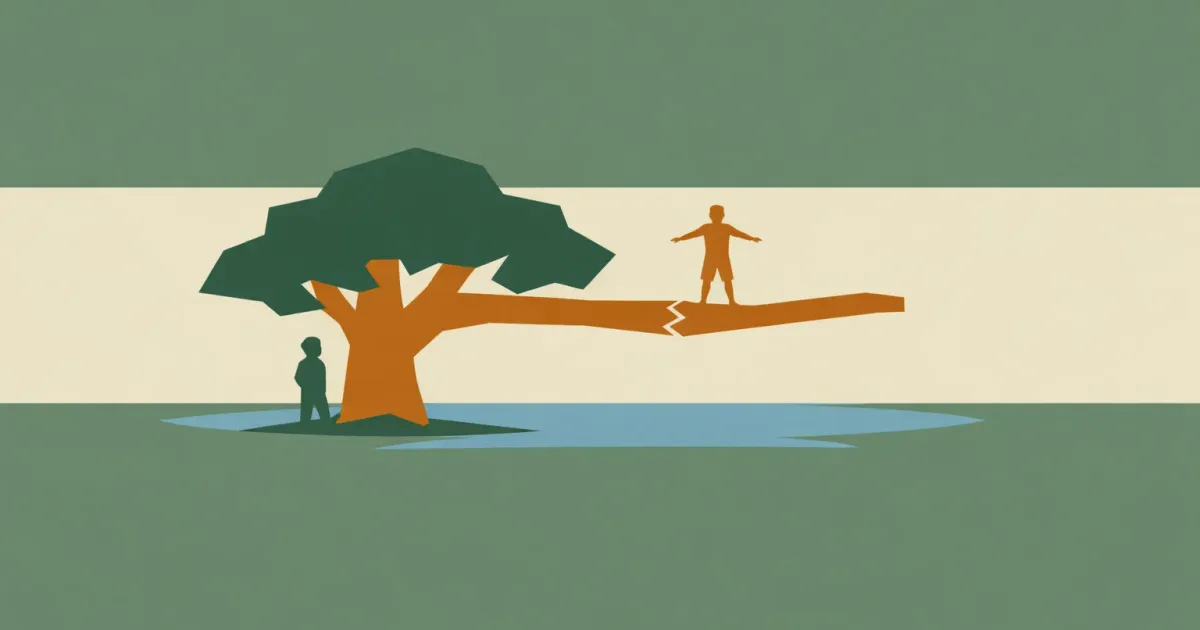
7. Describe exactly what happens at the tree when Finny falls. What is ambiguous about the moment?
Gene and Finny climb the tree together to attempt a "double jump." Standing on the limb, Gene — in his own single-sentence account — bends his knees and "jounced the limb." Finny loses his balance, looks at Gene "with extreme interest," and falls through the lower branches onto the bank, shattering his leg. The ambiguity lies in whether the jounce was conscious. Gene's phrasing — "my knees bent and I jounced" — uses a passive-feeling construction that leaves open whether this was an impulse, a reflex, or a decision. Gene himself never fully resolves this; in Chapter 12 he calls it "some blind impulse."
Knowles stages the fall with calculated grammatical evasion. Gene's sentence — "my knees bent and I jounced the limb" — is syntactically structured to distribute agency: the knees "bent" as though on their own, and Gene "jounced" as a consequence. This is the grammar of partial self-exculpation, and Gene will spend the entire novel circling whether it exculpates or condemns him. The question the novel poses is not whether Gene did it — he clearly did — but whether the doing was the kind of act that carries moral weight. Can something "blind" be guilty?
The exchange in Chapter 5 at the infirmary deepens the ambiguity. Finny tells Gene that he had a feeling Gene was responsible, but "you can't say anything for sure from just feelings. And this feeling doesn't make any sense." He is formulating a new commandment: "Never accuse a friend of a crime if you only have a feeling he did it." That Finny's protective ethical instinct shields Gene from confrontation even before Gene's guilt has fully formed is one of the novel's bitterest ironies.
8. Why does Gene put on Finny's pink shirt in Chapter 5?
While Finny is at the infirmary, Gene finds the pink shirt and puts it on. Looking in the mirror, he finds that he looks like Finny — "his humorous expression," "his sharp, optimistic awareness." He says this gives him "intense relief," temporarily lifting the confusion of his own character. The moment is both psychologically precise and symbolically rich: without Finny to define himself against, Gene does not know who he is.
9. Why does Finny refuse to believe Gene's confession at the Boston house?
When Gene visits Finny at his home and confesses to jouncing the limb deliberately, Finny says "Of course you didn't do it" and orders Gene to sit down. His refusal to accept the confession is partly self-protective — believing it would mean accepting that his best friend destroyed his athletic career — but it also reflects Finny's genuine incapacity to recognize malicious intent. He keeps shouting Gene down ("You damn fool. Sit down, you damn fool") until Gene, realizing he is causing further harm, recants. The confession, which was meant to unburden Gene, ends up leaving both of them worse off.
Chapters 6–8: The Winter Session Returns
10. How does the transition from the Summer Session to the Winter Session change the atmosphere at Devon?
The Summer Session was a stripped-down, easygoing institution of only two hundred boys and substitute masters willing to overlook infractions. The Winter Session restores Devon's full authority: seven hundred boys, regular faculty, and the weight of tradition. Gene registers this as a loss. The summer's "gypsy music" — the barefoot rules-breaking that Finny conducted — gives way to hymns and appointments and the machinery of institutional life. Two rivers also mark the transition: the clean freshwater Devon River of summer gives way to the saline, tidal Naguamsett of winter, which Gene falls into on his first day.
11. What is Finny's theory about the war, and why does Gene half-believe it?
Finny proposes that the war is a hoax invented by "fat old men" who don't want young people crowding them out of their jobs. Previous generations got Prohibition and the Depression as control mechanisms; the war is the current version. Gene knows this is absurd, but in the locker room he finds himself almost taken in by it — not because the argument is convincing but because his own happiness has briefly made peace seem natural. Finny's conspiracy theory, however ludicrous, is more emotionally satisfying than the facts, and Gene's partial belief in it is one of the novel's most acute observations about how grief and guilt can distort one's grip on reality.
Finny's war theory is the novel's most extended comic passage, but Knowles uses it to make a serious point about the relationship between belief and need. Gene is explicit: "I began to see that Finny had actually jounced the limb for me, or else the war had jounced it, or else time or chance or whatever it is." The fantasy that the war doesn't exist is directly connected to Gene's guilt — if there's no war, there's no urgency to enlist, no need to leave Finny, no confrontation with the damage Gene has done. The Olympic training sequences, with Gene running laps in pre-dawn cold while Finny shouts encouragement from his cane by the elm, are the most lyrical passages in the novel precisely because they represent what Gene most wants: a world in which the summer could simply continue, undisturbed.
The crack in the fantasy comes in the locker room, when Finny blurts "Because I've suffered" in response to Gene's challenge. That sentence collapses the entire fiction because it comes from a place below strategy. Finny has been the architect of the peace fantasy, but this unguarded admission reveals how much the fantasy costs him to maintain.
12. When Finny returns to Devon in Chapter 7, why does Gene abandon his plan to enlist?
Gene spends the evening shoveling snow at the railroad yards and, inspired by Brinker's talk, resolves to enlist — a way to shed everything, start clean, escape the tangle of his guilt. Then he opens his door and finds Finny sitting at his desk. The sight of Finny's closed, remote expression at the mention of Gene's possible departure is enough: "I could see nothing but that he needed me." Gene's impulse to escape dissolves instantly. Whether this is loyalty, guilt, or codependency — the novel insists it is all three at once.
Chapter 9: Leper's Enlistment and the Winter Carnival
13. What prompts Leper Lepellier to enlist, and why is his departure significant?
Leper enlists in the ski troops after watching a recruiting film in the Renaissance Room. The film shows skiers in white uniforms descending pristine slopes, and Leper, an avid solo cross-country skier who has always preferred looking at nature to competing in it, finds in this image a version of the war he can recognize and enter. His departure is significant because it is quiet and completely sincere — the opposite of Brinker's theatrical enlistment threats. The disappearing "white stocking cap bobbing" through the doorway is the first real incursion of the war into the boys' lives.
14. What is the Devon Winter Carnival, and how does it function in the novel?
Finny organizes an unofficial Winter Carnival in a park by the Naguamsett River: snow statues, a miniature ski jump, Chet Douglass on trumpet, stolen cider, and a decathlon in which Gene is crowned with an evergreen wreath. The carnival is Finny's most sustained act of peace-making — a deliberate construction of joy in the face of winter and war. Gene later calls it "this afternoon of momentary, illusory, special and separate peace." Its destruction by Leper's telegram is the structural pivot that ends the novel's second act.
Chapters 10–11: Vermont and the Trial
15. What does Gene find when he arrives at Leper's house in Vermont?
Gene travels overnight by train and bus to reach Leper's Vermont farmhouse. What he finds is not the gentle naturalist of Devon but a frightened, partially unraveled young man who has gone AWOL to avoid a Section Eight discharge. Leper describes hallucinations at basic training — a corporal's face changing into a woman's, a broom transforming into a severed leg — and accuses Gene, with sudden clarity, of having knocked Finny out of the tree "like a savage underneath." Gene kicks Leper's chair over and runs.
The Vermont sequence is structurally essential because it makes the war physically present for the first time. Up to this point, the war has been filtered through newsreels, headlines, and Finny's theory; in Leper's dining room it arrives as embodied trauma. Leper's descriptions of basic training — the inedible food, the coughing man in the next cot, the corporal's face that keeps changing — introduce a register of language new to the novel: fragmented, over-explained, with a terrible internal logic that cannot hold. When he says "psycho" in a "sudden mental-ward reality" that strikes Gene "as though it were in Japanese," Knowles is documenting the gap between Devon and the actual war.
Gene's violent reaction to Leper's accurate accusation — "you crippled him for life" — is the chapter's moral center. He is not running from Leper's madness; he is running from accurate testimony. The choice of the word "savage," which Leper uses with odd precision, will resurface in the novel's final meditation on "something ignorant in the human heart." Leper, who has just experienced what that ignorance looks like when it is given institutional form, names Gene's act correctly — and Gene's first response is physical violence.
16. How does Brinker's mock trial in the Assembly Room proceed, and what breaks it apart?
Brinker and several classmates, wearing graduation robes, march Gene and Finny into the Assembly Room of the First Academy Building at night and stage an informal inquiry into Finny's accident. Brinker questions Finny, then Gene, drawing contradictions out of both of them. He then summons Leper — who has been hiding in the chapel — and Leper delivers his testimony: two figures on the limb "moved like an engine," one sinking and then the other falling. The room understands what this means. Finny stands up, says "I don't care," walks out, and falls down the marble stairs.
17. Why does Finny say "I don't care" and leave the trial?
Finny's exit is not resignation or cowardice — it is the moment when he finally understands, beyond any remaining doubt, what happened. He has been able, through the whole inquiry, to hold the question at arm's length. Leper's piston-engine description removes that distance. Finny's "I don't care" is a statement of genuine dignity: the facts don't matter now, because nothing that can be proved will change what has been lost. The sudden crying that Gene witnesses as Finny leaves — "I had never seen Finny crying" — tells us that he does care, enormously. The exit is the only form of self-protection still available to him.
Chapters 12–13: Aftermath and Enlistment
18. How does Gene describe Finny's death, and why doesn't he cry at the funeral?
Finny dies during the routine operation to set his second broken leg when bone marrow enters his bloodstream and stops his heart. Dr. Stanpole explains it as a freak complication, not anyone's fault. Gene does not cry at the funeral, and he tells us why: he felt as though he were attending his own funeral, "and you do not cry in that case." The formulation is exact — Gene has understood that killing his enemy was an act of self-destruction, that Finny's death diminished Gene permanently.
The manner of Finny's death is one of the novel's most deliberate artistic choices. Knowles could have arranged any number of dramatically satisfying exits — a fall, a relapse, a confrontation. Instead Finny dies from a medical accident in a routine procedure, from bone marrow in a bloodstream. The flatness of the cause refuses to carry metaphorical weight, and this refusal is the point. Dr. Stanpole's explanation — "There is only one explanation" — is offered twice with slight variation, as though repetition might make it comprehensible. It doesn't. Finny dies from the war's clinical vocabulary, from "plasma" and "sulfa" and surgical procedure, before the war ever touches him directly.
The coda in Chapter 13 reframes the entire novel. Gene's closing reflection — that wars are not made by generations but by "something ignorant in the human heart" — is the adult narrator's retrospective verdict. Every character in the book has developed a defense mechanism against this inner enemy: Quackenbush strikes out, Brinker grows cynical, Leper withdraws then collapses, Mr. Ludsbury rises above. Only Finny never recognized the enemy, and so only Finny was destroyed by it. The novel ends with Gene's enlistment in the Navy, but his private war, he tells us, ended at Devon.
19. What does Gene mean in the final chapter when he says "I killed my enemy there"?
In the novel's closing lines, Gene reflects that he never developed hatred for the enemy in the war because his war was already over before he put on a uniform. The enemy he killed at Devon was not Finny — it was the "something ignorant" inside himself, the blind envy that jounced the limb. He killed it by understanding it and, through Finny's death, losing the person it had harmed. The paradox — that Gene "killed" something by destroying the person he loved — is the novel's final, unresolved irony.
Thematic Questions
20. How does Knowles use the two rivers at Devon to develop the novel's themes?
The freshwater Devon River represents summer, freedom, and the world Finny creates — clean, above the dam, removed from tidal forces. The saline Naguamsett, fed by the ocean and governed by "the Gulf Stream, the Polar Ice Cap, and the moon," represents the Winter Session, the war's pull, and the world of adult consequence Gene cannot escape. Gene's first act of the Winter Session is to fall into the Naguamsett after his fight with Quackenbush. The symbolism is efficient: Gene has crossed from one world to another, and the river he falls into baptizes him into winter's order.
Knowles's two-river structure is his most sustained symbolic pattern. The Devon flows from "familiar hills a little inland," passes through the school grounds, and drops into the Naguamsett — it is local, knowable, controllable, ending in a "small spectacle" at the waterfall. The Naguamsett is "ugly, saline, fringed with marsh, mud and seaweed," connected to the ocean and governed by forces no schoolboy can name. This is precisely the relationship between the Summer Session's private peace and the actual war: one is self-contained and beautiful, the other is vast, tidal, and indifferent. The novel's title points to the same structure. The "separate peace" is the Devon River — a self-enclosed system of meaning that eventually gives way to everything it was trying to keep out.
21. Gene accuses himself of acting from envy, but is envy a complete explanation for what he did at the tree?
Envy is Gene's preferred explanation — it is tidier than the alternatives. In the novel's culminating conversation in the infirmary, Gene tells Finny it was "some ignorance inside me, some crazy thing inside me, something blind." This formulation suggests something pre-rational and unnameable, more like an instinct than a motive. The novel is finally unwilling to diagnose Gene's act as simple jealousy, because simple jealousy could be repented and resolved. The "blind impulse" framework leaves Gene with a more troubling conclusion: that he acted from something he could not have prevented because he could not have seen it.
22. In what sense is Phineas Gene's double, and how does Knowles develop this relationship?
Phineas and Gene are established as complementary figures from the opening — Finny the athlete, Gene the scholar — and throughout the novel Gene describes seeing himself through Finny's eyes and taking his identity from their friendship. When Finny is injured, Gene puts on his clothes and looks like him in the mirror. When Finny coaches Gene for the Olympics, Gene runs laps that Finny cannot run. The doubling deepens into something stranger: Gene calls his enlistment a feeling that he is attending his own funeral when Finny dies, and ends the novel describing himself as "Phineas-filled." The implication is that Finny's death does not separate them but permanently fuses them — Gene carries Finny's way of seeing into adult life.
The double motif operates on multiple levels simultaneously. On the surface, Finny and Gene compensate for each other's limitations: Finny gives Gene physical courage; Gene gives Finny academic survival. But at a deeper level, they represent split versions of a single adolescent self — the body and the mind, pleasure and calculation, spontaneity and guilt. Gene says explicitly that he lost "part of himself" to Finny after the phone call in Chapter 6, and that his purpose had always been "to become a part of Phineas." This is unusual phrasing — not to be like Finny, but to be a part of him. The jounce on the limb is, among other things, an act of unconscious self-destruction: killing the half of himself he cannot become.
Knowles also develops the doubling through the two falls from the tree. The first fall, summer, happens beside the river — there is water below, a soft landing of sorts, a survival. The second fall, winter, happens down marble stairs — hard, cold, institutional. Between those two falls is the arc of the novel: summer to winter, river to marble, impulse to consequence.
23. How does the novel treat the relationship between adolescence and war?
The Devon boys are sixteen in the summer of 1942, not quite old enough to enlist, close enough to the war to feel its pull on every choice they make. The faculty, as Gene notes, treats them with unusual tolerance that summer — "we reminded them of what peace was like." The war exists at the edges of the novel as a kind of coming-of-age accelerator: boys who might have had years to figure themselves out are instead being sorted, drafted, deployed. Leper breaks first; Finny dies before he can serve; Gene enlists in the Navy. The novel suggests that war doesn't simply interrupt adolescence — it is a particular, extreme version of the same process, a forcing of the self toward definition under pressure it cannot control.
24. What role does guilt play in Gene's development over the course of the novel?
Gene's guilt is the engine of the entire narrative. In the immediate aftermath of the fall it produces avoidance, then a failed confession. Through the Winter Session it produces compulsive service to Finny — tutoring, training, maintaining the fiction of the war's nonexistence. The trial forces the guilt toward reckoning, and the final conversation in the infirmary offers something like absolution — Finny says he believes Gene. But the novel refuses a clean catharsis. Finny dies the same afternoon. Gene cannot cry at the funeral because mourning and guilt have become indistinguishable. The adult narrator fifteen years later has "made his escape from fear," but the cost of that escape was everything — Finny, Devon, the summer, and the version of himself that might have confessed sooner and earlier and differently.
25. The novel ends with Gene reflecting that wars are made not by generations but by "something ignorant in the human heart." What does this claim mean in context, and is it convincing?
Gene's closing meditation is a direct rebuttal of Brinker's generational-grievance theory (the older generation started the war; the young have to fight it) and an extension of Finny's cosmic-conspiracy theory (fat old men manipulate history). Gene argues that both explanations locate evil outside the self — in a generation, in a class, in fat men behind closed doors. His own experience has taught him that the source is interior: the blind impulse that jounced the limb, the envy he nurtured and then pretended not to have. Whether this is wisdom or rationalization is a question the novel leaves open. It is also, notably, a very convenient conclusion for someone who wants to forgive himself.
The final chapter's meditation on Maginot Lines is the novel's most overtly philosophical passage, and it risks tipping into thesis statement. Knowles lists each character's defense mechanism against the perceived inner enemy: Mr. Ludsbury's hauteur, Quackenbush's aggression, Brinker's resentment, Leper's protective vagueness. Finny alone "escaped" because he never recognized the enemy. The structure of the argument is elegant, almost too elegant — it makes Finny's innocence into something like a fatal flaw, a fatal lack of defensive armor, rather than a moral achievement. Gene's formulation "So at last I had" — he was the thing that broke Finny's "harmonious and natural unity" — is an admission of guilt dressed as analysis. The novel ends without resolving whether understanding one's capacity for harm is the same thing as having escaped it.