Themes & Motifs
The Enemy Within
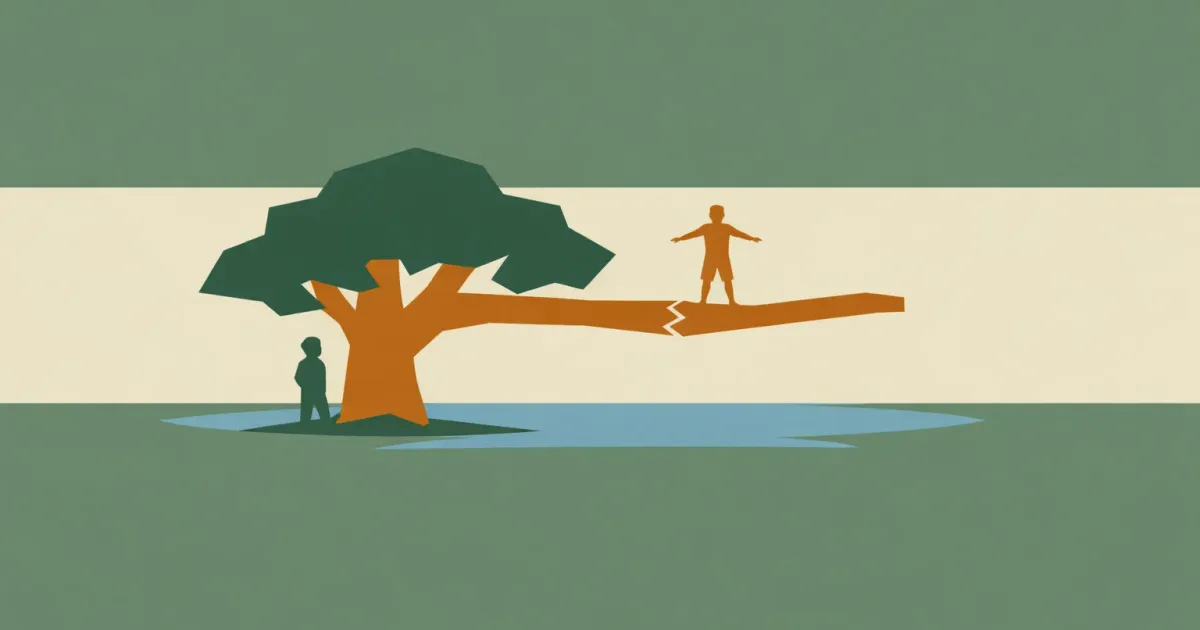
A Separate Peace is a war novel in which the decisive combat takes place inside a single adolescent skull. Gene Forrester spends the book looking for an enemy to fight and keeps pointing the finger in the wrong direction — at Finny, at the school's codes, at Brinker's pieties, at the distant Germans and Japanese — until, fifteen years later, he names the only enemy who was ever really there. The novel's closing lines make this the book's central claim: "I never killed anybody and I never developed an intense level of hatred for the enemy. Because my war ended before I ever put on a uniform; I was on active duty all my time at school; I killed my enemy there."
What makes this theme more than just a moral lesson is how quietly Knowles plants it. The "enemy" is not Gene's temper or even his envy. It is the suspicion — almost a reflex — that someone else is out to get him. Finny sets a swimming record that Gene was never going to beat, and Gene concludes Finny must be sabotaging his grades. Brinker cracks a joke about getting a single room, and Gene interprets it as an accusation. Every time the novel seems about to deliver a clean external antagonist, it redirects the reader back to Gene's own mind.
Knowles builds the theme by letting Gene rehearse the logic of enemies in escalating scenes. The trigonometry-book scene in Chapter 4 is the critical unit. Gene watches Finny writing at the study table and decides, with no new information, that Finny has "deliberately set out to wreck my studies." The passage moves with the snap of a courtroom verdict — "it was all cold trickery, it was all calculated, it was all enmity" — and Gene's conclusion is explicitly relief: "I felt better. Yes, I sensed it like the sweat of relief when nausea passes away." The relief itself is damning. Gene feels better once he has invented a hostile opposite, which tells the reader that the need for an enemy precedes the evidence for one.
That pattern recurs under different costumes. In the Butt Room, Gene flees Brinker's joke because he cannot distinguish teasing from prosecution. In the Vermont scene, Leper's accusation — calling Gene "a savage underneath" — sends Gene sprinting across a snow-covered field, again running from a perceived attacker. Even the fistfight with Quackenbush, which Knowles stages as Gene's first real violence, is launched by a slur ("maimed") that Gene chooses to take personally. Each episode reinforces how automatically Gene's mind converts stimulus into threat.
The closing pages of Chapter 13 make the theme explicit by listing everyone else's defensive posture against the "enemy" they believed they saw: Quackenbush always striking out, Brinker growing cynical, Mr. Ludsbury rising above, Leper collapsing entirely. Knowles names these "Maginot Lines" — the real-world fortifications the French built against a German attack that never came that way. The metaphor does double duty. It places Gene's generation inside the actual history of World War II while insisting that the worst harm these boys will do is to themselves, through fortifications built against threats that were never crossing their particular borders. Phineas alone dies because Phineas alone built no wall. The novel's most unsettling implication is not that Gene was wrong to imagine an enemy but that everyone around him was doing the same thing more quietly.
Friendship as Identification and Envy
Gene and Finny are a case study in how love between adolescents can become indistinguishable from rivalry. The novel treats friendship as the most complicated relationship in the book — more complicated than any romance, which Knowles pointedly leaves offstage. What Gene feels for Finny is admiration, dependence, resentment, and something like possession, braided so tightly that Gene himself cannot pull them apart. Finny, meanwhile, feels only affection, which is why the novel can end only in his death: he is missing the defensive equipment the rest of the boys are issued at adolescence.
The theme's clearest anchor is Gene's late admission, mid-procession at the First Building: "Phineas had thought of me as an extension of himself." That line reframes the entire friendship. Finny does not need rivals because he does not distinguish Gene from Finny. Gene, who does make the distinction constantly, is in a relationship whose terms only one of them understands.
Knowles tracks the imbalance from the opening pages. When Gene tries to claim five feet nine inches and Finny corrects him to five eight and a half — "We're on the short side" — Finny is speaking as if the two boys share one height between them. The correction is affectionate and automatic, and it takes a half-inch away from Gene. Gene notices. He is the one who keeps score: the A average, the Ne Plus Ultra Scholastic Achievement Citation, the Galbraith Football Trophy, the swimming record he was not told about. Finny's refusal to advertise the broken record is, for Gene, the most suspicious act of all — because in Gene's mental economy, achievements only count when they are counted.
The novel's psychological engine is the way Gene manufactures Finny's envy in order to bear his own. The trigonometry scene turns on a single sentence — Finny's "I'd kill myself out of jealous envy" — which Gene reads past the smile to a buried confession. It is of course Gene's projection; the novel offers no other evidence that Finny cares about academic rank. What Gene calls a "sustaining thought" — "You are even in enmity. You are both coldly driving ahead for yourselves alone" — is the thought of a boy who cannot tolerate the asymmetry of loving someone more than they envy him.
After the fall, the theme inverts but does not disappear. Finny's Olympic-training program in Chapters 8 and 9 collapses the two boys into something closer to a single athlete: Finny coaches, Gene runs, and the pair works toward a Games that Finny insists is coming and Gene knows is not. Gene calls himself at one point the extension Finny already treated him as. The ironic cost is that this identification — the real fusion Finny seems to have wanted all along — is only possible after Gene has broken him. Finny can keep Gene inside his "choreography of peace" only because Finny himself is no longer able to compete. The novel's harshest suggestion is that Gene gets the intimacy he wanted by destroying the condition — Finny's wholeness — that made the intimacy worth having.
The War as Atmosphere
World War II is almost never onstage in A Separate Peace, which is itself the point. The novel sets its action in 1942 and 1943, but no one fires a rifle, no one dies in combat, and no one at Devon really believes in the war until almost the end. Instead, the war saturates the book like weather — in troop trains glimpsed from dorm windows, in the enlistment posters tacked up in the gym, in the sewing machines carted onto the Far Common for a Parachute Riggers' school, in Leper's ski-troop recruiter whose voice Gene will not forget. Knowles is interested in what living next door to a war does to teenagers who are still children and almost soldiers at once.
Two small details stand in for the larger pattern. Gene opens Chapter 1 by noting that the campus has been freshly varnished — because, fifteen years earlier, "varnish, along with everything else, had gone to war." And Finny explains his pink shirt in the summer chapters as "an emblem" of American bombing raids, dressed up as a joke but betraying how deeply the news has already colonized his imagination. The war is not an event the boys attend. It is the air they breathe.
Knowles's strategy is to make the war arrive in waves of increasing intimacy. In the summer session, it is wallpaper — an accelerated curriculum, the cupola bell, the lazy headlines nobody takes seriously. In the winter session, it acquires a face in the person of Leper Lepellier, who enlists, cracks up, and returns to Vermont with a mind that has fallen apart in ways Gene can barely process. By the final chapters, it is physically on campus: Jeeps and olive-drab blankets and an officer giving a speech to troops on the steps of Veazy Hall. The steady progression is the novel's most underrated structural choice. The war moves in the way a tide does — without drama, but without stopping.
The novel's most unsettling move is to suggest that the war's real damage runs ahead of its physical arrival. Leper does not die in combat; he breaks in basic training, before anyone has pointed a gun at him. Finny does not die in a foxhole; he dies on an operating table, from a complication Dr. Stanpole describes in the medical vocabulary — "plasma," "psycho," "sulfa" — that Gene recognizes as war vocabulary migrating into civilian rooms. When Gene reaches the Infirmary for the last time, he notes that the air is "filled with much worse things" than what is happening inside Devon's small tragedy. The genius of the line is that it marks no break: Devon's tragedy and the global one are the same weather, arriving at different addresses.
Knowles's closing observation turns the war into an ethical argument. Gene rejects both Brinker's generational indictment — that the old men started the war and the young will have to fight it — and Finny's comic inversion of it, the fantasy that fat men in clubs invented the war for sport. Gene's conclusion is harsher than either: "wars were not made by generations and their special stupidities, but … by something ignorant in the human heart." The war is not a historical accident or a policy failure. It is what the novel has been examining for two hundred pages, scaled up. Whatever jounced the limb is what sends armies across borders.
Knowledge of Evil and the Fall from Eden
The summer session at Devon is staged as a brief Eden, and the rest of the novel is the story of its loss. Knowles leans on the biblical architecture without making it heavy: the boys are almost naked in the sun, the river is clean, the rules are relaxed, and the tree — forbidden to Upper Middlers and below — supplies the single prohibition that the boys cannot leave alone. When Gene jounces the limb, the Fall is literal. What follows is the slow education of the narrator into the knowledge that he is capable of doing harm he cannot explain, and the rest of the book is a sustained attempt to live with that knowledge.
The theme is not guilt in a simple sense. Gene is not tormented into confession like a Dostoevsky protagonist; he is a quieter case, more like a person who has discovered a permanent flaw in his own wiring. His repeated attempts to describe the jounce — "some ignorance inside me, some crazy thing inside me, something blind" — are the novel's recurring attempts to name an evil that will not settle into a word.
The Edenic register of the early chapters is deliberate and, on close reading, exaggerated. The Chapter 4 beach scene compares the sleeping Phineas to Lazarus "brought back to life by the touch of God," and Knowles lets the whited beach become "as pure as the shores of Eden." These are big literary signals, and they exist so that their betrayal will land. Within pages of the Eden image, Gene has flunked his trigonometry test, convinced himself of Finny's enmity, and climbed the tree with the intent — conscious or not — of pushing his friend off it.
Knowles is careful to refuse Gene the comfort of clear villainy. The jounce itself is described in a sentence whose grammar protects the narrator: "my knees bent and I jounced the limb." The verb has no agent a court could prosecute. When Gene finally explains it to Finny in the Infirmary, the language reaches for metaphysics because moral vocabulary will not hold the shape of the act. "It was just some ignorance inside me, some crazy thing inside me, something blind, that's all it was." The phrase "something blind" points to the same darkness Gene names in the novel's closing paragraph — "something ignorant in the human heart" — collapsing the private jounce and the global war into one moral category.
The novel's insistence on this theme is why Finny must die. A Finny who survives would eventually require Gene to reconcile a restored friendship with the knowledge that he had once tried to destroy it. Knowles will not permit this resolution. Finny's death, caused not by Gene but by bone marrow entering the bloodstream during a routine procedure, forces the knowledge to become permanent. There is no forgiveness scene that solves anything. The last real exchange between the two boys — Finny saying "I believe you. It's okay because I understand and I believe you" — is extended grace from a dying friend, not an erasure of what Gene did. In the novel's theology, knowledge of evil cannot be undone; it can only be carried. Gene's closing sentences, measured and almost philosophical, are the voice of a man who has learned to carry it.
Memory, Return, and the Unreliable Narrator
The book's first page is a middle-aged man walking through a rainy New Hampshire afternoon to look at a tree. Its last page is the same man, fifteen years later, telling us what the tree and a flight of marble stairs meant. Everything in between is memory, which means everything in between is shaped by the person remembering. One of the novel's quiet themes is the limits of retrospective understanding — how adulthood neither erases adolescent damage nor fully explains it, only makes the damage sayable.
The frame is not decoration. Gene opens the novel by admitting that he had to "make my escape" from the fear that filled those years, and he describes Devon's new varnish with a wary distance: "I didn't entirely like this glossy new surface, because it made the school look like a museum, and that's exactly what it was to me, and what I did not want it to be." The adult Gene is a narrator who has done his work and still does not quite trust his own answers. The novel's authority comes from that honesty about the process of remembering.
Knowles's narrator is unreliable in a specific American-literary way — not because he lies but because he reaches the full truth in halting installments, the way a patient reaches it in therapy. The most famous example is the jounce itself, which the sixteen-year-old Gene describes in passive grammar and the thirty-something Gene still cannot fully unpack. Throughout the middle chapters, the narrator's voice slides between the boy's limited understanding and the adult's hindsight without flagging the change, and readers are meant to feel the vertigo. When Gene admits in Boston that "I caused it. I deliberately jounced the limb so you would fall off," the admission is authored by the adult and refused by the teenager Finny is addressing. The novel makes the reader sit inside that refusal for another hundred pages.
The novel's opening tree scene quietly establishes memory as a theme in its own right. The adult Gene finds the tree smaller than he remembered — "shrunken by age" — and notes that "the more things remain the same, the more they change after all." The observation applies to Devon, to Gene himself, and to any act of return. Memory promises access to the past and delivers only the slightly diminished artifact of it, inspected by someone who is no longer quite the person who saw it happen. Knowles keeps returning the narrator to that limit.
The coda, set weeks after Finny's funeral, refines the theme into an argument. Gene does not cry at the funeral; he feels he is attending his own. The adult Gene looks back and calls the moment a kind of death and also an emptying, a fury "dried up at the source, withered and lifeless. Phineas had absorbed it and taken it with him." The line is extraordinary because it credits Phineas with a last, unasked-for act of grace — taking Gene's capacity for hatred with him into the ground — while also showing Gene the cost of accepting that gift. What the adult Gene has learned, and what the novel teaches through him, is that memory's job is not to resolve. It is to keep attendance on what cannot be undone, year after year, until the person remembering has grown large enough to hold it.