Characters
Janie Mae Crawford
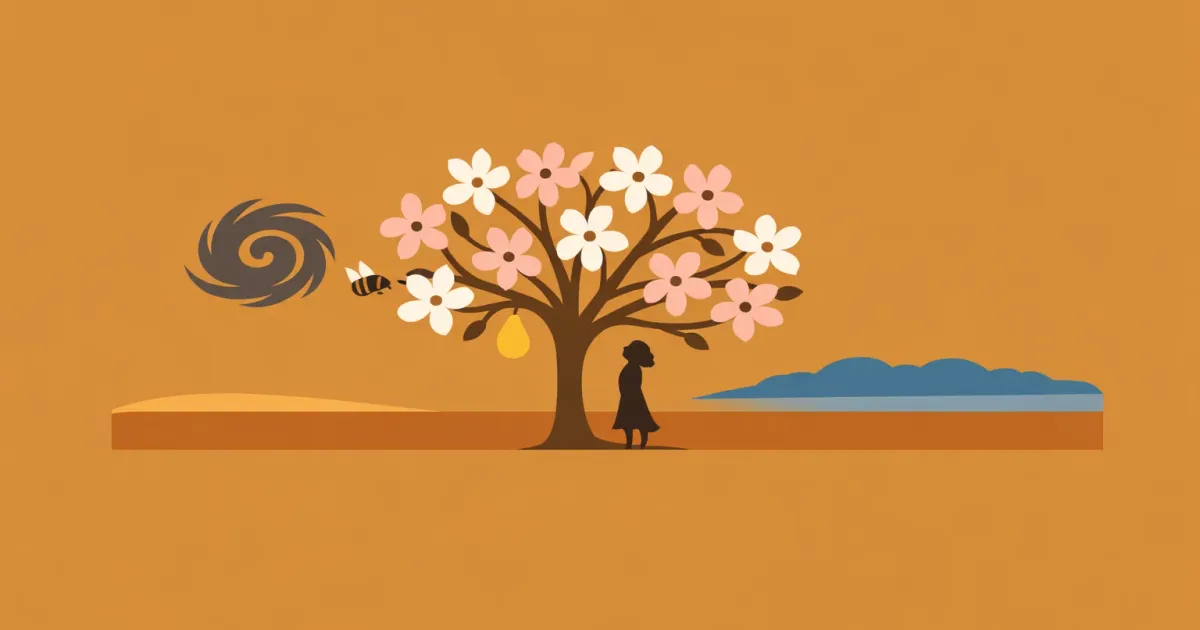
Janie is the woman at the center of every scene, even the ones that try to push her to the edge. She grows up in a West Florida backyard belonging to white people named Washburn, raised by her grandmother Nanny, not quite sure whether she's Black until a photographer shows her. By the time she walks back into Eatonville at the end of the novel in muddy overalls with her hair swinging down her back, she has buried two husbands, outlived a third, survived a hurricane, and stood trial for murder. What she wants — from sixteen on, under that blossoming pear tree in chapter 2 — is something she rarely names out loud: to feel about a person the way she felt about the bees on the blossoms, "marriage" as a word for ecstasy rather than a contract. Everything she does after Nanny marries her off to Logan Killicks is an attempt to get back to the pear tree or to understand why she can't.
Readers sometimes mistake Janie for passive because she spends long stretches of the book listening instead of speaking. That misreads her. She is the only character in the novel who actually changes her mind on camera. She also ends up telling the whole story to Pheoby on the back steps, which makes her, in the book's own logic, its author.
Hurston structures Janie's arc around three marriages, each of which corrects the previous one and exposes a different version of what a woman like her is supposed to want. Logan Killicks offers protection without love — Nanny's version of safety, rooted in memories of slavery and Janie's mother's rape. Joe Starks offers horizon without voice — a "big voice" that only swells by silencing hers. Tea Cake offers presence, play, and equality, at the cost of stability and, eventually, his life. Each marriage is also a stage of Janie's speech: she barely talks in the Killicks scenes; under Joe she learns to hold her tongue so completely that her "inside and outside" split apart (chapter 7); with Tea Cake she enters the muck's porch culture as a teller, not an ornament, and by chapter 20 she is the narrator of her own legend.
The novel's central metaphor for Janie's consciousness is the horizon, and Hurston uses it to trace the whole arc in a single gesture. In chapter 9 Janie realizes she hated Nanny for taking "the biggest thing God ever made, the horizon... and pinch[ing] it in to such a little bit of a thing that she could tie it about her granddaughter's neck tight enough to choke her." At the book's close she "pulled in her horizon like a great fish-net... from around the waist of the world and draped it over her shoulder. So much of life in its meshes!" The rope around the neck becomes a net on the shoulder — the same vastness, but now she carries it instead of being strangled by it. Her signature line to Pheoby, "you got tuh go there tuh know there," rejects every secondhand wisdom she has inherited from Nanny, Joe, the porch, and the novel's reader.
Janie's relationship to her own body, especially her hair, runs parallel to her arc. Joe forces her to wrap her hair because other men look at it; the morning after his death, she burns the head rags and lets it swing free (chapter 9). Tea Cake combs it at the piano. When she kills him in chapter 19, he dies biting her forearm — the last mark any husband leaves on her body. She comes home alone and that is not a defeat; it is the point.
Tea Cake (Vergible Woods)
Tea Cake walks into the store in chapter 10 at five-thirty on a slow afternoon and teaches Janie checkers. That one detail does more character work than most novels manage in a whole chapter. Joe had told her for twenty years that the game was too heavy for her brain; Tea Cake assumes she can learn, and she can. He is about twelve years younger than she is, owns basically nothing, picks beans for a boss-man, plays a guitar, gambles with a switchblade in his pocket, and treats Janie like a person he wants to spend his day with rather than a trophy he wants to display. His real name is Vergible Woods; nobody uses it.
For a long stretch of the novel Tea Cake is the closest thing to the pear tree Janie has ever actually touched. He takes her fishing at midnight, combs her hair, makes her come out to the bean field because he misses her during the day, and teaches her to shoot a rifle — the rifle she will eventually have to use on him.
Hurston refuses to let Tea Cake be either a savior or a villain, and the whole back half of the novel lives in that refusal. Chapter 13's chicken-and-macaroni episode is Hurston's first sharp reversal: the reader, like Janie, expects the Annie Tyler and Who Flung story — old widow robbed by a charming young hustler — and instead Tea Cake comes home at dawn with a guitar, three hundred and twenty-two dollars, and a razor slash in his back. The money is all there. The commitment is real. "You done married one uh de best gamblers God ever made," he tells her, which is funny and also a warning. Chapter 17's "brainstorm," in which he slaps Janie around not because of anything she's done but to "reassure himself in possession" after Mrs. Turner brings her brother around, is Hurston's equally sharp counter-move. Sop-de-Bottom's porch speech — "Uh person can see every place you hit her. Ah bet she never raised her hand tuh hit yuh back, neither" — turns the beating into community spectacle, and Hurston lets the ugliness of that sit on the page without softening it.
What makes Tea Cake a great literary creation is that both things are true at once: he is the first man who treats Janie as a full subject, and he is a man who hits her to perform ownership for an audience. The hurricane chapter forces the contradiction to a point. He is the one who insists they stay when the Seminoles leave. He is also the one who dives in to kill the rabid dog attacking her on the cow, taking the bite himself. Three weeks later, rabies-delirious, he fires a pistol at her, and she kills him with a rifle he taught her to use. She buries him in Palm Beach "like a Pharaoh to his tomb," with a new guitar in his hands. The ending does not ask the reader to forgive him or to condemn him; it asks the reader to accept that loving him was still the most alive Janie ever was.
Joe "Jody" Starks
Joe comes whistling down a road in West Florida in chapter 4 with three hundred dollars saved, a stylish suit, and a plan to be a "big voice" in an all-Black town being built further south. He tells Janie she "ain't got no mo' business wid uh plow than uh hog is got wid uh holiday" and marries her inside of a week. In Eatonville he buys two hundred more acres, opens a store and post office, gets himself elected mayor, installs the town's first street lamp, and builds a two-story house that makes the rest of the settlement look like servants' quarters. He is ambitious, charismatic, genuinely visionary, and — toward his own wife — a petty tyrant.
The core of Joe's character is that he cannot share a stage. He forbids Janie to join the porch storytellers, makes her tie up her hair so other men cannot look at it, and publicly declares that she is a "woman and her place is in de home." He isn't a cartoon villain; he's a man whose vision of success requires a silent wife to complete the picture.
Joe is Hurston's portrait of how ambition can metastasize into domination inside a marriage, and his decline is one of the best-constructed arcs in American fiction. Chapter 6 gives him his grand gestures — the yellow mule bought and "freed" in front of the town, the mock-epic funeral, the Lincoln-flavored rhetoric — while simultaneously showing him barring Janie from the funeral she'd most like to see. By chapter 7 his body has started to betray him: "He squatted over his ankles when he walked. That stillness at the back of his neck. His prosperous-looking belly that used to thrust out so pugnaciously... sagged like a load suspended from his loins." Hurston is careful: the physical decay and the increase in cruelty happen together. He pours ridicule onto Janie in front of customers because he can feel his own power leaking out.
The novel's hinge is the "playing the dozens" scene in chapter 7, when Janie finally answers back in public and tells him that when he pulls down his britches he looks "lak de change uh life." Hurston narrates what happens inside Joe with surgical precision: "Janie had robbed him of his illusion of irresistible maleness that all men cherish... she had cast down his empty armor before men and they had laughed, would keep on laughing." He strikes her, drives her from the store, and from that point forward is dying. On his deathbed in chapter 8 he is still trying to talk over her, and Janie finally says everything she has not been allowed to say — that he mistook obedience for love, that he never listened. He dies mid-curse. Hurston is not sentimental about any of it. Joe built an all-Black town, a real achievement; he also built a marriage in which his wife's voice was the one thing he could not tolerate. The book holds both truths without blurring them.
Logan Killicks
Logan Killicks is the sixty-acre farmer Nanny picks out for sixteen-year-old Janie as protection in chapter 3. Janie describes him as looking "like some ole skullhead in de grave yard." He has a house, a mule, land, and exactly zero interest in the romance Janie is reaching for under the pear tree. Within the year he has stopped talking in rhymes and started asking her to haul manure and chop wood; by chapter 4 he is shopping for a second mule "all gentled up so even uh woman kin handle 'im," meaning Janie will plow.
He is not cruel in the way Joe will be cruel. He is something simpler: a man who bought a wife the way he buys a second mule, and is bewildered when she won't pull her share.
Logan's real function in the novel is to literalize Nanny's warning. "De nigger woman is de mule uh de world," Nanny tells Janie in chapter 2, and Logan's sixty acres are where that sermon becomes a lived fact. Hurston's final exchange between them in chapter 4 is brutally clear. Logan tells Janie she should be grateful — he took her "out de white folks' kitchen" and set her down on her "royal diasticutis" — and threatens to kill her with an axe. Janie walks out of the gate that morning, unties her apron, flings it on a bush, and keeps going. It is the first time in the book she chooses her own direction, and Hurston marks the decision with one of her cleanest physical images: "The morning road air was like a new dress."
Logan is also the first marriage that teaches Janie a brutal lesson stated in chapter 3: "She knew now that marriage did not make love." Everything in the rest of the novel is measured against that line. He is barely on stage for sixty pages, but he establishes the baseline of what the pear tree is up against.
Nanny (Nanny Crawford)
Nanny is Janie's grandmother and the woman who raises her in the Washburns' back yard. She was born into slavery near Savannah, gave birth to Janie's mother Leafy after being raped by her master, hid in the swamp with a newborn to escape a whipping, and eventually worked her way to West Florida to "make de sun shine on both sides of de street for Leafy." Leafy was raped by a schoolteacher at seventeen, took to drinking, and vanished. Nanny took Janie and vowed to finish the "great sermon about colored women sittin' on high" she never got to preach.
Her entire theory of life comes out of that history: protection is the only love a Black woman can afford, and marriage is the only protection the world offers. When she catches Janie kissing Johnny Taylor over the gate, she moves fast and hard — Logan Killicks within weeks.
Nanny is the novel's counter-argument to itself, and Hurston is too honest a writer to caricature her. The chapter 2 monologue in which Nanny tells Janie "de nigger woman is de mule uh de world" is one of the most important speeches in twentieth-century American literature: a generational theory of survival, earned at a cost the reader is made to feel. She is not wrong about the world she knows. She is wrong about Janie, and the novel makes the reader sit with both facts.
The key passage for understanding Nanny is Janie's retrospective verdict in chapter 9, after Joe's funeral: "She hated her grandmother and had hidden it from herself all these years... Nanny had taken the biggest thing God ever made, the horizon... and pinched it in to such a little bit of a thing that she could tie it about her granddaughter's neck tight enough to choke her." That sentence is Hurston's argument with Nanny in miniature. Nanny's love was real. Her vision of safety was also a noose. The novel's closing fish-net image — Janie pulling in her own horizon and draping it over her shoulder — is the direct answer Janie spends the rest of the book earning the right to give.
Pheoby Watson
Pheoby is Janie's best friend in Eatonville and the only person she will tell the whole story to. She's the one who leaves the porch gossips with a plate of mulatto rice to hear it straight from Janie, and she sits on the back steps for the length of the novel, listening. Before Janie runs off with Tea Cake, Pheoby is the voice of careful love — she warns Janie about Annie Tyler, tells her to take two hundred dollars pinned inside her shirt just in case, and promises to keep quiet no matter what happens.
Pheoby is married to Sam Watson, she is loyal to the point of risk, and she is the person without whom the novel could not exist.
Hurston uses Pheoby to stage the book's central argument about who gets to hear a Black woman's life. The porch-sitters at the front of the house in chapter 1 are ready to judge Janie before she opens her mouth; Pheoby goes around back and listens. By chapter 20 she has been remade by the hearing: "Ah done growed ten feet higher from jus' listenin' tuh you, Janie. Ah ain't satisfied wid mahself no mo'. Ah means tuh make Sam take me fishin' wid him after this." Janie's response is the novel's quiet thesis — "you got tuh go there tuh know there" — and it is delivered not to a crowd but to a single friend on the back steps.
Structurally Pheoby is the reader's proxy. She asks the questions we'd ask, accepts the answers we'd struggle with, and becomes the carrier of Janie's story once Janie is done telling it. In a novel that has spent twenty chapters arguing that Black women should narrate their own lives, the last listener is also a Black woman, and that is not incidental.
Mrs. Turner
Mrs. Turner runs an eating-house on the muck and is Hurston's single most devastating portrait of internalized racism. Her shoulders round, her pelvis sticks out, her nose is slightly pointed and she worships it. She befriends Janie the instant she meets her because Janie's "coffee-and-cream complexion" and straight hair place her, in Mrs. Turner's mental hierarchy, on the white side of the color line. She cannot forgive Janie for marrying a man as dark as Tea Cake, but she has a plan: her brother.
Hurston's narrator describes Mrs. Turner's worldview with a theological seriousness that makes the satire land harder. Mrs. Turner has built "an altar to the unattainable — Caucasian characteristics for all"; she kneels before it and asks her deity, "in lieu of a cow, to remove the clots from her blood." The conversation in chapter 16 in which she tells Janie, "Ah can't stand black niggers... 'Tain't de poorness, it's de color and de features," is a clinical portrait of the ideology Hurston spent her career arguing against — a Black woman who has swallowed the aesthetic standards of white supremacy whole and built a life around trying to live up to them.
Functionally, Mrs. Turner exists to provoke Tea Cake's "brainstorm" in chapter 17 and to be run off the muck by the orchestrated brawl in her restaurant. But the more interesting thing Hurston does with her is refuse to make her a monster. Mrs. Turner suffers, believes, and has a theology; she is as human as anyone in the book. The cruelty she directs at other Black people is something she experiences as loyalty. That is what makes her the hardest character in the novel to dismiss.
The Muck Circle: Hezekiah, Motor Boat, Sop-de-Bottom, Nunkie, Sam Watson
The supporting cast on and around the muck carries the book's community texture. Hezekiah, Joe Starks's teenage store clerk, is a small comic miracle — he takes on Joe's mannerisms after the mayor's death, "cocking his hat" and borrowing the cheroots, and is the one whose afternoon off gives Tea Cake the opening to walk into the store. Motor Boat is the friend who refuses to keep running with Tea Cake and Janie during the hurricane in chapter 18 and instead climbs into an abandoned upstairs to sleep; the house miraculously floats and he survives, a small Hurston joke about the uselessness of prudence. Sop-de-Bottom is Tea Cake's closest friend on the muck and the source of the chapter 17 speech that makes the beating into a trophy — his "uh person can see every place you hit her" is one of the most uncomfortable passages in the book, and Hurston leaves it without editorial cushioning. After the trial he leads the Black men who came to testify against Janie; his grief and his misogyny are bound up in each other, which is exactly Hurston's point. Nunkie is the young woman in the cane rows who flirts with Tea Cake in chapter 15, provoking the jealous chase and the reconciliation-through-sex scene; she exists mainly to test the marriage and to show how Janie handles a threat she can actually see. Sam Watson, Pheoby's husband, is one of the porch's sharpest talkers ("Y'all really playin' de dozens tuhnight," he gasps when Janie finally answers Joe back), and the novel closes with Pheoby planning to make him take her fishing — a small, final domestic echo of everything Janie has taught her.
The Outer Ring: Johnny Taylor, Matt Bonner, Dr. Simmons
Johnny Taylor is the "shiftless" boy Janie kisses over Nanny's gatepost in chapter 2, the kiss that ends her childhood. He barely appears, but he is the trigger for everything. Nanny's glimpse of "Johnny Taylor lacerating her Janie with a kiss" is what makes her rush Janie into the Logan Killicks marriage within days. He is less a character than a catalyst. Matt Bonner is the small-time Eatonville farmer whose yellow mule the porch roasts across chapter 6 — worked too hard, starved, and mocked. The mule's eventual "freeing" by Joe Starks and its mock-epic funeral are the novel's extended running joke and its bleakest symbol: Nanny's mule-of-the-world sermon rendered in public comedy. Matt himself is mostly a punchline, but his humiliation gives the porch its rhythm and gives Hurston the scaffolding for some of her best folk-talk set pieces. Dr. Simmons is the white muck doctor in chapter 19 who examines the rabid-dog bite, diagnoses Tea Cake, wires Miami for serum too late, and testifies at Janie's trial. His role is brief and decisive. He tells Janie privately what she already suspects — that Tea Cake will get worse and probably try to hurt her — and his medical testimony is what gets Janie acquitted by an all-white jury in five minutes. Hurston's handling of him is coolly ambiguous: he is a decent man performing an act of racial mercy in a courtroom where the Black community that loved Tea Cake is the one denied the chance to save him.