Themes & Motifs
Voice, Silence, and Self-Authorship
The novel's deepest argument is about who gets to narrate a Black woman's life. Janie spends most of the book being spoken for — by Nanny, by Logan, by Joe, by the porch, by the Eatonville gossips who open Chapter 1. She only becomes a full person when she learns to speak, and the book itself is the evidence: every word past the first page is Janie telling her story to Pheoby. Hurston frames the novel so that the act of narrating is the victory.
Consider the two scenes that bookend Joe's marriage. In the store (Chapter 6), Janie "pressed her teeth together and learned to hush" because fighting back "just made Joe do more." Years later, she finally answers his public insult with the crack about the "change uh life," and Joe falls apart on the spot. Speech is not decorative in this book — it is the hinge on which power turns.
Hurston builds the theme architecturally. The frame narrative in Chapter 1 shows the porch-sitters making Janie "a chewing cud" for their gossip, producing speculation about her without her consent. Janie's counter-move is to refuse them and tell Pheoby instead. This is not a private choice; as Janie tells Pheoby in the opening frame, "Tain't no use in me telling you somethin' unless Ah give you de understandin' to go 'long wid it." Speech requires a worthy listener, and Hurston is careful that Janie's audience is another Black woman.
The Joe Starks chapters track silencing as physical confinement. He ties her hair up in the store, bars her from the mule funeral, and pronounces in public that "she's uh woman and her place is in de home." When she finally talks back about his body, the narrator remarks that she has "cast down his empty armor" and "robbed him of his illusion of irresistible maleness." Janie does not kill Joe — his vanity does — but his death follows directly from her words. Hurston is arguing that patriarchal authority is sustained by the silence it enforces, and that it cannot survive a Black woman who decides to speak.
The theme gets its final answer in the narrative technique itself. Hurston moves in free indirect discourse between literary English and African American Vernacular, so that Janie's consciousness shapes the narration even where she is not "speaking." When Janie tells Pheoby in Chapter 20 that "you got tuh go there tuh know there," she is making an epistemological claim: knowledge belongs to the person who lived it, not to the porch that comments on it. The novel's whole form is built to honor that claim.
Love vs. Protection: The Pear Tree and the Mule
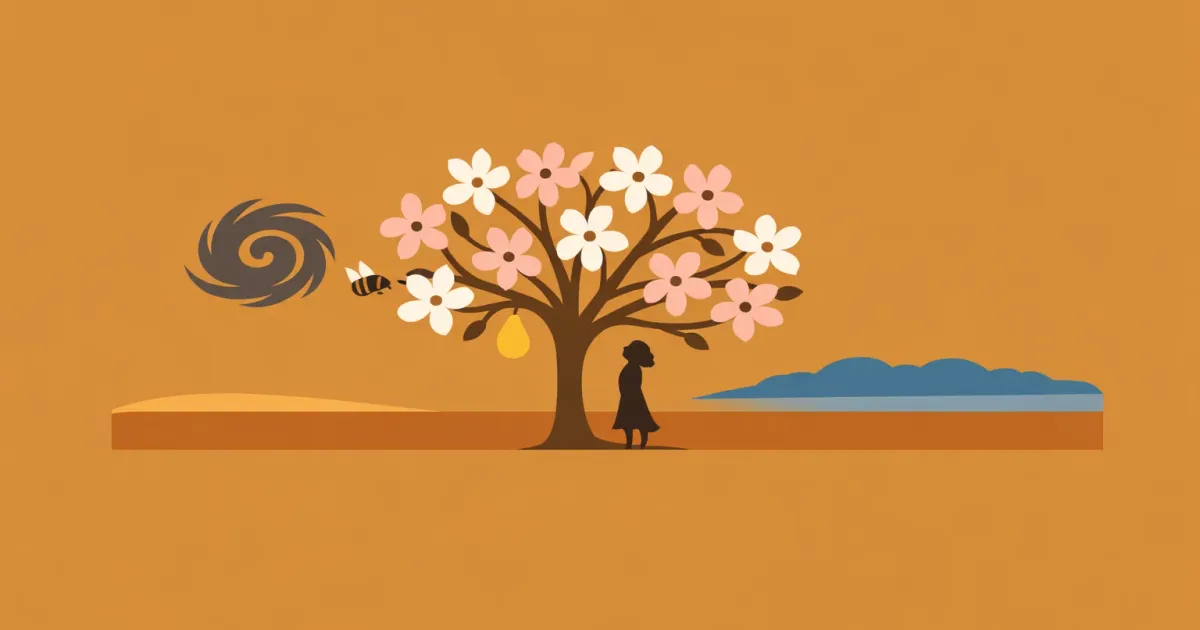
Two competing definitions of what a Black woman should want structure the entire novel. Nanny wants Janie safe. Janie wants Janie alive. These sound like the same thing and are not. Nanny, born into slavery and raped by her enslaver, watches her own daughter raped by a schoolteacher, and concludes that a Black woman's only hope is material security — a house, sixty acres, a husband with property. Janie, lying under the blossoming pear tree in Chapter 2, decides love must feel like the bee sinking into the bloom: reciprocal, ecstatic, inevitable.
The novel refuses to pretend either woman is wrong. Nanny's fear is a rational response to documented violence. Janie's pear-tree vision is, in a world of Nannys, a dangerous luxury. But Hurston treats the pear tree as a real standard, not a teenage fantasy, and measures every man in the book against it.
Nanny compresses her philosophy into one of the novel's famous lines — "de nigger woman is de mule uh de world" (Chapter 2) — and its logic is survival through submission. She tells Janie bluntly that she wants her married to Logan not because of love but because "'Tain't Logan Killicks Ah wants you to have, baby, it's protection." Logan, with his sixty acres and his organ-that-nobody-played, is a shelter. He is also, within a year, demanding Janie help him buy a second mule so she can plow a second field. Nanny's protection becomes Nanny's prophecy: the Black woman is the mule of the world, even inside the marriage meant to shield her.
Joe Starks is the protection theme's second iteration — upward-mobility edition. He "spoke for change and chance" and "far horizon" (Chapter 4), offering Janie a class leap rather than a pear tree. What he actually delivers is a two-story house and a head-rag. Hurston's critique is pointed: the Black bourgeois protection Joe provides requires the same submission as Logan's plow. Janie realizes in Chapter 7 that Joe has never "stopped to think whut she was thinkin'." Protection, in both its agrarian and its middle-class forms, still asks a woman to disappear.
Tea Cake is the first man who offers something closer to the pear tree. He teaches her checkers rather than forbidding it; he insists she come to the picnic rather than hiding her at home; he picks beans beside her on the muck. Hurston is not naive about him — his possessive jealousy in Chapter 17, when he slaps Janie to "reassure himself in possession," reveals that even love this rare is shadowed by the same ownership logic Nanny feared. But Tea Cake also dies listening to her, and he dies because he went into the water to save her. The novel's answer to Nanny is not that love is safer than protection but that love is worth the risk protection exists to prevent.
The Horizon and Self-Discovery
The horizon is the book's most insistent image, and it belongs specifically to Janie. Hurston opens Chapter 1 with it — ships on the horizon, some coming in with the tide, some receding forever — and closes Chapter 20 with Janie pulling her horizon in "like a great fish-net" and draping it over her shoulder. Between those two images, the horizon is what every marriage either expands or pinches.
At the simplest level, Janie wants a bigger life than the one handed to her, and the horizon names that longing. But Hurston uses the image to track power as much as appetite. Nanny shrinks it; Joe promises it and withholds it; Tea Cake actually carries Janie toward it.
Chapter 9, the great interior passage after Joe's death, turns the horizon into an explicit political image. Janie realizes she has hated Nanny for "taking the biggest thing God ever made, the horizon … and pinching it in to such a little bit of a thing that she could tie it about her granddaughter's neck tight enough to choke her." The horizon stops being a view and becomes a collar. Nanny's protection, rendered through this image, is figured as strangulation — the same pinched-in smallness Joe enforces with head-rags and store counters.
Joe himself is the man who first "spoke for far horizon" in Chapter 4, which is what seduces Janie onto the train. Hurston's irony is that a man who advertises horizons ends up building a house with walls instead. The horizon Joe offered was a real estate horizon — property, status, mayoralty — and it turned out to be another fence. Tea Cake, by contrast, delivers the horizon by depriving Janie of the things Nanny and Joe both insisted were essential: no house of their own, no savings, no dignity of social position, just bean fields and porch music and the Everglades sky.
The closing fish-net image is the book's precise rebuttal of Nanny. Where Nanny "pinched" the horizon in to choke, Janie now "pulled it from around the waist of the world and draped it over her shoulder." She owns it as a garment rather than wearing it as a yoke. That this happens in solitude, after Tea Cake's death, is also the point: Janie's horizon is not something a man gives her. It is something she has at last learned to carry.
Race, Color, and the Black Community
Hurston writes race in a register very different from the protest novels of her contemporaries, which is why Richard Wright accused her of ducking the subject. He was wrong — the novel treats race with constant attention — but the attention is aimed inward, at the segregated emotional and social world of Black Florida, rather than outward at white antagonists. Hurston's subject is not the white gaze; it is what Black people do with the interior space the color line leaves them.
Two episodes anchor the theme: Eatonville as an all-Black town with its own mayor and store and porch culture, and the Mrs. Turner chapters in which a half-white restaurant owner befriends Janie specifically to detach her from "too-black" Tea Cake.
Eatonville itself is a political argument. Hurston's real hometown, incorporated in 1887, was one of the first self-governing Black municipalities in the United States, and she treats it as neither utopia nor embarrassment. The town has its own politics (Joe's mayoralty, the schoolhouse, the street lamp), its own class snobbery (Joe's two-story house looming over the shotgun shacks), and its own vernacular culture (the porch, the mule jokes, the dozens). White characters are nearly absent from the middle of the book, not because white power is absent but because Hurston wants to show what Black community life sounds like when it is not performing for white readers. The porch chapters in Chapter 6 — the yellow mule stories, the nature-versus-caution debate, the courtship play-acting with Daisy — are Hurston the anthropologist getting her own people down on the page without translation.
Mrs. Turner (Chapter 16) is the novel's study in internalized racism, and Hurston writes her with an almost cruel clarity. Mrs. Turner tells Janie she can't stand "black folks" and wishes she could "class off" with light-skinned people; she keeps "an altar to the unattainable — Caucasian characteristics for all." The character is devastating because she is not an outlier but a type — the mixed-race colorism that runs through twentieth-century Black communities. Hurston uses Mrs. Turner to argue that the color line did not only wound Black people from outside; it also taught some of them to wound each other.
The Palm Beach burial chapter (Chapter 19) is the book's sharpest direct indictment of white power. Armed white men conscript Tea Cake and others into hurricane cleanup, and orders come from "headquarters" that white bodies get pine coffins and Black bodies get quicklime. Hurston reports this without editorial commentary — she trusts the fact to do the work. The scene reframes everything that has come before: the Black community's interior world, porch culture, horizons, pear trees — all of it persists inside a white power structure that still sorts bodies by color even in mass graves.
Gender, Marriage, and the "Mule of the World"
Nanny's line about the Black woman as the mule of the world is the book's governing proposition about gender, and the novel treats it less as metaphor than as diagnosis. Marriage after marriage, the men in Janie's life reach for language or gestures that put her in harness. Logan literally wants her to help buy a second mule. Joe says women are like "chickens and cows," requiring somebody "to think for" them. Even Tea Cake, in his brainstorm moment on the muck, beats Janie partly to demonstrate to the Turners that he owns her.
Hurston's response is not a counter-slogan. It is the slow accumulation of scenes in which Janie refuses the bridle.
The yellow mule of Eatonville (Chapter 6) is the book's central symbolic knot. Matt Bonner works the mule too hard and starves it; the porch turns the mule's misery into running comedy; Joe "frees" the mule in a grand gesture that makes him "like George Washington and Lincoln" — an analogy Janie delivers with enough sweetness to pass as praise and enough edge to register as irony. When the mule dies, Joe bars Janie from the funeral because "de mayor's wife is somethin' different again." The mule gets a public funeral. Janie gets to stand in the store doorway. Nanny's prophecy arrives in its most literal form: the mule of the world is not allowed to attend the mule's funeral.
The store becomes the long laboratory for Janie's education in gendered submission. Joe requires her to cover her hair because other men's looking at it is a property violation. He publicly humiliates Mrs. Tony Robbins for begging meat from her husband, and the porch agrees that "beatin' women is just like steppin' on baby chickens." Janie finally pushes into the conversation — "It's so easy to make yo'self out God Almighty when you ain't got nothin' tuh strain against but women and chickens" — and Joe shuts her down by ordering her to fetch the checker-board. Hurston stages the whole scene so that the porch's casual misogyny, Joe's public ownership of Janie, and Janie's first full sentence of rebellion all happen in the same half page.
The answer the novel eventually gives to Nanny's mule line is not that the Black woman is no longer a mule but that she can become the person who pulls in her own horizon. When Janie kills Tea Cake in self-defense and is acquitted by an all-white, all-male jury, the verdict is ambivalent on purpose: the system that exonerates her is the same system that buried Black hurricane dead in quicklime. Hurston refuses the consolation of cleanly earned freedom. What she gives Janie instead is the right to tell the story afterward, which in this book is the only freedom that finally counts.
Nature, God, and the Indifferent Universe
The novel's title comes from Chapter 18, the hurricane night, when the workers in their flooded shanty stare into the dark "and their souls asking if He meant to measure their puny might against His. They seemed to be staring at the dark, but their eyes were watching God." This is not a devotional posture. It is the question a person asks when the storm is louder than the walls: does the God we were raised on actually care about us, or are we furniture he moves?
The question organizes the book's whole metaphysics. Nature in Hurston is not the pastoral backdrop of nineteenth-century fiction; it is a force that makes and unmakes human arrangements without consulting them.
The pear tree and the hurricane are the two poles of the novel's nature writing. The pear tree in Chapter 2 shows nature as erotic revelation — the bee sinking into the bloom, the "ecstatic shiver of the tree from root to tiniest branch." Janie reads the tree as a promise: marriage should feel this alive. The hurricane in Chapter 18 shows nature as the same force at a different register — Okeechobee personified as a monster in his bed, the dike breaking, the lake walking. Hurston's argument is not that the pear tree lied but that nature's indifference cuts both ways. The same creative force that animates the bloom also drowns two hundred people in the muck.
Hurston also undercuts the easy pieties that normally cluster around "God." The Seminoles and the animals read the storm correctly and leave; the white boss-man reads it wrong and stays; Tea Cake, deferring to white authority, also stays. When the dike breaks, neither prayer nor social hierarchy offers protection. The Chapter 19 burial detail continues the argument in a human register: the God who watched the hurricane apparently also watches white men sorting coffins by race, and intervenes in neither. Hurston is close, here, to the existentialism her critics denied her having — her God is less a moral agent than a standard against which human puny-ness is measured.
The title's ambiguity is the point. "Their eyes were watching God" can be read as reverent, accusatory, or simply descriptive — eyes turned upward because there is nowhere else to look. Hurston never resolves which reading is correct, and that refusal is itself the theological claim. Meaning in this novel is not handed down from the sky. It is what Janie makes, after the storm, with her horizon draped over her shoulder and her soul called in to witness.
Folklore, Oral Tradition, and the Porch
Hurston trained as an anthropologist under Franz Boas and spent years collecting folklore across the rural South and the Caribbean. Their Eyes Were Watching God is the novel where that training meets her fiction most directly. The porch is where the book thinks about storytelling itself — who gets to tell stories, whose stories are taken seriously, and what is lost when a Black woman is forbidden from joining the porch talk.
On the accessible level, this is why Chapter 6 reads the way it does. The yellow-mule jokes, the nature-vs.-caution debate between Sam and Lige, the courtship play-acting with Daisy — none of it advances the plot. All of it is the sound of a Black community producing its own meaning.
Hurston renders porch talk as collective authorship. The mule stories are not told by one narrator but built hyperbolically by Sam and Lige and Walter, each line topping the last, the porch laughing as quality control. The Sam-Lige nature debate is explicitly a "contest in hyperbole … carried on for no other reason" — a model of Black vernacular performance as art form rather than gossip. The courtship around Daisy — "Ah'd step backward offa dat earoplane just to walk home wid you" — is "acting-out courtship and everybody is in the play." Hurston's point is that the porch is a literary tradition, even if white critics have never recognized it as one.
Janie's exclusion from the porch is therefore a specifically literary injury, not just a social one. Joe forbids her to "indulge" in mule talk because "Mrs. Mayor Starks" should not be "treasurin' all dat gum-grease from folks dat don't even own de house dey sleep in." This class contempt is also a gender contempt and an artistic censorship: Janie, whom Hambo calls a "born orator" in the mule-freeing scene, is barred from the one tradition in which her oratory would be at home. Her whole arc from that point is a slow return to porch-level speech — first in her deathbed monologue to Joe, then in the dozens on the muck, and finally in the book-length narration to Pheoby that is the novel itself.
The book's frame closes this theme with precision. Pheoby, who has listened to Janie's whole story on the back steps, tells her she is going to make her husband take her fishing — a small, concrete change that Janie's story has produced. That is Hurston's model of how stories actually move through a community: not as moral lessons from a pulpit but as talk from one Black woman to another, carried forward in the quiet of a back yard after the porch at the front of the house has finally given up guessing.