Key Quotes
"Ships at a distance have every man's wish on board."
Speaker: Narrator (Chapter 1)
This is the famous opening line of the novel, and it kicks off a short meditation on how men and women carry desire differently. For men, Hurston suggests, the ships either come in or drift forever on the horizon. For women, dreams operate by a different set of rules — which is exactly the life we're about to watch Janie live.
The ship-and-horizon image is the novel's first planting of a motif Hurston will return to in every section: the horizon as the full reach of a human life, and the individual's willingness to sail toward it. The sentence also establishes the book's dual register. Narration moves in literary English, elevated and almost biblical, while the dialogue that follows will be rendered in dense African American Vernacular. That split is not accidental — it signals that Janie's story will be told on two linguistic planes at once, and that Hurston intends to be read as both folk ethnographer and prose stylist.
"Now, women forget all those things they don't want to remember, and remember everything they don't want to forget."
Speaker: Narrator (Chapter 1)
The narrator's second sentence pivots from men's dreams to women's memory. The line sets up the novel's structure as a work of active remembering: Janie has come back to Eatonville to tell Pheoby the entire story, and she will not edit the painful parts out.
The sentence reads like folk wisdom but does serious structural work. It justifies the frame narrative — everything from chapter 2 onward is Janie's memory, unprompted and selective on her own terms rather than the town's — and it names the book's theory of female selfhood. Women do not get to choose what stays with them, but they can choose what to do with it. Hurston will test that claim through three marriages, a hurricane, and a courtroom. The chiasmus (forget/remember, remember/forget) also establishes the rhythmic, quasi-oral cadence that will shape the narration throughout.
"So this was a marriage!"
Speaker: Narrator, voicing Janie (Chapter 2)
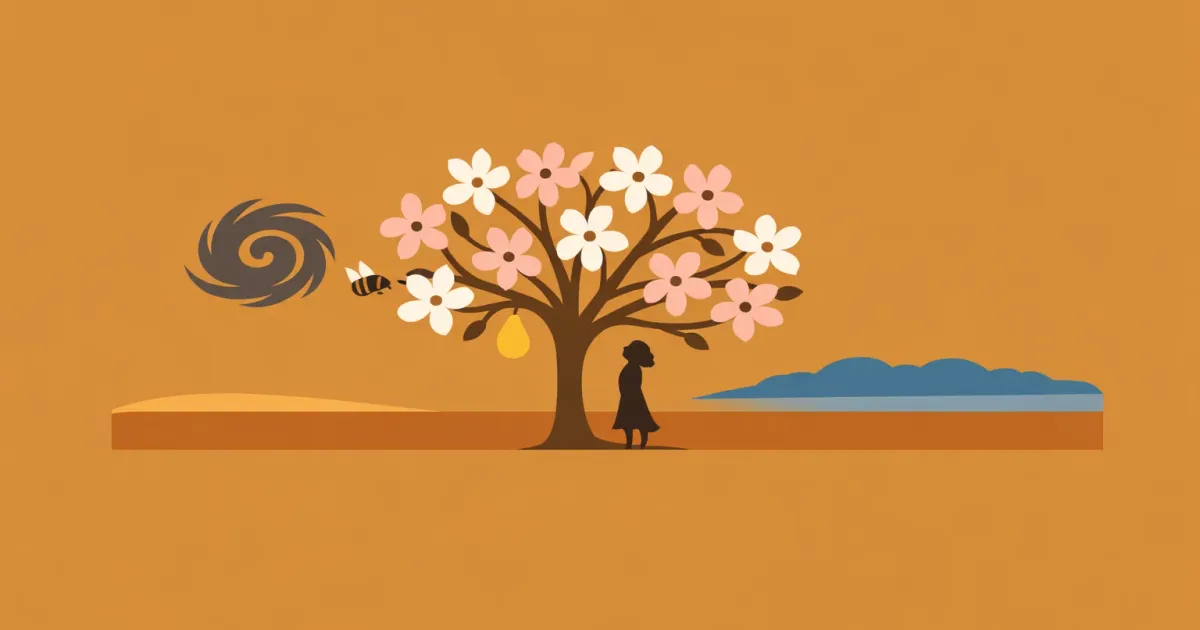
Sixteen-year-old Janie is lying under a blossoming pear tree in Nanny's yard when she watches a bee sink into a bloom. The whole tree shivers in answer, and Janie feels an ache she decides must be what marriage is supposed to feel like. Every relationship in the book will be measured against this moment.
The pear-tree passage is the governing image of the novel — an erotic, ecstatic, self-chosen standard of love that exists before any man has ever approached Janie. Hurston codes it as revelation ("summoned to behold"), not instruction, which matters: Janie's definition of marriage is born inside her own body, not handed down by Nanny or Logan or Joe. Every disappointment that follows is legible against this benchmark. Logan's manure pile desecrates the pear tree. Joe's head-rag smothers it. Only Tea Cake, who arrives with "the sun for a shawl," comes anywhere near that original pollinated light — and the novel's tragedy is that even he cannot stay.
"De nigger woman is de mule uh de world so fur as Ah can see."
Speaker: Nanny (Chapter 2)
Nanny says this to a weeping sixteen-year-old Janie while explaining why she is forcing her into marriage with Logan Killicks. The line is her theory of Black women's place in the racial hierarchy — white men rule, Black men carry the load they're handed, and Black women carry whatever the men set down.
Hurston preserves the full force of Nanny's dialect because softening it would flatten the character. Nanny is not wrong about her own century; she was born into slavery, raped by her enslaver, hunted with her infant through a Georgia swamp. Her "mule" analysis is hard-won survival knowledge. The novel's argument is not that Nanny is cruel but that her ceiling has become Janie's ceiling — protection mistaken for love, safety mistaken for a life. Janie's entire arc is the slow work of refusing the mule-of-the-world inheritance without refusing the grandmother who handed it down. The literal mule that dominates Eatonville chapters, Matt Bonner's yellow mule, is Hurston's grimly comic reminder that Nanny's metaphor is also the town's reality.
"She's uh woman and her place is in de home."
Speaker: Joe "Jody" Starks (Chapter 5)
After Joe has been elected mayor of Eatonville, the crowd asks Mrs. Mayor Starks to give a few words. Joe cuts in before Janie can answer and declares she has nothing to say. It's the moment the marriage curdles — publicly, in front of the town.
This is the sentence that ends Janie's first belief in Joe. Hurston is careful not to make Joe a cartoon: he has real political vision and genuine charisma, and he has built an all-Black town where a Black woman can in theory be called Mrs. Mayor. What he cannot tolerate is Janie having a voice of her own, and the form of his refusal matters — he answers a question directed at her, in the third person, while she is standing there. The statement codifies what will become twenty years of silence in the store, the head-rag covering her hair, the ban on participating in porch storytelling. It is also the rhetorical setup for the chapter 7 moment when Janie finally talks back.
"When you pull down yo' britches, you look lak de change uh life."
Speaker: Janie Crawford (Chapter 7)
Joe has been picking at Janie's looks in front of the store porch, taunting her for aging. Janie answers publicly for the first time in the marriage, telling him that underneath his big belly and bluster he looks like a menopausal woman. The porch goes silent; Joe has been unmanned in front of the entire town.
The scene is written as a round of "playing the dozens," the Black Southern tradition of ritual insult, and Hurston treats Janie's line as the novel's hinge. Until this moment Janie has kept her inside and outside separate, performing wife while thinking otherwise. The insult is so lethal precisely because it uses Joe's own weapon — public male talk on the porch — against his sexual pride, the one thing propping him up. He never recovers. Within a chapter he is physically dying, and Hurston explicitly ties his collapse to this humiliation. The scene also establishes speech itself as the novel's central act: the first time Janie uses her voice in public, it kills the man who spent twenty years trying to take it from her.
"She hated the old woman who had twisted her so in the name of love."
Speaker: Narrator, free indirect (Chapter 9)
After Joe's funeral, Janie sits alone in the big house and lets herself think a thought she has been hiding from herself for years: she hates Nanny. Not for cruelty, but for shrinking the horizon down to Logan Killicks's sixty acres and calling it protection.
This passage contains the novel's sharpest single image — Nanny taking "the biggest thing God ever made, the horizon" and pinching it in tight enough to choke her granddaughter — and it is the book's most quietly radical moment. Hurston refuses the sentimental reconciliation that most twentieth-century novels about grandmothers and granddaughters would deliver. Nanny's love was real, and it was also a cage. The honesty of that judgment licenses the reader to honor Nanny as a historical witness without treating her wisdom as the endpoint of Black women's imagination. The horizon image returns in the book's final pages, reclaimed — Janie will pull it in like a fish-net rather than wear it as a noose.
"Their eyes were watching God."
Speaker: Narrator (Chapter 18)
In the depth of the 1928 hurricane, Janie, Tea Cake, and Motor Boat sit in a flimsy shanty while the wind doubles back and the lamp goes out. They cannot see each other in the dark, but they are looking up, asking whether God means to measure their small lives against his storm.
This is the sentence that gives the novel its title, and its weight comes partly from its position — deep inside the book's longest, most apocalyptic setpiece — and partly from its theology. The eyes are not praying. They are asking a question the King James Bible would never put so bluntly: does this God mean us harm? Hurston personifies the storm as a single body with a heel and a breath, and the human response is neither resignation nor faith but sustained, clear-eyed interrogation. The image also rhymes with the novel's first page, where the "Watcher" gives up and turns his eyes away from ships that never land. Here, under the hurricane, the watchers refuse to look away. That refusal is itself the book's working definition of courage.
"Two things everybody's got tuh do fuh theyselves. They got tuh go tuh God, and they got tuh find out about livin' fuh theyselves."
Speaker: Janie Crawford, to Pheoby (Chapter 20)
Back on the porch at the end of her story, Janie hands Pheoby what sounds like a country proverb but is really the thesis of the book she's just finished telling. No one else — not Nanny, not a husband, not a church — can do either of these things on your behalf.
The line is the novel's answer to Nanny's "mule of the world" speech from chapter 2, and the symmetry is deliberate. Nanny's frame was collective — Black women as a class, carrying a load not their own — and her cure was protection arranged by someone else. Janie's frame is individual and unassignable. Hurston's insistence on the vernacular ("fuh theyselves" rather than standard English) is the point: this theological claim is not being delivered from a pulpit or a university, it is the earned speech of a Black woman in overalls on her back porch. Pheoby, who has spent the novel listening, is now the carrier of the argument.
"Love is lak de sea. It's uh movin' thing, but still and all, it takes its shape from de shore it meets, and it's different with every shore."
Speaker: Janie Crawford, to Pheoby (Chapter 20)
Janie's definition of love, offered to Pheoby as she finishes the story. Love is not a fixed template or a grindstone that shapes everything the same way — it takes the form of whoever it meets, which is why her love with Tea Cake cannot be judged against anyone else's.
The metaphor is a direct inheritance from the book's first page, where men's wishes were ships at a distance. Janie has moved the water from the horizon into the heart: love is no longer something to sail toward, it is the sea itself, shaped by contact. The formulation preempts the porch-sitters and Pheoby's earlier warnings about Tea Cake. Yes, the marriage was short. Yes, it ended in a rifle. But those facts cannot measure the love, because the shore that was Tea Cake no longer exists. The sentence is also Hurston's quiet rebuttal to any reader — Richard Wright included — who expected the novel to deliver a universal verdict on Black heterosexual love. Hurston refuses the grindstone.
"She pulled in her horizon like a great fish-net… She called in her soul to come and see."
Speaker: Narrator (Chapter 20)
The last image of the novel. Alone in her bedroom in Eatonville with a lamp, Janie gathers her experience around her like a fisherman hauling in a heavy net, drapes it over her shoulder, and invites her own soul to witness what she's made of her life.
Hurston closes with the exact image she needed to answer Nanny's strangling of the horizon in chapter 9. Where Nanny pinched the horizon tight enough to choke her granddaughter, Janie now reels it in herself and wears it. The fishing-net figure is quietly audacious: it claims for a Black woman in her forties, widowed twice and once a defendant on a murder charge, the posture of a classical hero returning home with the catch. The final clause — calling in her soul to come and see — refuses the expected religious consolation. No God descends. Janie is her own witness, and the novel ends on the act of self-beholding that Nanny never got to have and that Joe spent two decades trying to prevent.