Summary
Overview
Their Eyes Were Watching God is the story of a Black woman who gets to tell her own life on her own terms. Janie Mae Crawford walks back into the all-Black town of Eatonville, Florida one evening in muddy overalls, past a porch full of neighbors already chewing over rumors about her. Instead of explaining herself to them, she sits down with her best friend Pheoby Watson and tells the whole story — three marriages, one hurricane, and a long argument with what other people thought a woman like her was supposed to want. Everything between that first porch scene and the last page is Janie's memory.
The novel follows Janie from a childhood under her grandmother Nanny in West Florida, through a loveless first marriage to the farmer Logan Killicks, into her twenty-year run as the silenced wife of Eatonville's mayor Joe "Jody" Starks, and finally into a brief, ecstatic, and devastating marriage to Vergible "Tea Cake" Woods down in the Everglades "muck" around Lake Okeechobee. Along the way Hurston writes some of the most lyrical prose in American literature and some of the richest dialect dialogue ever put in print. The central question is one Janie keeps asking under different names: what would it look like to love, to speak, and to choose for herself, in a world that keeps telling her she doesn't get to?
When Hurston published the novel in 1937 it was received coldly. Richard Wright, reviewing it in New Masses, accused Hurston of writing a "minstrel" novel that carried no serious racial protest — a judgment that helped push the book out of print and Hurston into obscurity. Alice Walker's 1975 essay "In Search of Zora Neale Hurston's Grave" restored the novel to the canon almost single-handedly, and it now anchors most serious reading lists in African American literature, the Harlem Renaissance, and twentieth-century women's writing. What Wright mistook for apolitical is in fact the book's argument: that a Black woman's interior life, her appetites and her refusals, is itself political terrain worth a novel.
Structurally, the book is a frame narrative. The present-tense Eatonville porch opens Chapter 1 and closes Chapter 20, and everything between is Janie's oral storytelling to Pheoby, rendered in a free indirect style that lets Hurston shuttle between standard literary English in the narration and rich African American Vernacular English in the dialogue. That split is not decorative — it stages the novel's argument about whose voice gets to shape a life. Hurston, a trained anthropologist who had collected folklore across the rural South and the Caribbean, uses the frame to make Janie the author of her own myth rather than its object. The repeated motifs — the pear tree in bloom, the horizon, Janie's heavy unpinned hair, the hurricane — accumulate into a private vocabulary that gives the book its particular, unmistakable sound.
Chapters 1–2: The Frame and the Pear Tree
The novel opens at sundown as Janie walks back into Eatonville after eighteen months away. The porch-sitters watch her and gossip — where is the young man she left with, where is her money, why is she wearing field overalls? Pheoby leaves the porch with a plate of mulatto rice and finds Janie washing her feet on the back steps. Janie tells her she's come back because Tea Cake is gone, and settles in to tell the full story. Chapter 2 jumps back to her girlhood in West Florida, where she was raised in the Washburns' back yard by her grandmother Nanny. As a teenager under a blossoming pear tree, Janie has her first erotic vision — a bee sinking into a blossom — and decides that marriage must feel like that. Nanny catches her kissing the shiftless Johnny Taylor over the gate and, terrified, announces she wants Janie married off immediately to a much older landowner named Logan Killicks. Nanny tells Janie the story of her own enslavement, her daughter Leafy's rape by a schoolteacher, and her dream of seeing Janie "safe" — protection, not love.
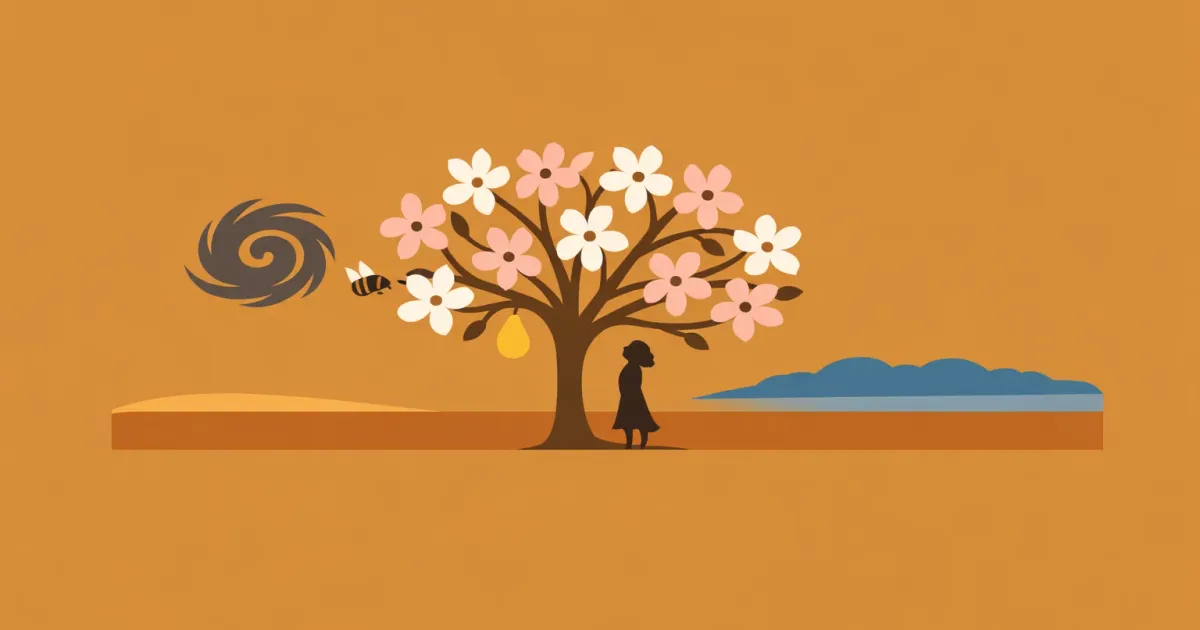
These two chapters do the heaviest structural work in the book. Chapter 1 installs the frame (Janie telling Pheoby) and seeds every major motif — the sunset porch, the overalls and the loose hair, the horizon, judgmental public talk versus private truth. Chapter 2's pear tree is the novel's governing image: an ecstatic, private standard of what love should feel like, against which every marriage will be measured. Nanny's monologue is the counter-argument — a generational theory of survival built on the line that "de nigger woman is de mule uh de world." The book's central tension is audible from the start: Janie's pear-tree appetite against Nanny's protective realism.
Chapters 3–6: Logan Killicks and the Rise of Joe Starks
Janie marries Logan Killicks and moves to his sixty acres. She waits for love to arrive; it doesn't. After Nanny's death Logan starts demanding she work like a second mule — help him move the manure pile, plow a second field — and Janie realizes marriage did not make love. One spring morning while she is cutting seed potatoes in the yard, a "cityfied" stranger in a nice suit comes whistling down the road: Joe Starks, on his way to an all-Black town being built further south. He tells her she wasn't made to plow, he wants to be a "big voice," and he will treat her like a lady. Within days Janie leaves Logan, meets Joe on the road, and marries him in Green Cove Springs. They arrive in Eatonville to find it barely a settlement. Joe buys two hundred more acres from the white Captain Eaton, opens a store and post office, gets himself elected mayor, and installs the town's first street lamp. He builds a two-story house that makes the rest of Eatonville look like servants' quarters and requires Janie to tie her hair up so other men can't look at it. Chapter 6 centers on the slow grinding of their marriage around the life of Matt Bonner's yellow mule — the porch storytellers' running joke, then Joe's grand gesture of "freeing" the mule, and finally the mule's mock-epic funeral. Joe forbids Janie to join the crowd. She watches from the store doorway as the town leaves her behind.
This stretch is the novel's long study of how a "big voice" silences other voices. Joe isn't a cartoon villain — Hurston gives him real charisma, real vision, and a genuine political ambition for an all-Black town. What he cannot tolerate is Janie as a subject with her own speech. The head-rag, the high chair, the ban on the porch storytelling, and Joe's public line "she's uh woman and her place is in de home" are all versions of the same gesture: reducing Janie to an ornament that reflects his status. The yellow mule is the perfect symbol — worked to death, mocked, "freed" only when it is too old to matter, mourned in a parody funeral where men perform speeches while a Black woman is barred from attending. Nanny's prophecy, that the Black woman is the mule of the world, has come true in a setting Nanny would have called success.
Chapters 7–9: Joe's Decline, His Death, and Janie's Widowhood
Janie learns to hold her tongue. Her "inside" and "outside" separate, and the marriage becomes a performance. After years of this, Joe — now sagging and aging visibly — picks at Janie's looks in front of the store porch one afternoon. Janie finally answers back and tells him that when he pulls down his britches he looks like "de change uh life." The men on the porch gasp; Joe has been publicly unmanned. He strikes her and drives her from the store. From that night he moves to a downstairs room, stops eating her cooking, and brings in a "two-headed" root-doctor, convinced Janie has poisoned him. Joe is dying of kidney failure. Janie forces her way into his sickroom and tells him, finally, everything she has not been allowed to say — that he never listened, that he mistook obedience for love. He dies mid-sentence while cursing her. At the lavish funeral Janie "starches and irons her face" behind her veil; underneath, she is free. She burns her head rags, lets her hair swing down her back, and spends six months politely ignoring every suitor in South Florida.
The "playing the dozens" scene in the store is the hinge of the novel. It is the first time Janie speaks herself in public, and the shock of it literally kills Joe's vanity, which Hurston treats as the only thing keeping him upright. The chapter 8 deathbed scene inverts every power dynamic of the marriage — she is standing over him, she is talking, he is the one trying and failing to silence her. Chapter 9's long interior passage, in which Janie realizes she has hated Nanny all along for "pinching in the horizon" to fit around her granddaughter's neck, is one of the most quietly radical moments in the book. The horizon is Janie's own word for what she wants, and she is done letting other people shrink it.
Chapters 10–13: Tea Cake and the Leap
One slow afternoon when nearly everyone has gone to the Winter Park ball game, a tall, lean, purple-lipped stranger walks into the store and teaches Janie to play checkers. His name is Vergible Woods; everyone calls him Tea Cake. He is about twelve years younger than Janie, owns almost nothing, and treats her as if playing is the whole point. Over the next weeks he combs her hair at the piano, takes her on a midnight fishing trip, drives her to a Sunday school picnic in a battered borrowed car, and teaches her to shoot. The town gossips. Pheoby warns Janie that Tea Cake is too young, too poor, and likely to end her up like Annie Tyler — the old widow taken to Tampa by a hustler and sent home broken. Janie listens, then sells the store, hides two hundred dollars in a vest pocket, and takes the train to Jacksonville to marry him. There, one morning, Tea Cake disappears with her money. Janie spends a full day and night terrified she's become Annie Tyler, remembering every cautionary word Pheoby said. Tea Cake comes home at dawn with a guitar and three hundred and twenty-two dollars; he has spent her money on a free chicken-and-macaroni supper for railroad workers, then won it back shooting dice, then taken a razor slash in the back on his way out of the game. He promises from now on she will live on what he earns — and proposes they go "on the muck," down to the Everglades where the real money is.
These chapters are the book's great pivot from restraint to appetite. Tea Cake is the first man Hurston writes who actually sees Janie. The checker game in chapter 10 does more work than it looks — Joe had ridiculed Janie as too stupid to learn the game; Tea Cake assumes she can. Every small scene that follows (combing her hair, picking lemons for lemonade, insisting she come to the picnic) quietly reverses a specific humiliation from the Starks marriage. The Annie Tyler parallel is Hurston's sharpest rhetorical move: she sets up the reader, the town, and Pheoby to expect that cautionary story, then refuses to deliver it. The chapter 13 razor fight is also the first flare of what the novel will later have to reckon with — that Tea Cake is a man who plays for keeps and keeps a knife.
Chapters 14–17: On the Muck
The Everglades are Janie's paradise. Tea Cake picks beans for a boss-man; Janie cooks big pans of rice and peas; their shack becomes the social center of the quarters, the "unauthorized center of the job." Tea Cake plays guitar, gambles, tells stories; the porch culture of Eatonville is reborn here, but this time Janie is inside it, laughing and telling stories herself. She goes out to the bean field to pick alongside him because he misses her during the day. She learns to shoot better than he does. The season isn't clean, though. A young woman named Nunkie flirts with Tea Cake in the cane rows; Janie catches them and beats on him until they collapse together into jealous sex. Later, the half-white Mrs. Turner — who runs a nearby eating-house and worships straight hair and pointed noses — befriends Janie with the goal of prying her loose from the "too-black" Tea Cake and setting her up with Mrs. Turner's own brother. When Mrs. Turner's brother arrives on the muck, Tea Cake has what Hurston calls a "brainstorm": he slaps Janie around not for anything she's done but to "reassure himself in possession" in front of the Turners. The men on the porch envy him. That Saturday, Tea Cake's friends engineer a brawl in Mrs. Turner's restaurant that wrecks the place and runs the Turners off the muck for good.
Hurston refuses to sanitize Tea Cake, and the Nunkie and beating chapters are the reason. The flinch at chapter 17's casual "he just slapped her around a bit" is part of the point. Hurston is writing honestly about a marriage inside a community where such violence was both condemned and celebrated. She will not let the reader make Tea Cake into saint or monster. Mrs. Turner is the novel's case study in internalized racism; her "altar to the unattainable — Caucasian characteristics for all" is one of the most devastating short passages in the book. The chapters on the muck also belong to Hurston the folklorist: the porch talk, the skin games, the Bahamian "Saws" dances, Big John de Conquer, and the gambling slang are as carefully transcribed as anything in her anthropological work.
Chapters 18–19: The Hurricane and the Trial
The Seminoles pass eastward first, then the rabbits and snakes and panthers. Tea Cake decides the boss-man would know if a storm were really coming and they stay. Sometime that night the 1928 Okeechobee hurricane shatters the dikes and Lake Okeechobee walks the earth. Tea Cake, Janie, and their friend Motor Boat flee east on foot through chest-deep water. Motor Boat gives up and sleeps in an abandoned upstairs; miraculously the house floats and he survives. Tea Cake and Janie keep going. Janie is blown off the fill into the lake and grabs the tail of a swimming cow; the huge dog riding the cow lunges at her, and Tea Cake swims in and knifes the dog to death, but not before it bites him in the face. In Palm Beach, Tea Cake is press-ganged by armed white men into burying hurricane dead in segregated mass graves — coffins for white bodies, quicklime for Black ones — and he escapes to take Janie back to the muck. Three weeks later he gets a sick headache. He can't swallow water. The white muck doctor, Dr. Simmons, tells Janie privately that the dog was rabid, that the shot that would have saved Tea Cake needed to be given weeks ago, and that he is going to suffer badly and probably try to hurt her. He wires Miami for serum. Before it arrives, a rabies-delirious Tea Cake pulls a pistol from under his pillow and fires at Janie. Janie, who has quietly unloaded three chambers and hidden shells from the rifle, shoots him with the rifle just as his pistol finally fires and goes wide. He falls forward into her arms and bites her forearm as he dies. She is arrested and tried that same afternoon. An all-white, all-male jury, hearing Dr. Simmons testify and Janie tell the story herself, deliberates five minutes and returns a verdict of accidental, justifiable death. The white women gather around her protectively; the Black men from the muck — Sop-de-Bottom and the others who came to testify against her because they loved Tea Cake — leave with their heads down. Janie buries Tea Cake in Palm Beach "like a Pharaoh to his tomb," in a strong vault so storms cannot touch him, with a brand-new guitar placed in his hands.
The hurricane chapter is the novel's technical summit. Hurston personifies the storm as a single monstrous body — Okeechobee rolling in his bed, the sea walking the earth with a heavy heel — and stages the famous line that gives the book its title: "Their eyes were watching God." The question the eyes are asking is not reverent. It is whether the God they were raised on means to measure their puny might against his. The burial-detail scene in chapter 19 is Hurston's most explicit racial indictment in the whole book; the coffins-for-whites-quicklime-for-Blacks detail is historical fact from 1928 and she puts it on the page without a word of commentary. The killing of Tea Cake is the moment Hurston has been refusing to resolve for twenty chapters: the man who taught Janie to shoot is killed by Janie with a rifle he taught her to use, in self-defense that is also mercy, and the trial that exonerates her is conducted by white strangers while the community that knew them both testifies against her. No reading of the ending gets to keep its hands clean, and that is the design.
Chapter 20: Back on the Porch
Janie returns to Eatonville. On the back steps, she finishes telling Pheoby the story that the porch-sitters at the front of the house have been guessing at all night. She is not bitter. She tells Pheoby that love is not a grindstone that does the same thing to everything it touches; love is like the sea, shaped by whatever shore it meets. Pheoby, moved, says she will never let anyone criticize Janie in her hearing again and that she means to make Sam take her fishing. Janie goes upstairs to her bedroom with a lamp. The day of the gun and the body and the courthouse rises up around her, then settles, and Tea Cake comes "prancing around her" in memory, "with the sun for a shawl." She pulls in her horizon "like a great fish-net" and drapes it over her shoulder. She calls in her soul to come and see.
The ending deliberately refuses closure in the expected registers. Janie does not remarry, does not return to the muck, does not inherit a new community; she simply comes home with her horizon intact and her soul called in to witness what she's made. The fish-net image answers Nanny's strangling image from chapter 9 — where Nanny had pinched the horizon in "tight enough to choke her," Janie now gathers it up and wears it herself. Hurston also quietly returns Pheoby to the start of the frame: Pheoby, who has spent the whole book listening, is now the carrier of Janie's story. The novel ends with a Black woman who has told her own life telling another Black woman how to hear it — and that, finally, is the argument Richard Wright missed.