Essay Prompts
1. The Frame Narrative and Janie's Authorship
Question: Does the frame — Janie telling her life to Pheoby on the back steps — make Janie the author of her own story, or does Hurston's third-person narrator ultimately take that authority back? (Intermediate)
Start by marking the seams of the frame. Chapter 1 and chapter 20 bracket Janie's oral account, and in between the prose swings between AAVE dialogue and literary English narration. A solid thesis argues one side clearly: either Hurston hands Janie the pen (look at how Pheoby promises to carry the story back to the porch, how Janie says "mah tongue is in mah friend's mouf"), or the lyrical narrator keeps a layer of authorial control Janie can't reach (look at the pear-tree passage, the hurricane, the free indirect shifts into Janie's unspoken thoughts). Pick your lane and stay in it.
The sophisticated version of this essay refuses the either/or and argues that the split itself is the point. Hurston, trained as an anthropologist, is dramatizing the gap between a Black woman's vernacular speech and the literary English that has historically erased it — and she's making that gap productive rather than resolving it. Read Robert Stepto's well-known objection (that Hurston undercuts Janie by never letting her tell the story in her own voice on the page) against Henry Louis Gates Jr.'s counter-argument about "speakerly" narration and free indirect discourse. Ground your argument in specific handoffs: the moment in chapter 1 where the narrator says "Pheoby's hungry listening helped Janie to tell her story," the chapter 6 porch scenes where Janie is forbidden to speak, and the final image of Janie pulling in her horizon alone in her bedroom with "no Pheoby in the house." A thesis worth defending might claim that Hurston stages authorship as collaborative — Janie speaks, Pheoby carries, the narrator transcribes — precisely to argue that a Black woman's self-telling is never fully private and never fully public.
2. The Pear Tree as Measuring Stick
Question: Is the pear tree a genuine standard for love that the novel endorses, or a girlish fantasy the book quietly outgrows? (Intro)
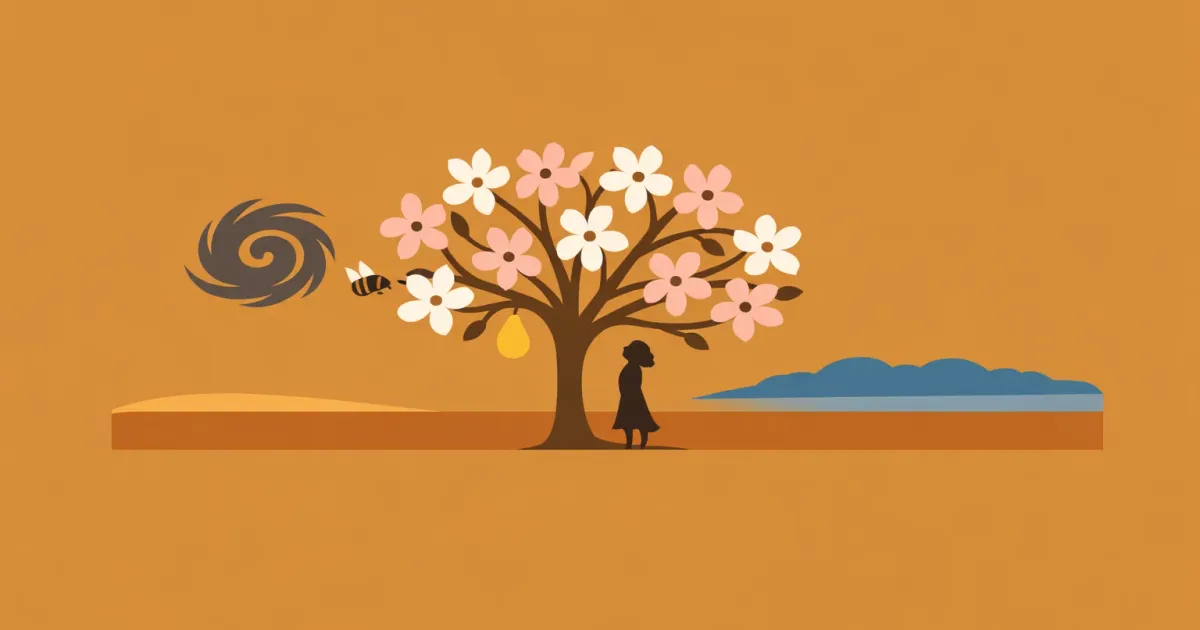
Trace every return of the pear tree through the novel — the original vision in chapter 2, the moment Janie realizes Logan "desecrated" it, her test of Joe against it ("Janie pulled back a long time because he did not represent sun-up and pollen and blooming trees"), and its revival with Tea Cake ("he could be a bee to a blossom — a pear tree blossom in the spring"). A strong straightforward thesis picks a position: either the tree is the book's moral compass and Tea Cake finally answers it, or the tree is a standard the novel both honors and critiques because no real marriage can live up to a sixteen-year-old's vision under a blossom. Use the checker game, the Everglades shack, and the jealousy/beating chapters as test cases.
To push past the obvious reading, notice that the pear tree is never just about romance — it's about reciprocity, "a marriage" of bee and bloom where both parties act. Build a thesis that reads the tree as Janie's theory of mutual recognition, then stress-test it against the parts of the Tea Cake marriage that don't fit: the stolen two hundred dollars in Jacksonville, the jealousy over Nunkie, and especially chapter 17's "he just slapped her around a bit." Does Hurston want us to say Tea Cake fulfilled the pear tree and then betrayed it, or that the pear tree was always an ideal no human man could occupy without cracking? The strongest versions of this essay reckon with the fish-net image at the end of chapter 20, where Janie pulls her horizon in alone — suggesting that the novel's final endorsement is not of any marriage but of Janie's capacity to keep the standard alive inside herself.
3. Voice and Silence Across the Three Marriages
Question: How does Janie's relationship to her own voice change across her three marriages, and which marriage does the novel treat as the real turning point? (Intro)
Map the arc. Under Logan, Janie is silent because nothing calls her speech out. Under Joe, she's silenced on purpose — barred from the porch, the mule funeral, the storytelling. Under Tea Cake, she talks, laughs, tells stories on the muck, and eventually testifies at her own trial. A solid thesis picks the pivot: most students will say the "change uh life" scene in the store with Joe is the turn, but you can also argue it's the chapter 8 deathbed monologue, or the trial in chapter 19 where Janie speaks in courtroom English to save her own life. Whichever you pick, anchor it in specific language — what she says, who's listening, and what happens to her after.
A sharper argument takes seriously that Janie's voice doesn't just grow louder — it changes register. The novel gives us three different kinds of speech: the interior monologue (the horizon passage at the end of chapter 9, the "inside" and "outside" split Hurston names in chapter 7), the public vernacular (her signifying comeback to Joe, her storytelling on the muck), and the literary English of the trial, which Hurston conspicuously does not transcribe. Build an essay around the fact that Hurston skips the trial testimony. Why does the novel finally give Janie a stage and then refuse to let us hear her? A strong thesis might argue that Hurston is drawing a distinction between voice-as-self-possession and voice-as-public-performance, and that the book values the first so much it withholds the second. Use the final chapter — Janie narrating alone to Pheoby on the back steps — as your clinching evidence.
4. The Horizon from Nanny to Janie
Question: Nanny says she has "saved" Janie; Janie says Nanny "pinched the horizon" in like a strangling rag. Which woman does the novel think is right? (Intermediate)
This is a fight between two Black women's theories of survival, and the novel stages it deliberately. Nanny's monologue in chapter 2 — "de nigger woman is de mule uh de world," Logan Killicks as a high chair, protection as the only love available to a formerly enslaved grandmother — against Janie's furious rethinking in chapter 9, where she realizes Nanny "took the biggest thing God ever made, the horizon … and pinched it in to such a little bit of a thing that she could tie it about her granddaughter's neck tight enough to choke her." A confident thesis argues that Hurston sides with Janie without letting us forget why Nanny was right on her own terms. Close-read the horizon imagery, and end with the fish-net in chapter 20 — Janie's answer to the strangling rag.
The deeper essay refuses to treat this as a simple generational victory. Nanny's theory is built on the rape of her daughter Leafy and her own escape from slavery with an infant; Janie's theory is built on the economic cushion Joe Starks's store provided. You can argue that Hurston is interrogating the class gap the novel mostly doesn't name — that Janie's horizon only becomes possible because Nanny did the pinching first. Strong evidence: the two hundred dollars Janie hides in the vest before leaving for Jacksonville (wealth Joe left her), the store she sells to fund her life with Tea Cake, the big house she returns to in Eatonville. A genuinely nuanced thesis might hold that the novel endorses Janie's horizon while making visible the survival labor of the grandmother who made it reachable — and that the fish-net at the end is not a repudiation of Nanny but a more generous version of the same gesture.
5. The Hurricane and the Question in the Title
Question: The title comes from chapter 18: "Their eyes were watching God." What question are those eyes asking, and what answer does the novel give? (Advanced)
Start with the passage itself. The shack on the muck, the lamp, Tea Cake and Motor Boat and Janie sitting in the dark as Lake Okeechobee walks the earth. "They seemed to be staring at the dark, but their eyes were watching God." A straightforward thesis treats the line as reverent — the people of the muck facing the sublime, finding God in the storm. A better one notices the line is not reverent at all. The eyes are asking whether God means to measure their "puny might" against his, and the question is hostile. Decide what answer chapter 18 and chapter 19 deliver together, and argue it.
The advanced version reads the hurricane against the burial detail in chapter 19 — coffins for white corpses, quicklime for Black ones — as one continuous theological argument. Hurston is writing in the tradition of the Book of Job, and her God is not kind. Strong evidence: the storm personified as a single monstrous body, the dog on the cow's back (a figure of malicious agency, not accident), Tea Cake's bite, the rabies that makes him fire a pistol at the wife who loves him. A sophisticated thesis might argue that the novel's God is indistinguishable from the white state that segregates the dead, and that Hurston's theology is not reverent but accusatory — the eyes are watching God the way witnesses watch a defendant. Push further and ask whether Janie's final image of pulling in her horizon like a fish-net is a private human answer to the question the storm asked, a way of saying that meaning has to be gathered by the survivor because no cosmic gathering is coming.
6. Mrs. Turner and the Anatomy of Internalized Racism
Question: Mrs. Turner occupies maybe ten pages of the novel. Why does Hurston give her so much attention, and what is she diagnosing through her? (Intermediate)
Mrs. Turner runs an eating-house on the muck. She is half-white, worships "Caucasian characteristics," tells Janie she's wasted on the too-black Tea Cake, and tries to arrange Janie with her own brother. A solid thesis reads her as the novel's case study in internalized racism — anti-Blackness turned inward, a theology of the nose and the hair. Use Hurston's devastating line that Mrs. Turner "built an altar to the unattainable — Caucasian characteristics for all" and the image of her worshipping Janie's lighter skin and looser hair the way a penitent worships a saint. A strong thesis might argue that Mrs. Turner is the mirror image of Nanny: both women teach Janie that whiteness (or its proximity) equals safety, and the novel rejects both.
A college-seminar essay complicates that mirror. Nanny's racial theory is a theory of survival under slavery and its aftermath; Mrs. Turner's is a theory of social climbing within an all-Black community. One is tragic, the other is ridiculous — and Hurston writes them differently. Pay attention to tone. Nanny gets a monologue that makes your chest hurt; Mrs. Turner gets satire, including the brawl her brother's arrival triggers, which wrecks her restaurant and runs her off the muck. A strong argument asks what it means that Hurston resolves the Mrs. Turner problem through farce while leaving the Nanny problem painfully unresolved. A thesis might claim that the novel reserves its real moral force for the forms of racism that answer to economic survival, and treats colorism as comedy precisely because it has no such alibi — or alternatively, that the satire is its own indictment, suggesting that colorism is so absurd the only fitting response is mockery.
7. The Ethics of Tea Cake
Question: Tea Cake is the most loving man Janie ever meets and also a man who beats her in chapter 17 to "reassure himself in possession." How does the novel want us to hold those two facts together? (Advanced)
This is the hardest prompt in the guide and the one most worth writing. Don't duck it. A straightforward approach names both facts plainly and argues for one of three positions: (1) the novel endorses Tea Cake and expects us to read the slap as a product of a community where such violence was casually accepted; (2) the novel critiques Tea Cake, and the rabies-induced attempt to kill Janie is karmic payment for the earlier slap; (3) the novel refuses both endorsement and critique and holds the contradiction as irreducible. Whichever you pick, quote chapter 17 ("he just slapped her around a bit to show he was boss"), the Sop-de-Bottom scene ("tuh show dem Turners who is boss"), and Tea Cake's death scene — and do not let yourself off the hook.
The seminar-level version engages the scholarly debate directly. Alice Walker recovered this novel in 1975; Black feminist critics since — including Mary Helen Washington and Hazel Carby — have argued hard about whether the book lets Tea Cake off too easy, whether Hurston's refusal to condemn the slap is a failure of politics or a commitment to unsentimental realism. A strong thesis stakes a position in that debate and defends it with close reading. Consider: the slap is not narrated from Janie's point of view — Hurston gives it to the envious porch men, which is itself a distancing move; Tea Cake's rabies symptoms include paranoid jealousy that textually rhymes with the earlier "brainstorm"; Janie's hidden three rifle chambers are quietly premeditated. A sophisticated argument might claim that Hurston refuses a clean ethical verdict because she is writing inside a tradition where Black men's violence cannot be isolated from the white violence that surrounds them (the press-ganged burial detail, the armed white men with guns), and that the novel's ethics are about survival rather than judgment. The weakest versions of this essay try to save Tea Cake. The strongest versions don't.
8. Hurston vs. Wright: The Protest Fiction Debate
Question: Richard Wright reviewed Their Eyes Were Watching God in 1937 and accused Hurston of writing a "minstrel" novel with no serious racial protest. Was he right? (Advanced)
Read Wright's review (it's short, and it's online) before you start. His charge is that Hurston sanitizes Black life for a white audience, that her characters "swing like a pendulum … between laughter and tears," that the book has no argument against white supremacy. A straightforward thesis rejects this reading by pointing to what Wright missed: the burial detail in chapter 19 (coffins for whites, quicklime for Blacks), the courtroom scene where white women circle around Janie while her own community testifies against her, the entire political project of writing an all-Black town as a self-sufficient world in which whites are almost absent. A solid argument defends Hurston as political in a different register than Wright's — interior rather than confrontational.
The sophisticated essay takes Wright's critique more seriously than most defenses do. He wasn't wrong that the novel refuses the rhetorical shape of protest fiction; the question is whether that refusal is a limitation or the argument itself. Build a thesis around the claim that Hurston is writing against Wright's theory of Black literature before Wright has fully articulated it — that Native Son (1940) and Their Eyes Were Watching God (1937) stage two opposed ideas of what a Black novel is for. Wright writes toward a white reader who must be forced to see Black suffering; Hurston writes toward a Black reader (Pheoby) who must be trusted to hear a Black woman's interior life. Evidence: the frame structure, the refusal to explain AAVE to outsiders, the way racial violence (the burial detail, the all-white jury) appears as background weather rather than foreground subject. A strong thesis might argue that Hurston's political project is the radical insistence that a Black woman's appetites and refusals are worth a novel on their own, without the scaffolding of white-facing argument — and that Wright's failure to see this was a limitation of his own theory of what protest looks like.
9. The Trial and Competing Justices
Question: An all-white, all-male jury acquits Janie in five minutes while the Black men from the muck testify against her. Whose justice does chapter 19 serve? (Intermediate)
The trial is one of the strangest scenes in American fiction. The people who loved Tea Cake come to court to bury Janie; the white strangers who don't know any of them set her free; the white women gather around her protectively at the end. A straightforward thesis argues one of three things: (1) the novel uses the trial to expose the tragic misalignment between legal justice and communal justice — Janie is right and her community is wrong, but being right doesn't bring Tea Cake back; (2) the novel quietly critiques the white court by showing its acquittal as a failure of real understanding (they couldn't see Tea Cake as a full person, so of course they can't see his killing as a real loss); (3) the novel refuses to rank these justices and presents the collision itself as the point.
A deeper essay notices the scene's unsettling gender and race dynamics. Janie, a Black woman, is saved by white women and white men and condemned by Black men. Hurston is making us notice this alignment. Build an argument around the fact that Sop-de-Bottom and the others testify not because they believe Janie murdered Tea Cake but because grief demands a defendant — a reading that turns the community's hostility into something closer to mourning than misogyny. Then push harder: the scene is also the novel's most uncomfortable moment about the racial loneliness of Black women, caught between a white legal system that can only see them as victims and a Black community that can only see them as threats. A sophisticated thesis might claim that Hurston stages the trial not to endorse any justice but to document a trap — one that an individual Black woman can survive only by being alone, which is exactly how Janie ends the novel.
10. Comparative: Janie Crawford and Helga Crane
Question: Compare Janie Crawford (Their Eyes Were Watching God, 1937) with Helga Crane (Nella Larsen's Quicksand, 1928). Both are Harlem Renaissance heroines searching for selfhood across multiple men and multiple geographies. Why does one reach the horizon and the other drown in it? (Advanced)
This is a real comparison, not a compare-contrast. A straightforward thesis names the structural parallel — both women move through a series of men and places looking for the life they want, both are constrained by gender, race, and class — and then argues why they end so differently. Helga ends pregnant with her fifth child in rural Alabama, broken by a preacher husband; Janie ends alone in her bedroom with her horizon pulled in. A solid argument credits Hurston's frame narrative: Janie gets to tell her story, Helga does not. Or: Janie has Eatonville and the muck — communities that hold her — and Helga has only the elite Black spaces that reject her for being too dark or too light.
A seminar-level version of this essay takes the geography seriously. Both novels are maps. Helga moves from Naxos (a Black Southern college) to Chicago to Harlem to Copenhagen to Harlem again to rural Alabama — a trajectory of escalating escape that collapses into annihilation. Janie moves from West Florida to Eatonville to the Everglades muck to Eatonville again — a trajectory that pulls her down the social ladder but, Hurston argues, up into life. A strong thesis might claim that Larsen and Hurston are writing opposed theories of Black women's freedom: Larsen's Helga believes freedom is escape from Black community, and the novel punishes her for it; Hurston's Janie finds freedom only inside Black community — the porch, the muck, Pheoby's listening. Push the comparison onto their sexual arcs: Helga's desire destroys her (marriage to Reverend Green as a consequence of an unwanted sexual awakening); Janie's desire (the pear tree, Tea Cake) is the engine of her becoming. A sophisticated thesis holds both novels together as a Harlem Renaissance argument about whether Black women's interior lives can survive without community — Larsen says no and mourns, Hurston says yes and celebrates, and the two novels together mark the era's outer limits on that question.
11. Pheoby as Reader-Surrogate
Question: Pheoby Watson listens to the entire novel. What work is she doing in the book, and what does she teach us about how to read it? (Intermediate)
Pheoby appears in chapter 1 and chapter 20 and disappears for the eighteen chapters in between. A straightforward thesis reads her as the reader's stand-in: the friend who brings food, who listens without judgment, who promises to carry the story back to the porch. Ground this in specific moments: the plate of mulatto rice, her warning about Annie Tyler (the cautionary tale the novel refuses to repeat), her closing line that she's grown "ten feet higher" just from listening. A solid argument claims Hurston uses Pheoby to model the kind of listening the novel wants — patient, loving, un-judging, willing to have your mind changed by a story.
A richer essay notices that Pheoby is not a passive listener — she's an active co-author. Janie says "mah tongue is in mah friend's mouf," and the book takes this literally: whatever version of Janie's story reaches the porch will be Pheoby's version. Hurston is quietly arguing that a Black woman's self-telling survives only through other Black women who agree to hear it well. Build an argument around the contrast between Pheoby and the front-porch gossipers, who have already composed their version of Janie's story before she sits down to tell her own. Strong evidence: the envious dialect of the porch ("What she doin coming back here in dem overalls?") against Pheoby's cautious, protective listening. A sophisticated thesis might claim that Pheoby is Hurston's model of the ethical Black female reader — and that the novel's real argument is about the transmission of Black women's stories from speaker to witness to community. The book ends with Pheoby walking home, not with Janie's horizon, because the final act of authorship belongs to the listener who carries the story out the door.