Exam & Discussion Questions
These are the questions teachers most consistently ask — in class discussion, on quizzes, and on exams. Each comes with a model answer you can study from and adapt for your own responses.
Chapters 1–2: The Frame and the Pear Tree
1. Why does the novel open with Janie returning to Eatonville rather than starting at the beginning of her life?
Hurston uses a frame narrative: Chapter 1 places Janie on Pheoby's back steps after eighteen months away, and everything that follows is Janie's own telling of her story. This structure means the reader knows from the start that Janie has survived and returned — so the novel isn't a suspense story but a reckoning with what that life meant. The opening porch scene also establishes the community's habit of judgment and gossip, which the novel will keep pushing back against.
The frame is not just a narrative convenience — it is Hurston's argument about voice. By making Janie the teller rather than the subject, Hurston prevents the community's version of events (the porch gossip that opens the book) from becoming the authoritative one. The free indirect style that Hurston employs through the frame — shifting between standard literary narration and Janie's vernacular interiority — lets the novel occupy two registers at once: the literary tradition that dismissed Black women's stories and the oral tradition that preserved them. When Janie says "mah tongue is in mah friend's mouf" and entrusts the story to Pheoby, she is choosing her audience. The frame's closing image — Pheoby moved to change her own life, Janie pulling in her horizon "like a great fish-net" — answers the opening gossip with a private triumph that the porch will never fully understand.
2. What does Janie see under the pear tree, and why does it matter to the rest of the novel?
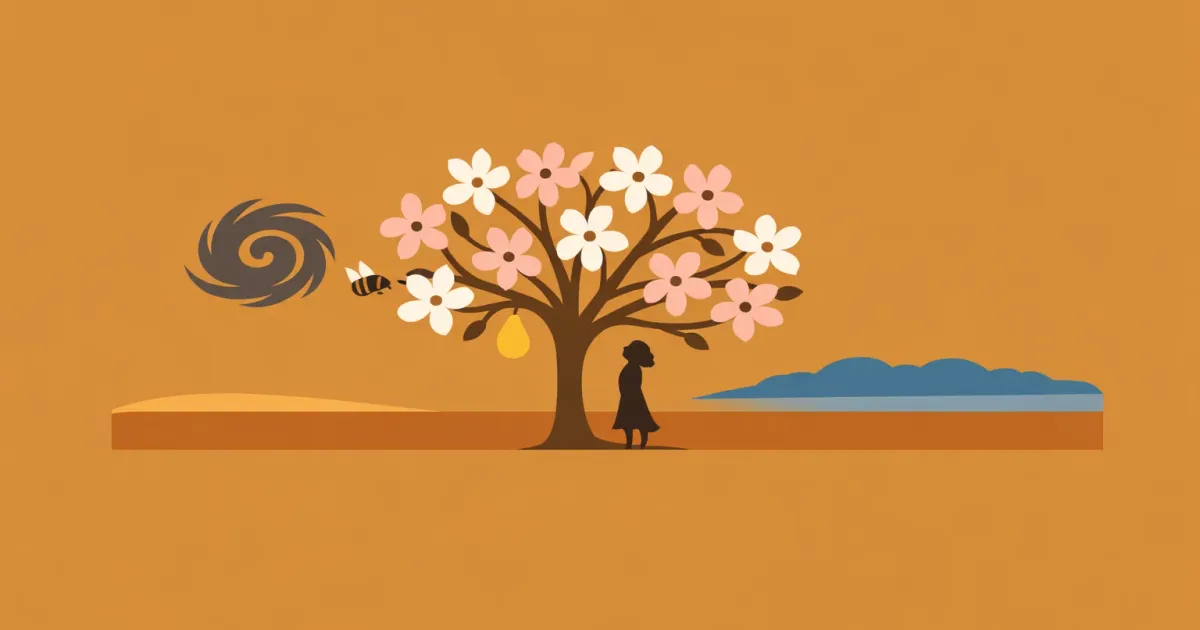
Janie watches a bee sink into a blossom and has what Hurston describes as an ecstatic, almost physical vision of what love and marriage ought to feel like — mutual, alive, reciprocal. This becomes the standard against which all three of her marriages are measured. Logan Killicks fails it immediately. Joe Starks promises it and then withdraws it. Tea Cake comes closest to delivering it.
The pear tree is the novel's governing symbol precisely because it is Janie's own vision, arrived at alone, before anyone else has told her what to want. Hurston writes that Janie "saw a dust-bearing bee sink into the sanctum of a bloom; the thousand sister-calyxes arch to meet the love embrace and the ecstatic shiver of the tree from root to tiniest branch creaming in every blossom and frothing with delight." The language is deliberately erotic and deliberately natural — love as something organic, not transactional. Every subsequent relationship gets tested against this standard without Janie ever naming it directly, which is part of what makes the novel so structurally elegant. The pear tree does not reappear as an explicit symbol after Chapter 2, but it operates as a pressure behind every scene in which Janie is silenced, possessed, or reduced.
3. Who raised Janie, and what is Nanny's guiding philosophy about women's lives?
Janie was raised by her grandmother, Nanny, who had been enslaved and whose daughter Leafy — Janie's mother — was raped by a schoolteacher and later disappeared. Nanny's philosophy is rooted in survival: she believes the Black woman is "de mule uh de world," burdened by everyone above her, and that safety and property are the highest goods a woman can secure.
Chapters 3–6: Logan Killicks and the Rise of Joe Starks
4. Why doesn't Janie's first marriage to Logan Killicks work out, and how does she respond when he changes?
Janie married Logan out of obedience to Nanny, hoping love would come afterward. It doesn't. When Logan begins demanding she plow alongside him and move a manure pile — treating her as a second mule — she realizes marriage did not automatically produce love. She meets Joe Starks on the road shortly after, and when Logan threatens to grab an axe and kill her, she leaves him.
5. What does Joe Starks represent when he first arrives, and how does Janie respond?
Joe presents himself as a man of ambition heading to an all-Black town where he intends to be "a big voice." He flatters Janie directly: tells her she wasn't born to plow, that he wants to show her off, that she is wasted on Logan. Janie responds with excitement — Joe seems to offer the opposite of everything Logan is. She runs off with him the morning Logan picks a fight.
Joe's appeal is real and Hurston is careful not to make Janie naive for feeling it. He does build the town he promises: he becomes mayor, installs the street lamp, opens the store, and transforms Eatonville into a functioning municipality. What Janie couldn't see at the roadside is that Joe's vision of a big voice requires small, silent ones around it. His line that "she's uh woman and her place is in de home" isn't a private sentiment — he says it publicly, repeatedly, as policy. The head-rag he forces Janie to wear (so other men won't look at her hair) and the high stool he seats her on in the store are both versions of the same maneuver: Janie as display case for his status, not a person with her own. His courtship offered escape from Logan's farm; his marriage offers a different kind of captivity.
6. What is the significance of Matt Bonner's yellow mule in Chapters 5 and 6?
The mule is a running joke in Eatonville — the porch-sitters mock Matt Bonner for starving and overworking it. Joe eventually "frees" the mule and throws it a grand mock-epic funeral when it dies. Janie watches both events from behind the store counter, barred from participating. The mule directly echoes Nanny's prophecy that the Black woman is "de mule uh de world" — worked hard, dismissed, freed only when it is too late.
Chapters 7–9: Joe's Decline, His Death, and Janie's Widowhood
7. What happens when Janie finally talks back to Joe in the store, and what are the consequences?
After years of silence, Joe publicly mocks Janie's body in front of the store customers — comparing her to a worn-out old woman. Janie responds in kind, telling him that when he pulls down his pants he looks "lak de change uh life." The men on the porch are stunned. Joe strikes her and never fully recovers, moving downstairs and deteriorating until his death.
Hurston frames this scene as "playing the dozens" — a tradition of competitive verbal insult — and the crowd recognizes it as such ("Y'all really playin' de dozens tuhnight"). But what makes the moment seismic isn't the insult itself; it's who delivers it. For the first time in twenty years of marriage, Janie speaks herself in public. Sam Watson gasps not because the line is cruel but because Janie said it at all. Joe's reaction — he strikes her, retreats, and within a chapter is dying — reveals that his authority was entirely dependent on her silence. Hurston gives this a physical logic: Joe, who has been performing health and power, cannot sustain the performance once the audience stops believing him. His kidney failure was already there; what Janie's words do is strip the last illusion. The chapter 8 deathbed scene then inverts everything: she stands over him, she talks, and he dies trying to silence her. That reversal is the hinge the whole novel has been building toward.
8. How does Janie feel at Joe's funeral, and what does she do immediately after?
At the funeral, Janie performs grief — Hurston writes that she "starched and ironed her face" behind her veil. Inside, she feels free. That night she burns every one of her head rags and the next morning wears her hair in one thick braid down her back. It is the only outward sign of change the community sees.
9. What does Janie realize about her grandmother during her widowhood in Chapter 9?
Digging through her own feelings, Janie discovers she has hated Nanny "all these years under a cloak of pity." She blames Nanny for taking the horizon — the biggest thing in the world — and "pinching it in to such a little bit of a thing that she could tie it about her granddaughter's neck tight enough to choke her." This is Janie's harshest reckoning with the logic of safety over desire, and it marks the moment she decides not to repeat it.
Chapters 10–13: Tea Cake and the Leap
10. How does Tea Cake first appear in the novel, and what does he do that immediately distinguishes him from Janie's previous husbands?
Tea Cake walks into the store on a slow afternoon when nearly everyone is at a ball game and offers to teach Janie to play checkers. He treats her as capable without being told to — Joe had dismissed Janie as too simple to learn the game. Tea Cake's ease, his assumption that she can play and will want to, signals something new.
The checker game is the first of many small reversals Tea Cake performs on the Starks marriage without acknowledging it. Joe had put Janie on a high stool where no one could reach her; Tea Cake sits down with her and plays. Joe had barred her from the porch storytelling; Tea Cake includes her. Joe had controlled every moment of her public presentation; Tea Cake takes her midnight fishing and insists she come to the picnic because he wants her there. When he later combs her hair at the piano — the hair Joe kept tied away — the gesture is intimate and deeply specific. None of this is accidental on Hurston's part. Tea Cake does not announce that he respects Janie; he simply acts as though she is worth being with.
11. Why does Janie sell the store and follow Tea Cake to Jacksonville despite Pheoby's warnings?
Pheoby warns Janie that Tea Cake is too young and too poor, and might leave her destitute like Annie Tyler. Janie listens, weighs it, and goes anyway. She has the money to take the risk and, more importantly, she knows that the kind of safety Pheoby is describing is exactly what Joe offered her — and she refuses to choose it again.
12. What happens when Tea Cake disappears with Janie's two hundred dollars in Chapter 13, and how is the episode resolved?
Tea Cake vanishes overnight with Janie's money. She spends the night convinced she has become Annie Tyler — the cautionary story she was warned about. Tea Cake returns at dawn with a guitar, a razor slash in his back, and three hundred and twenty-two dollars: he spent her money throwing a party for railroad workers, then won it back at dice. He promises from then on they will live on what he earns.
Chapters 14–17: On the Muck
13. What is the Everglades community like, and how does it differ from Eatonville?
The muck community around Lake Okeechobee is working-class, seasonal, and racially mixed (Black American and Bahamian workers). The social life — gambling, music, storytelling, dancing — looks like Eatonville's porch culture, but Janie is inside it this time. She picks beans alongside Tea Cake because she misses him during the day, tells stories, and learns to shoot. The muck is the first place in the novel where Janie is a full participant rather than a spectator or display object.
14. Who is Nunkie, and what does the episode involving her reveal about the Tea Cake marriage?
Nunkie is a young woman on the muck who flirts persistently with Tea Cake in the cane rows. When Janie catches them together, she beats on Tea Cake; they fight, then collapse into jealous sex. The episode reveals genuine passion and genuine mutual jealousy — Janie is not a passive wife — but also that Tea Cake attracts other women and that Janie has something real to lose.
15. Who is Mrs. Turner and what is her relationship to the novel's themes of race?
Mrs. Turner runs an eating-house near the bean fields and worships "Caucasian characteristics" — straight hair, light skin, pointed noses. She befriends Janie because Janie is lighter-complexioned and wants to set her up with her own brother, away from the "too-black" Tea Cake. Hurston describes Mrs. Turner's attitude as an "altar to the unattainable" and her case study in internalized racism: the way white supremacy turns members of a community against one another according to proximity to whiteness.
Mrs. Turner is the novel's most concentrated treatment of colorism, and Hurston handles it without sentimentality. Mrs. Turner is not a villain in the melodramatic sense — she genuinely believes lighter-skinned Black people are superior, and she acts on that belief with something like missionary zeal. What Hurston exposes is the mechanism: white standards of beauty, internalized so completely that Mrs. Turner enforces them within her own community, on her own behalf, against a woman she considers a friend. Tea Cake's "brainstorm" in response — slapping Janie around "to reassure himself in possession" in front of the Turners — is the novel's most uncomfortable moment, and Hurston does not soften it. The porch men who envy Tea Cake for the beating, and the subsequent engineered brawl that wrecks Mrs. Turner's restaurant and drives her family off the muck, are the community's crude solution to a problem of dignity. Hurston records it all with an anthropologist's fidelity and without a single sentence of moral instruction.
Chapters 18–19: The Hurricane and the Trial
16. What warning signs precede the hurricane, and why do Tea Cake and Janie stay on the muck?
Bands of Seminoles pass east, followed by rabbits, snakes, and panthers. Tea Cake, trusting that the white boss-man would have warned them if a real storm were coming, dismisses the signs. The men on the muck tell each other the money is too good to leave. When Tea Cake's friend 'Lias offers them seats in his car, Tea Cake declines.
17. Describe what happens to Tea Cake and Janie during the hurricane itself.
The storm floods the muck and breaks the dikes around Lake Okeechobee. Tea Cake, Janie, and their friend Motor Boat flee east on foot through chest-deep water. Motor Boat takes shelter in an abandoned house and miraculously survives as it floats. Janie is blown off the fill road into the lake; she grabs the tail of a swimming cow, but the big dog riding the cow lunges at her. Tea Cake swims in and knifes the dog — but it bites him high on the cheek before it dies. That bite is rabid.
The hurricane chapter is Hurston's greatest technical achievement in the novel. She personifies the storm without turning it into allegory — the lake "walking the earth with a heavy heel," the winds arriving like a drum vibrating from rim to center — and the flight sequence is written in a continuous present-tense urgency that makes it feel unedited, barely survivable. The novel's title appears here, during the crisis: "They seemed to be staring at the dark, but their eyes were watching God." The question those eyes are asking is not devout; it is whether the God they were raised on intends to measure their lives against his power. That the answer is indeterminate — the hurricane kills thousands and spares others by apparent accident — is Hurston's refusal to resolve the theological question the novel raises throughout. Motor Boat survives by sleeping. Tea Cake survives by fighting. The logic isn't moral; it's the logic of a storm.
18. What happens at Tea Cake's trial, and why is the verdict significant?
The trial takes place the same afternoon Tea Cake dies. An all-white, all-male jury hears Dr. Simmons's medical testimony and Janie's own account. They deliberate five minutes and return a verdict of justifiable, accidental self-defense. The Black men from the muck — Sop-de-Bottom and others who loved Tea Cake — had come to testify against Janie and leave without speaking to her. White women gather around Janie protectively.
The trial's racial dynamics are among the most layered in the novel. The community that loved Tea Cake and knew the whole story testifies against the woman who killed him in self-defense. The white strangers who knew neither of them deliver the verdict that allows her to walk free. Hurston does not offer this as a celebration of the justice system — she is being precise about the specific, ugly shape of that moment: Janie is protected by white institutions from her own community, while the community's grief finds no legitimate outlet. The white women who surround Janie after the verdict are doing something genuinely kind, but they are also doing it within a racial structure that makes their protection necessary. Nobody in this scene gets to be innocent.
19. How does Tea Cake contract rabies, and what are the symptoms Hurston describes?
Tea Cake is bitten by a rabid dog during the hurricane flood. The symptoms emerge weeks later: headaches, inability to swallow water, and eventually the delusions and violent behavior associated with late-stage rabies. Dr. Simmons privately tells Janie the diagnosis and warns her Tea Cake may try to hurt her. He wires Miami for serum, which arrives too late.
Chapter 20: Back on the Porch
20. How does Janie describe love in her final conversation with Pheoby?
Janie tells Pheoby that love isn't "a grindstone dat's de same thing everywhere and do de same thing tuh everything it touch. Love is lak de sea. It's uh movin' thing, but still and all, it takes its shape from de shore it meets, and it's different with every shore." This is her most direct statement about why her three marriages were incomparable — and why she doesn't regret any of them.
21. What is the significance of the fish-net image in the closing paragraph?
Alone in her bedroom, Janie pulls in her horizon "like a great fish-net" from around the waist of the world and drapes it over her shoulder. The image directly answers Nanny's act from Chapter 9 — where Nanny had pinched the horizon tight enough to choke Janie. Here Janie gathers it to herself, full of life, and keeps it. The horizon, which throughout the novel has meant the unfulfilled and the possible, is finally hers.
Thematic Questions
22. How does Hurston use the structure of Janie's three marriages to trace her development as a character?
Each marriage represents a different theory of what a woman's life is for. Logan Killicks offers safety and land (Nanny's vision). Joe Starks offers status and ambition (his own vision, into which Janie is incorporated). Tea Cake offers partnership and pleasure — he wants Janie present, not displayed. Janie's arc is a rejection, one marriage at a time, of other people's definitions of her life.
The three-marriage structure is not simply progressive — Janie does not get steadily happier. Her years with Joe are her longest and in many ways her most damaging, and the muck idyll with Tea Cake contains a domestic assault (Chapter 17) that the novel does not explain away. What changes across the three marriages is Janie's interior — her ability to name what she wants, to recognize its absence, and finally to choose. By the time she leaves Eatonville for Jacksonville in Chapter 12, she is choosing rather than being arranged. That difference is the arc. Logan's farm and Joe's store are both structures built to contain her; the muck is the first place where she is not a fixture. That Tea Cake dies and the marriage ends in violence is not a reversal of her development — it is proof that the novel refuses to offer development as compensation. Janie has grown; the world is still dangerous; those two things coexist.
23. How does Hurston depict the tension between community belonging and individual selfhood throughout the novel?
The porch in Eatonville represents collective life — storytelling, shared judgment, communal identity. Joe bars Janie from it; Tea Cake brings her inside its equivalent on the muck. But the porch also gossips, judges, and mistakes silence for submission. Hurston values both the community (without it, there is no story, no audience, no Pheoby) and the individual interior life it cannot access.
The frame narrative's dramatic irony is that the porch-sitters in Chapter 1 have been speculating about Janie's life all evening, and they are wrong about everything. Janie's answer — to tell the story only to Pheoby — is not a rejection of community but a selection of audience. Hurston spent years as a trained anthropologist recording the communal life of Black Southern towns: the mule jokes, the storytelling competitions, the folk songs. She understands that community is survival culture. But the novel also insists that Janie's interior — the pear-tree vision, the silent rebellion during Joe's speeches, the horizon — belongs to her alone and cannot be extracted by any amount of porch speculation. The community and the individual are not enemies in the novel; the community's problem is that it mistakes conformity for membership.
24. What role does silence play in the novel — who is silenced, who silences themselves, and when does speech become an act of power?
Janie is silenced throughout the Joe Starks years, first externally (he literally forbids her to speak at the store) and then internally (she learns to split her "inside" from her "outside"). Her speaking up in Chapter 7 is the novel's crisis point. But Hurston also shows Janie choosing silence with Logan (she doesn't explain why she's leaving, just goes) and with the court (she tells the truth, which is a kind of speech that costs her).
Silence in the novel operates on at least three registers. First, imposed silence: Joe forbids Janie the porch, forbids her to eulogize the mule, controls every word she says in public. Second, strategic silence: Janie learns to "talk some and leave some," watching the shadow of herself tend the store while her real self sits elsewhere. Third, speech as irreversible act: when Janie finally answers Joe in the store, she cannot unsay it, and the novel treats that as a kind of death for Joe and a kind of birth for her. Hurston — who was herself frequently silenced, dismissed, and later forgotten — is precise about what it costs a Black woman to speak in a public context. Janie's words in the store end her marriage. Her words in the courtroom end her trial. In each case the speech costs something real, which is what makes it powerful.
25. How does the 1928 Okeechobee hurricane function in the novel — as plot event, symbol, and historical record?
As a plot event, the hurricane brings about Tea Cake's death by putting him in the path of a rabid dog. As symbol, it is the force against which human certainty (Tea Cake's confidence that the bossman would warn them; the muck workers' faith in their own judgment) shatters. As historical record, Hurston documents the segregated burial of hurricane dead — coffins for white victims, quicklime for Black ones — which was a documented fact of the disaster's aftermath.
Hurston uses the hurricane to do what the novel's critics least expected: she writes explicit racial protest into what Richard Wright called an apolitical novel, but she does it without a speech or a lesson. The burial-detail scene in Chapter 19 — where guards instruct workers to "look at they hair" to determine race when decomposition makes visual identification impossible — is among the most damning passages in all of American literature, and Hurston drops it into the narrative without a single word of authorial commentary. Tea Cake's observation that the guards are "mighty particular how dese dead folks goes tuh judgment" and that "God don't know nothin' 'bout de Jim Crow law" does the work without editorializing. The hurricane also destroys the class distinctions of the muck community — the storm kills everyone without preference — before the Jim Crow burial order reinstates them on the dead. That juxtaposition is the point.
26. What is the significance of Janie's hair throughout the novel?
Janie's thick rope of black hair is a consistent marker of her identity and sexuality throughout the novel. Joe forces her to cover it with a head rag; when he dies she burns the rags immediately. The porch-sitters in Chapter 1 comment on her "great rope of black hair swinging to her waist." Tea Cake combs it out at the piano. Controlling Janie's hair is consistently how the men around her try to control her self-presentation.
The hair operates as the most visible part of Janie's person — something she cannot fully hide even when Joe commands it covered. When Joe forces the head rag, he is not just jealous; he is marking property, removing Janie from the visual field of other men and inserting himself as the mediator of her appearance. The head rag also has a class dimension in Black Southern culture: covered hair was associated with domestic labor and subordinate status; loose, dressed hair was associated with leisure and sexual freedom. Janie burning the head rags the night of Joe's funeral is therefore a gesture with a specific social meaning, not just a personal one. The porch sees her return in Chapter 1 with hair "unraveling in the wind like a plume" and immediately reads it as sexual transgression — she is "too old" to wear it down — which is exactly the judgment the novel has spent twenty chapters refusing.
27. How does the novel's ending refuse easy resolution, and what is Hurston arguing with that refusal?
Janie returns home having killed the man she loved, been acquitted by white strangers while her own community testified against her, and buried Tea Cake in Palm Beach. She is not bitter, not broken, and not remaking herself into a widow or a cautionary tale. She pulls in her horizon and calls in her soul. The novel does not reward her journey with peace in the conventional sense — it simply records that she has the self she fought for.
Most coming-of-age narratives resolve by reintegrating the protagonist into a community, a marriage, or a vocation. Hurston does none of these. Janie returns to Eatonville's house — the one Joe built and she has owned — not to resume her place in the town's social structure but to live, as she tells Pheoby, "by comparisons." The horizon, which has been the novel's word for the unlived and the possible, is pulled in and worn. That is not resignation; it is the opposite. The horizon is hers now, full of what she has actually lived, not just what she might have lived. The novel's final image — "She called in her soul to come and see" — is the most private moment in a book full of public performance and communal pressure. It answers the question the porch-sitters were never going to stop asking, not by answering them, but by making clear their question was never the right one.